<?xml version="1.0" encoding="utf-8"?>
<feed xmlns="http://www.w3.org/2005/Atom" >
  <generator uri="https://jekyllrb.com/" version="3.10.0">Jekyll</generator>
  <link href="https://irunning.app/feed.xml" rel="self" type="application/atom+xml" />
  <link href="https://irunning.app/" rel="alternate" type="text/html" />
  <updated>2026-11-02T19:17:34+00:00</updated>
  <id>https://irunning.app/feed.xml</id>


    <title type="html">iRunning</title>


    <subtitle>Interval running made simple. Build workouts, follow voice cues, track GPS runs, and train with plans — on iPhone and Apple Watch.</subtitle>


    <author>
        <name>iRunning Team</name>
      
      
    </author>


    <entry>
      

      <title type="html">NYC Marathon 2026 Results: Almgren Wins His Debut, Chepkirui Outkicks Obiri</title>
      <link href="https://irunning.app/blog/2026/11/nyc-marathon-2026-results/" rel="alternate" type="text/html" title="NYC Marathon 2026 Results: Almgren Wins His Debut, Chepkirui Outkicks Obiri" />
      <published>2026-11-01T18:00:00+00:00</published>
      <updated>2026-11-01T18:00:00+00:00</updated>
      <id>https://irunning.app/blog/2026/11/nyc-marathon-2026-results</id>
      
      
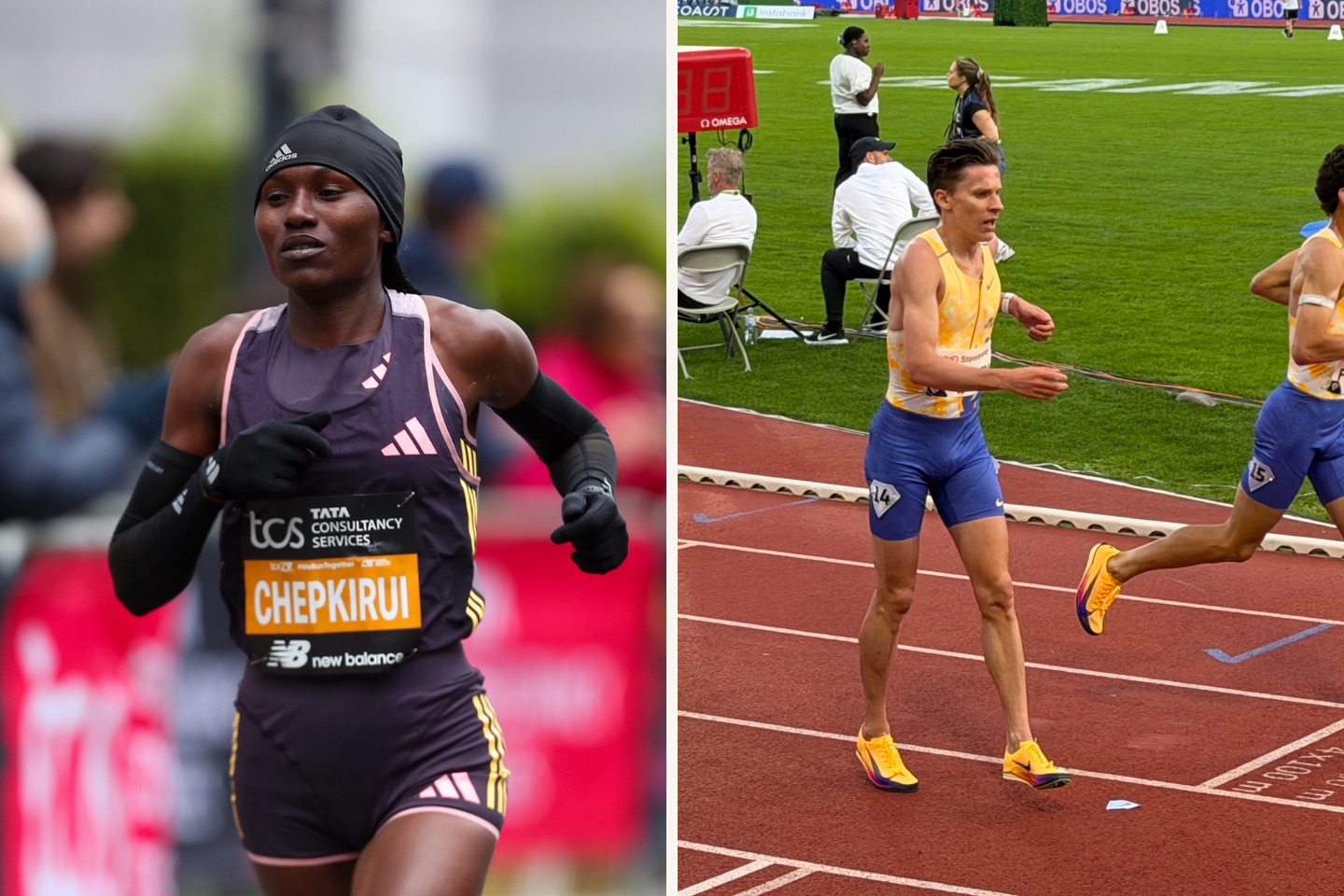
        <content type="html" xml:base="https://irunning.app/blog/2026/11/nyc-marathon-2026-results/"><![CDATA[<p>The 50th five-borough TCS New York City Marathon was decided late, in both races. <strong>Andreas Almgren</strong> of Sweden won the men’s race in <strong>2:06:01</strong> in his first marathon, breaking away from a group of ten that was still together at 35 km. <strong>Sheila Chepkirui</strong> of Kenya won the women’s race in <strong>2:24:36</strong>, pulling away from defending champion Hellen Obiri in the last two kilometres, while <strong>Jess McClain</strong> ran past Obiri in the final 200 metres to become the first American woman on the New York podium since 2018.</p>

<figure class="post-figure photo">
  <img src="/assets/images/blog/nyc-2026-winners.jpg" width="1440" height="960" loading="lazy" alt="Sheila Chepkirui racing in a marathon and Andreas Almgren racing on a track" />
  <figcaption>Sheila Chepkirui (left, London 2024) and Andreas Almgren (right, Oslo 2026). Photos from earlier races: Katie Chan and Ssu, both <a href="https://creativecommons.org/licenses/by-sa/4.0/">CC BY-SA 4.0</a>, via Wikimedia Commons.</figcaption>
</figure>

<h2 id="results-at-a-glance">Results at a glance</h2>

<p><strong>Women</strong></p>

<table>
  <thead>
    <tr>
      <th> </th>
      <th>Runner</th>
      <th>Time</th>
    </tr>
  </thead>
  <tbody>
    <tr>
      <td>1</td>
      <td>Sheila Chepkirui (KEN)</td>
      <td><strong>2:24:36</strong></td>
    </tr>
    <tr>
      <td>2</td>
      <td>Jess McClain (USA)</td>
      <td>2:24:42</td>
    </tr>
    <tr>
      <td>3</td>
      <td>Hellen Obiri (KEN)</td>
      <td>2:24:43</td>
    </tr>
    <tr>
      <td>4</td>
      <td>Edna Kiplagat (KEN)</td>
      <td>2:25:42</td>
    </tr>
    <tr>
      <td>5</td>
      <td>Mercy Chelangat (KEN)</td>
      <td>2:25:46</td>
    </tr>
  </tbody>
</table>

<p><strong>Men</strong></p>

<table>
  <thead>
    <tr>
      <th> </th>
      <th>Runner</th>
      <th>Time</th>
    </tr>
  </thead>
  <tbody>
    <tr>
      <td>1</td>
      <td>Andreas Almgren (SWE)</td>
      <td><strong>2:06:01</strong></td>
    </tr>
    <tr>
      <td>2</td>
      <td>Yemaneberhan Crippa (ITA)</td>
      <td>2:06:14</td>
    </tr>
    <tr>
      <td>3</td>
      <td>Kamohelo Mofolo (LES)</td>
      <td>2:06:26</td>
    </tr>
    <tr>
      <td>4</td>
      <td>Benson Kipruto (KEN)</td>
      <td>2:06:27</td>
    </tr>
    <tr>
      <td>5</td>
      <td>Haftu Strintzos (AUS)</td>
      <td>2:06:34</td>
    </tr>
  </tbody>
</table>

<p><strong>Wheelchair:</strong> Marcel Hug (SUI) won his eighth New York title in 1:28:14, one second ahead of Daniel Romanchuk (USA). Catherine Debrunner (SUI) won the women’s race in 1:40:02, more than eight minutes clear.</p>

<p>Nearly 60,000 runners were expected on the course, a year after a record 59,219 finishers. It was a good morning for it: around 13 °C, broken cloud and a light south-westerly. The clocks had gone back overnight, so everyone got an extra hour of sleep before the ferry.</p>

<h2 id="womens-race-40-km-together-then-200-metres">Women’s race: 40 km together, then 200 metres</h2>

<p>The professional women started at 8:35 and nobody wanted to lead. Carrie Ellwood of the US took the field through 5 km in 18:23, the second 5 km was a minute quicker, and through Brooklyn nothing happened. At halfway McClain led a line of four Americans in <strong>1:13:52</strong> with ten women inside a second of each other.</p>

<table>
  <thead>
    <tr>
      <th>Point</th>
      <th>Leader</th>
      <th>Time</th>
    </tr>
  </thead>
  <tbody>
    <tr>
      <td>10 km</td>
      <td>Viola Cheptoo</td>
      <td>35:45</td>
    </tr>
    <tr>
      <td>Halfway</td>
      <td>Jess McClain</td>
      <td>1:13:52</td>
    </tr>
    <tr>
      <td>30 km</td>
      <td>eight together</td>
      <td>1:44:02</td>
    </tr>
    <tr>
      <td>35 km</td>
      <td>Hellen Obiri</td>
      <td>2:01:15</td>
    </tr>
    <tr>
      <td>40 km</td>
      <td>Chepkirui and Obiri</td>
      <td>2:17:39</td>
    </tr>
    <tr>
      <td><strong>Finish</strong></td>
      <td><strong>Sheila Chepkirui</strong></td>
      <td><strong>2:24:36</strong></td>
    </tr>
  </tbody>
</table>

<p>The group came apart between 25 and 30 km, when a 16:36 five-kilometre segment left eight runners, four Kenyans and four Americans. At 35 km there were six. A year ago Obiri, Chepkirui and Sharon Lokedi had been together at the same point and Obiri didn’t get away until the final mile. This time it was Chepkirui who moved. She ran 35 to 40 km in <strong>16:24</strong>, about 5:17 per mile and the fastest 5 km of the race, and only Obiri could follow.</p>

<p>The last 2.2 km told the story: Chepkirui 6:57, McClain 6:59, Obiri 7:04. Chepkirui won by six seconds, her second New York title in three years and a second slower than her 2024 win. McClain, 34, with a 2:20:49 from Boston in April, caught Obiri on the short rise before the line and took second by four tenths of a second. The last American woman on the New York podium was Shalane Flanagan, third in 2018.</p>

<p>Edna Kiplagat, 46, who won here in 2010, was fourth. Obiri’s course record of 2:19:51 from 2025 was never under threat.</p>

<h2 id="mens-race-ten-men-at-35-km-one-at-the-finish">Men’s race: ten men at 35 km, one at the finish</h2>

<p>New York has run its professional races without pacemakers since 2007, and Almgren said he picked it for that reason. The first 5 km took 15:30, a pace for something outside 2:10. Zouhair Talbi of the US led at 10 km, Conner Mantz at 15 km, and Talbi again at halfway in <strong>1:04:01</strong>, with the next nine men, Almgren among them, within four seconds.</p>

<table>
  <thead>
    <tr>
      <th>Point</th>
      <th>Leader</th>
      <th>Time</th>
    </tr>
  </thead>
  <tbody>
    <tr>
      <td>Halfway</td>
      <td>Zouhair Talbi</td>
      <td>1:04:01</td>
    </tr>
    <tr>
      <td>25 km</td>
      <td>Zouhair Talbi</td>
      <td>1:15:41</td>
    </tr>
    <tr>
      <td>30 km</td>
      <td>Geoffrey Kamworor</td>
      <td>1:30:26</td>
    </tr>
    <tr>
      <td>35 km</td>
      <td>Conner Mantz</td>
      <td>1:45:33</td>
    </tr>
    <tr>
      <td><strong>Finish</strong></td>
      <td><strong>Andreas Almgren</strong></td>
      <td><strong>2:06:01</strong></td>
    </tr>
  </tbody>
</table>

<p>The 5 km segments from 20 to 30 km were both under 14:50, the fastest of the race to that point, and still nobody dropped. At 35 km the first ten men were separated by less than a second, Almgren fifth.</p>

<p>Then he went. Through Harlem, up Fifth Avenue and into the park, Almgren covered the last 7.2 km in <strong>20:27</strong>, about 2:50 per kilometre. Crippa, who won Paris in April, needed 20:40 for the same stretch and finished 13 seconds back. Almgren’s second half was 1:01:57, more than two minutes quicker than his first.</p>

<p>It’s the fastest winning time in New York since Tamirat Tola’s course record of 2:04:58 in 2023, and four seconds outside the Swedish record. Six weeks earlier Almgren had won the world half marathon title in Copenhagen in a European record of 58:06. He is a former 1:45 800 m runner, and this was his first race over the distance.</p>

<p>Behind him, Kamohelo Mofolo of Lesotho took third on his 21st birthday, more than two minutes under his previous best, and held off defending champion Benson Kipruto by just over half a second. Kipruto’s 2:06:27 was almost two minutes faster than his winning time last year. Talbi was the first American, sixth in 2:06:43.</p>

<h2 id="what-the-rest-of-us-can-take-from-it">What the rest of us can take from it</h2>

<ul>
  <li><strong>New York is decided after 35 km.</strong> Both races were a group until the 35 km mat, and both were won in the last 7 km. Almgren was fifth at 35 km and won by 13 seconds; Obiri led at 35 km and finished third. If your plan for the Fifth Avenue climb is “hang on”, you need a better plan. Our <a href="/blog/2026/10/how-to-pace-nyc-marathon/">NYC pacing guide</a> has split tables that already include the hills.</li>
  <li><strong>The winners ran the second half faster.</strong> Almgren split 1:04:04 and 1:01:57; the women went through halfway in 1:13:52 and finished in 2:24:36, a 1:10:44 second half. For the professionals that’s a tactic. For the rest of us it’s a reminder that the first half of New York, with Brooklyn screaming, is where races are lost.</li>
  <li><strong>The fastest 5 km came at the end.</strong> Chepkirui’s 16:24 from 35 to 40 km was the quickest segment of her race. That’s what a controlled first 30 km buys you.</li>
  <li><strong>A six-second margin is a sprint.</strong> The women’s podium was separated by seven seconds after 42 km. Being able to change pace in the last kilometre is a skill you build in interval sessions, not on long runs.</li>
</ul>

<h2 id="if-you-ran-today">If you ran today</h2>

<p>Congratulations. A few things for the coming days:</p>

<ul>
  <li><strong>Get your race into iRunning.</strong> Import the run from Apple Health, or as a GPX or FIT file from your watch, and look at your mile splits: where did the pace start to slip, on the Queensboro or on First Avenue? Our guide to <a href="/blog/2026/09/share-berlin-marathon-finish/">sharing your marathon finish</a> shows how, and how to turn the route into a video with <strong>Share › Video</strong>.</li>
  <li><strong>Take the next two weeks easy.</strong> Walk first, run easy later. We go through it day by day in <a href="/blog/2026/09/after-marathon-recovery-first-two-weeks/">After the Marathon: Your First Two Weeks</a>.</li>
  <li><strong>Didn’t get in this year?</strong> The 2027 drawing is expected to open in February. Here’s <a href="/blog/2026/10/how-to-get-into-nyc-marathon-2027/">how to get into the NYC Marathon in 2027</a>.</li>
</ul>

<p><em>Results and splits are from live race coverage on 1 November 2026 and may still change. The official results are at nyrr.org.</em></p>]]></content>


      <author>
          <name>iRunning Team</name>
        
        
      </author>


          <category term="events" />


        <summary type="html"><![CDATA[Andreas Almgren broke a ten-man pack after 35K and won the New York City Marathon in 2:06:01, his first marathon. Sheila Chepkirui beat Hellen Obiri in 2:24:36, and Jess McClain caught Obiri in the last 200 metres for second. Results, splits, and what the rest of us can take from the race.]]></summary>


        <media:thumbnail xmlns:media="http://search.yahoo.com/mrss/" url="https://irunning.app/assets/images/blog/nyc-2026-winners.jpg" />
        <media:content medium="image" url="https://irunning.app/assets/images/blog/nyc-2026-winners.jpg" xmlns:media="http://search.yahoo.com/mrss/" />
      
    </entry>
  
    <entry>
      

      <title type="html">How to Get Into the NYC Marathon 2027: Drawing, 9+1, Time Qualifiers, Charity</title>
      <link href="https://irunning.app/blog/2026/10/how-to-get-into-nyc-marathon-2027/" rel="alternate" type="text/html" title="How to Get Into the NYC Marathon 2027: Drawing, 9+1, Time Qualifiers, Charity" />
      <published>2026-10-31T09:00:00+00:00</published>
      <updated>2026-10-31T09:00:00+00:00</updated>
      <id>https://irunning.app/blog/2026/10/how-to-get-into-nyc-marathon-2027</id>
      
      
        <content type="html" xml:base="https://irunning.app/blog/2026/10/how-to-get-into-nyc-marathon-2027/"><![CDATA[<p>Tomorrow 50,000 people run the TCS New York City Marathon, and a good number of the two million watching will decide, somewhere on First Avenue, that they want to do it next year. Then they’ll discover that New York is the hardest Major to get into: the drawing takes more than 240,000 applications for a few thousand places.</p>

<p>The good news is that the drawing is only one of six doors, and two of the others reward planning more than luck. Here’s every route into the 2027 race, on <strong>Sunday, 7 November 2027</strong>, in the order you should think about them, and the one thing that has to happen before 31 December 2026.</p>

<figure class="post-figure photo">
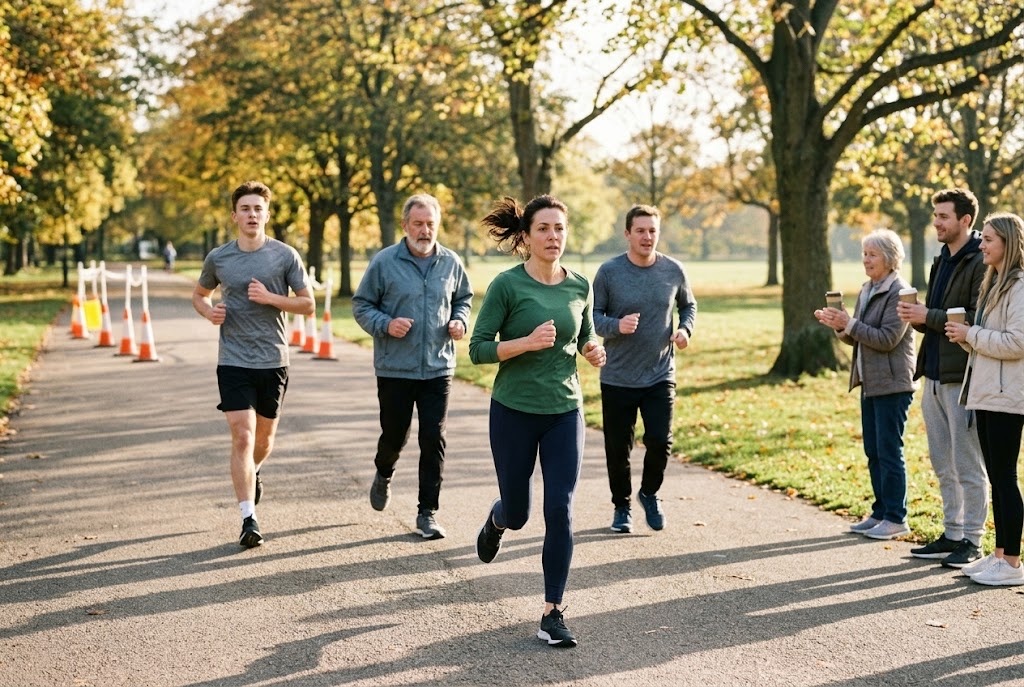
  <img src="/assets/images/blog/nyc-entry-2027-hero.jpg" width="1024" height="687" loading="lazy" alt="A small group of runners in winter layers rounding a bend on a frosty park road on a pale winter morning, apartment buildings above the bare trees" />
</figure>

<h2 id="the-short-version">The short version</h2>

<table>
  <thead>
    <tr>
      <th>Route</th>
      <th>Who it’s for</th>
      <th>When</th>
      <th>Your odds</th>
    </tr>
  </thead>
  <tbody>
    <tr>
      <td><strong>General drawing</strong></td>
      <td>Anyone</td>
      <td>Applications expected in February 2027, results early March</td>
      <td>Around 1–2%</td>
    </tr>
    <tr>
      <td><strong>9+1</strong></td>
      <td>NYRR members who can race in New York nine times in a year</td>
      <td>Complete it by <strong>31 Dec 2026</strong> for the 2027 race</td>
      <td>Guaranteed</td>
    </tr>
    <tr>
      <td><strong>Time qualifier</strong></td>
      <td>Fast runners</td>
      <td>Run the time in 2026</td>
      <td>Guaranteed at an NYRR race; fastest-first otherwise</td>
    </tr>
    <tr>
      <td><strong>Charity</strong></td>
      <td>Anyone willing to raise $3,000 or more</td>
      <td>Charities recruit from early 2027</td>
      <td>Very good, if you apply early</td>
    </tr>
    <tr>
      <td><strong>Tour operator</strong></td>
      <td>Runners outside the US</td>
      <td>Packages on sale from early 2027</td>
      <td>Very good, at a price</td>
    </tr>
    <tr>
      <td><strong>Legacy</strong></td>
      <td>15 or more New York finishes</td>
      <td>Automatic</td>
      <td>Guaranteed</td>
    </tr>
  </tbody>
</table>

<p>Entry fees in 2026 were $269.66 for NYRR members and $333.11 for non-members, with international entries higher. The 2027 fees are published with the drawing.</p>

<h2 id="the-drawing">The drawing</h2>

<p>The general drawing is free to enter and open to everyone. In recent years it has opened in the first week of February and closed about three weeks later, with results in the first days of March; for 2026 that was 4 to 25 February with results on 4 March. You give a card when you apply and it’s charged only if you’re drawn.</p>

<p>The numbers are the reason to read the rest of this article. The 2026 drawing had more than 240,000 applications, the most ever, and a success rate of roughly 1 to 2%. A second-chance drawing for about 24,000 NYRR members who were unsuccessful in the main one improves members’ odds a little, but not much.</p>

<p>So: enter the drawing in February, because it’s free and someone has to win. Then don’t plan your year around it.</p>

<h2 id="91-guaranteed-entry-if-you-live-close-enough">9+1: guaranteed entry, if you live close enough</h2>

<p>The <strong>NYRR 9+1 programme</strong> is the route most New Yorkers use. Be a New York Road Runners member, run nine qualifying NYRR races in a calendar year and volunteer at one, and you get guaranteed entry to the marathon the <em>following</em> year. Complete 9+1 in 2026 and you’re in for 2027.</p>

<p>Two things are different this time:</p>

<ul>
  <li><strong>The 2026 deadline is 31 December 2026.</strong> If you’ve already been working on it, count your races. The qualifying ones are NYRR-scored races in the five boroughs; virtual races and the marathon itself don’t count. The volunteer shift can be at any NYRR event, and the popular slots fill up early, so book it now rather than in December.</li>
  <li><strong>From 2027, 9+1 changes.</strong> NYRR now runs a drawing for the right to attempt it: members applied in September, about 15,000 were drawn on 1 October and pay a $99 pass fee, and only pass holders can complete 9+1 in 2027 for the 2028 race. If you didn’t get a pass, you can’t start 9+1 next year. People finishing 9+1 in 2026 under the old rules are unaffected.</li>
</ul>

<p>In practice 9+1 only works if you live in or near New York, or can visit nine times. For everyone else, it’s the next three routes.</p>

<h2 id="time-qualifiers">Time qualifiers</h2>

<p>Run fast enough in 2026 and you skip the drawing. The standards for the 2027 race, for a marathon or a half marathon run between 1 January and 31 December 2026, with your age on race day:</p>

<table>
  <thead>
    <tr>
      <th>Age</th>
      <th>Men: marathon / half</th>
      <th>Women and non-binary: marathon / half</th>
    </tr>
  </thead>
  <tbody>
    <tr>
      <td>18–34</td>
      <td>2:53 / 1:21</td>
      <td>3:13 / 1:32</td>
    </tr>
    <tr>
      <td>35–39</td>
      <td>2:55 / 1:23</td>
      <td>3:15 / 1:34</td>
    </tr>
    <tr>
      <td>40–44</td>
      <td>2:58 / 1:25</td>
      <td>3:26 / 1:37</td>
    </tr>
    <tr>
      <td>45–49</td>
      <td>3:05 / 1:28</td>
      <td>3:38 / 1:42</td>
    </tr>
    <tr>
      <td>50–54</td>
      <td>3:14 / 1:32</td>
      <td>3:51 / 1:49</td>
    </tr>
    <tr>
      <td>55–59</td>
      <td>3:23 / 1:36</td>
      <td>4:10 / 1:54</td>
    </tr>
    <tr>
      <td>60–64</td>
      <td>3:34 / 1:41</td>
      <td>4:27 / 2:02</td>
    </tr>
    <tr>
      <td>65–69</td>
      <td>3:45 / 1:46</td>
      <td>4:50 / 2:12</td>
    </tr>
    <tr>
      <td>70–74</td>
      <td>4:10 / 1:57</td>
      <td>5:30 / 2:27</td>
    </tr>
    <tr>
      <td>75–79</td>
      <td>4:30 / 2:07</td>
      <td>6:00 / 2:40</td>
    </tr>
    <tr>
      <td>80+</td>
      <td>4:55 / 2:15</td>
      <td>6:35 / 2:50</td>
    </tr>
  </tbody>
</table>

<p>The detail that matters: <strong>a time run at an NYRR race guarantees entry; a time run anywhere else doesn’t.</strong> Non-NYRR qualifiers are accepted fastest-first into a limited number of places, and in 2026 the cut was more than 20 minutes under the marathon standard. If you can run a qualifying half marathon, the NYRR races (the NYC Half in March, the Brooklyn Half in May, and a few others) are the sure route; a sub-2:53 somewhere else is not.</p>

<p>If a time like this is within reach, it needs a club-runner training block, not a finishing plan. But if you’re a 3:00 marathoner at 40, 2:58 is three minutes, and that’s a winter of work.</p>

<h2 id="charity">Charity</h2>

<p>The reliable route for most people. NYRR works with hundreds of official charity partners (670 in 2026, a record), each with a block of guaranteed entries. You commit to a fundraising minimum, which the programme sets at <strong>$3,000 or more per runner</strong>, and many charities ask $4,000–6,000, plus the entry fee. In return you get a bib, usually a training programme and a cheer station, and a reason to keep going at mile 22.</p>

<p>Charities open their 2027 applications from early 2027 and the well-known ones fill within weeks. The partner list is on NYRR’s site; the application goes to the charity, not to NYRR. If you’re abroad, check that the charity accepts international runners; many do.</p>

<p>NYRR’s own <strong>Team for Kids</strong> (minimum $3,000 plus a sign-up fee) is the largest programme and the easiest to find.</p>

<h2 id="tour-operators">Tour operators</h2>

<p>If you live outside the United States, official international travel partners sell packages with a guaranteed entry, usually bundled with a hotel and sometimes flights. They go on sale early in the year and the better-priced ones sell out quickly. Only operators on NYRR’s official list have real entries; a package from anyone else is a hotel booking and a drawing application.</p>

<h2 id="legacy">Legacy</h2>

<p>Finish the New York City Marathon 15 times and you’re eligible for guaranteed, paid entry for the rest of your running life. Not a plan for 2027, but a nice thing to know at mile 20.</p>

<h2 id="what-to-do-now">What to do now</h2>

<ol>
  <li><strong>Before 31 December:</strong> if you’re an NYRR member and have been running their races, count your 2026 races and book a volunteer shift. Nine plus one by New Year’s Eve means a 2027 bib.</li>
  <li><strong>In January:</strong> if you want a charity place, pick your charity and apply the week it opens. If you’re abroad, compare the tour operators.</li>
  <li><strong>In February:</strong> enter the drawing. It’s free. Set a calendar reminder for the day it opens; the window is three weeks.</li>
  <li><strong>In March:</strong> results. If you’re in, the race is 7 November 2027 and a <a href="/blog/2026/09/first-marathon-training-plan-16-weeks/">16-week marathon plan</a> starts on <strong>Monday, 19 July 2027</strong>. If you’re not, the charity places are still open, and so are <a href="/blog/2026/10/how-to-get-into-marathon-major-2027/">the other Majors</a>, some of which are easier to get into.</li>
</ol>

<p>Whatever route you take, the training is the same. In the app, start a marathon plan and pick a Monday; it shows you the Sunday you finish, which for New York should read 7 November.</p>

<p><em>Entry details are from New York Road Runners’ published 2027 entry information and the 2026 drawing statistics as of 14 October 2026. NYRR announces the 2027 drawing dates and fees in early 2027; check nyrr.org before you plan around them.</em></p>]]></content>


      <author>
          <name>iRunning Team</name>
        
        
      </author>


          <category term="events" />


        <summary type="html"><![CDATA[Six ways into the TCS New York City Marathon on 7 November 2027: the February drawing and its real odds, the 9+1 programme and why its rules change next year, the qualifying times by age, charity places from $3,000, tour operators, and the 15-finish legacy. What to do before 31 December 2026.]]></summary>


        <media:thumbnail xmlns:media="http://search.yahoo.com/mrss/" url="https://irunning.app/assets/images/blog/nyc-entry-2027-hero.jpg" />
        <media:content medium="image" url="https://irunning.app/assets/images/blog/nyc-entry-2027-hero.jpg" xmlns:media="http://search.yahoo.com/mrss/" />
      
    </entry>
  
    <entry>
      

      <title type="html">iRunning 1.2.5: Workout Insights, Pace Up Close, Warm-up and Cool-down Guides</title>
      <link href="https://irunning.app/blog/2026/10/irunning-1-2-5-insights-pace-warm-up-guides/" rel="alternate" type="text/html" title="iRunning 1.2.5: Workout Insights, Pace Up Close, Warm-up and Cool-down Guides" />
      <published>2026-10-30T08:00:00+00:00</published>
      <updated>2026-10-30T08:00:00+00:00</updated>
      <id>https://irunning.app/blog/2026/10/irunning-1-2-5-insights-pace-warm-up-guides</id>
      
      
        <content type="html" xml:base="https://irunning.app/blog/2026/10/irunning-1-2-5-insights-pace-warm-up-guides/"><![CDATA[<p>iRunning 1.2.5 is on the App Store. The last few updates were about the run itself. This one is about what happens around it: whether your reps are getting faster, where on the route you slowed down, how to get ready before you start and how to wind down after. Below is what’s new, and where to find each part.</p>

<h2 id="workout-insights-are-your-reps-getting-faster">Workout Insights: are your reps getting faster?</h2>

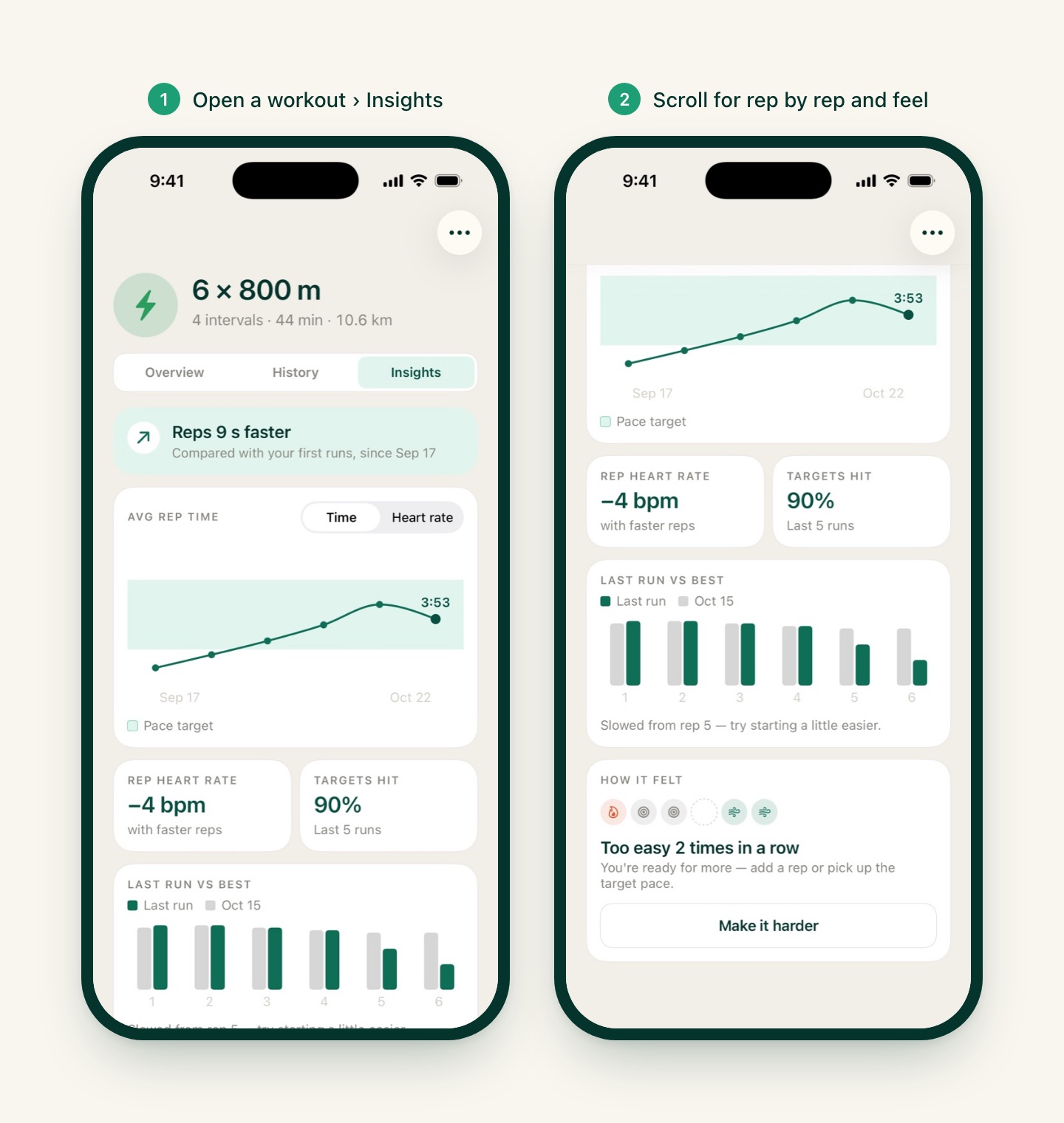
<p>Every workout now has a third tab next to <strong>Overview</strong> and <strong>History</strong>: <strong>Insights</strong>. It follows your reps from run to run, so you can see whether repeating the same session is paying off.</p>

<p>It grows with your history:</p>

<ul>
  <li><strong>No runs yet:</strong> a short invitation with a button to start the workout.</li>
  <li><strong>First run:</strong> your baseline.</li>
  <li><strong>Second run:</strong> the rep chart appears.</li>
  <li><strong>From the third run:</strong> a verdict in one line, like <strong>“Reps 9 s faster”</strong>, compared with your first runs.</li>
</ul>

<p>Slide a finger along the chart to see each run’s average rep time. If you change a workout’s structure, older runs are still counted but no longer charted, since their reps don’t match anymore.</p>

<p><strong>Where to find it:</strong> open any workout (from <strong>Workouts</strong>, or <strong>My workouts</strong> on Home) and tap <strong>Insights</strong>. The verdict and the rep chart are free. <strong>Premium</strong> adds heart rate on the chart, your rep heart rate and how often you hit the target pace, your last run against your best one rep by rep, and a feel trend with a one-tap <strong>“Make it harder”</strong> or <strong>“Make it easier”</strong> that takes you straight to the workout editor.</p>

<figure class="post-figure">
  <img src="/assets/images/blog/v125-insights.jpg" width="1440" height="1520" loading="lazy" alt="The iRunning Insights tab for a 6 × 800 m workout: the verdict Reps 9 s faster, a rep time chart, rep heart rate and targets hit, and lower down the last run versus best bars and a How it felt card with a Make it harder button" />
  <figcaption>Left: the verdict and the rep chart. Right: rep by rep against your best run, and the feel trend.</figcaption>
</figure>

<h2 id="pace-up-close">Pace, up close</h2>

<p>Your run summary used to give you one average pace. Now that number opens a whole screen.</p>

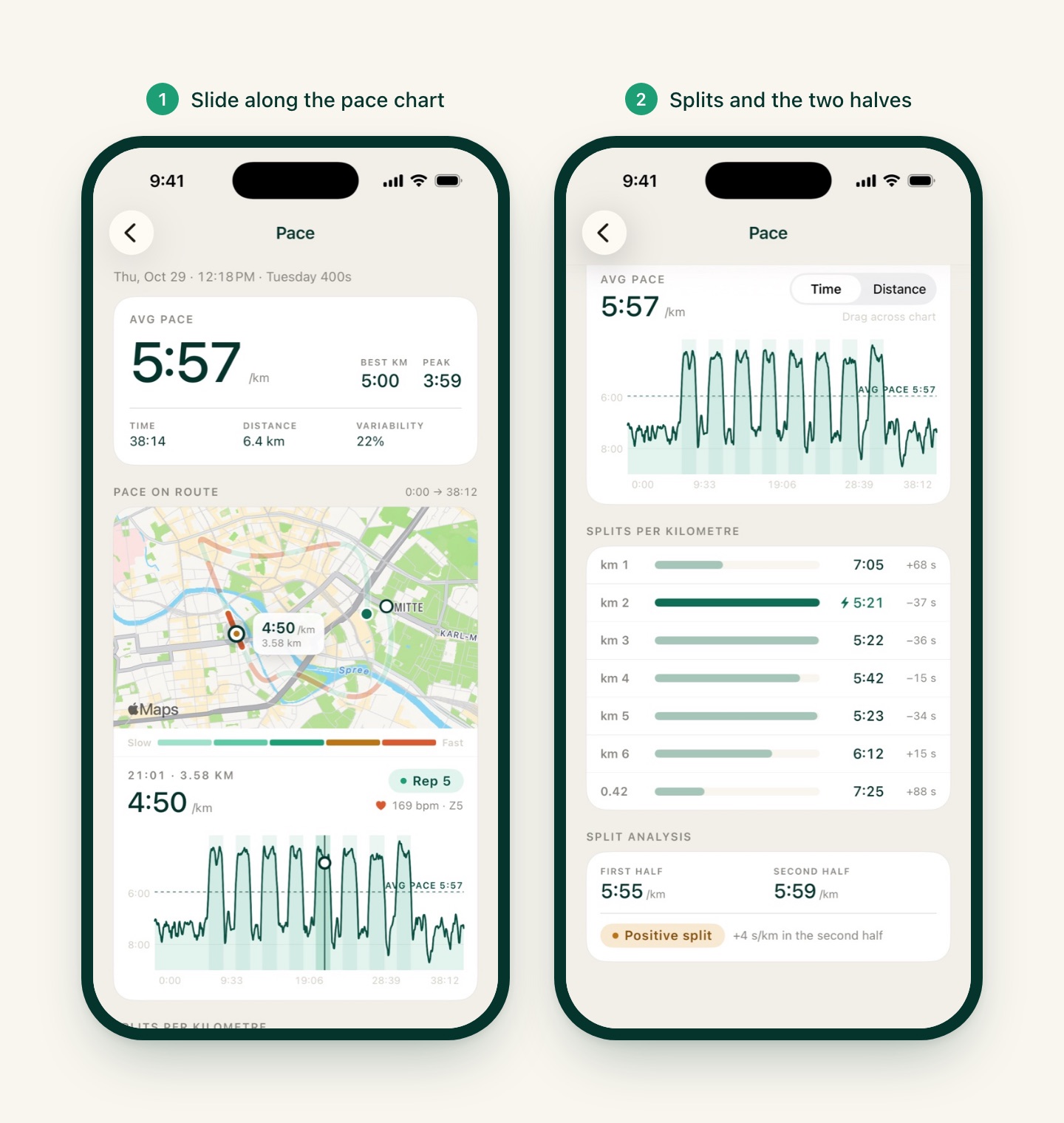
<p><strong>Where to find it:</strong> open a run in <strong>History</strong> and tap <strong>Avg pace</strong> (or your best split, like <strong>Best 400 m</strong>). The new <strong>Pace</strong> screen shows:</p>

<ul>
  <li><strong>Your route colored by pace</strong>, from slow to fast, so you can see exactly where the hills and the hard reps were.</li>
  <li><strong>A pace chart</strong> you can read by time or by distance. <strong>Slide a finger along it</strong> and a marker moves on the map, showing your pace, distance and heart rate at that moment and which rep you were in.</li>
  <li><strong>Splits per kilometre or mile.</strong> Your fastest one now gets a small <strong>bolt</strong>.</li>
  <li><strong>First half vs second half</strong>, with a plain verdict: negative or positive split.</li>
</ul>

<p>The <strong>heart rate zones</strong> screen works the same way: tap <strong>View details</strong> next to <em>Time in heart-rate zones</em> and slide along the heart rate chart to see the zone on the map.</p>

<figure class="post-figure">
  <img src="/assets/images/blog/v125-pace.jpg" width="1440" height="1520" loading="lazy" alt="The iRunning Pace screen for a run in Berlin: the route colored by pace with a 4:50 per km marker during rep 5, the pace chart below it, and lower down the splits per kilometre with a bolt on the fastest one and the first half versus second half card" />
  <figcaption>Left: a finger on the chart puts a marker on the map. Right: splits, with a bolt on the fastest kilometre, and the two halves.</figcaption>
</figure>

<h2 id="warm-up-and-cool-down-guides">Warm-up and cool-down guides</h2>

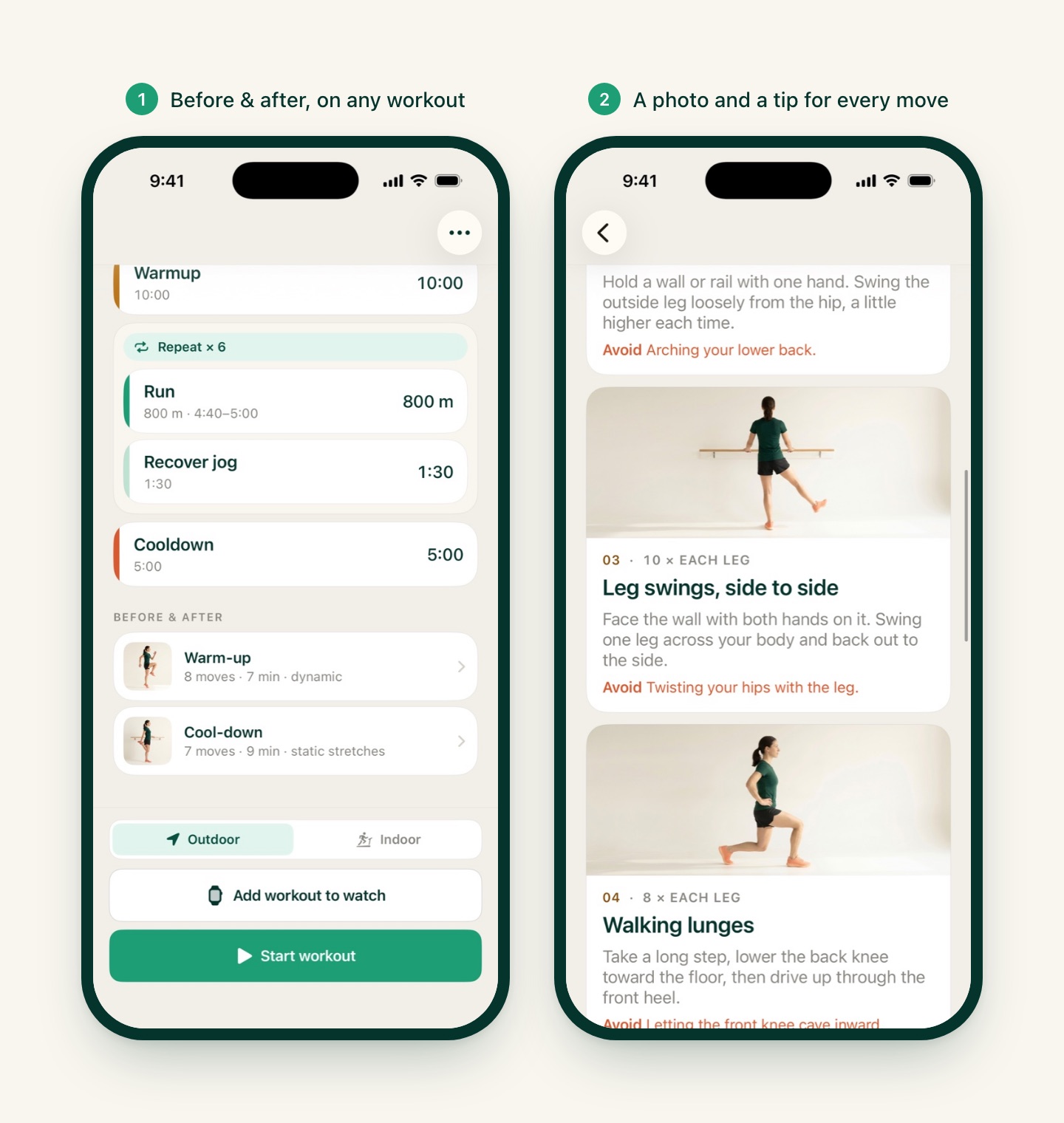
<p>Two short routines are now built into the app, each move with a photo, how long to do it, how to do it and <strong>the one mistake to avoid</strong>:</p>

<ul>
  <li><strong>Warm-up:</strong> 8 dynamic moves, about 7 minutes. Brisk walk, leg swings, lunges, hip circles, calf raises, high knees, butt kicks, plus optional strides before intervals or a tempo run.</li>
  <li><strong>Cool-down:</strong> 7 static stretches, about 9 minutes, finishing with a few slow breaths.</li>
</ul>

<p><strong>Where to find them:</strong></p>

<ol>
  <li>On any workout, scroll the <strong>Overview</strong> below the structure to <strong>Before &amp; after</strong>. Open the warm-up from here and it ends with a <strong>Start workout</strong> button, so you go straight from the last move into the run.</li>
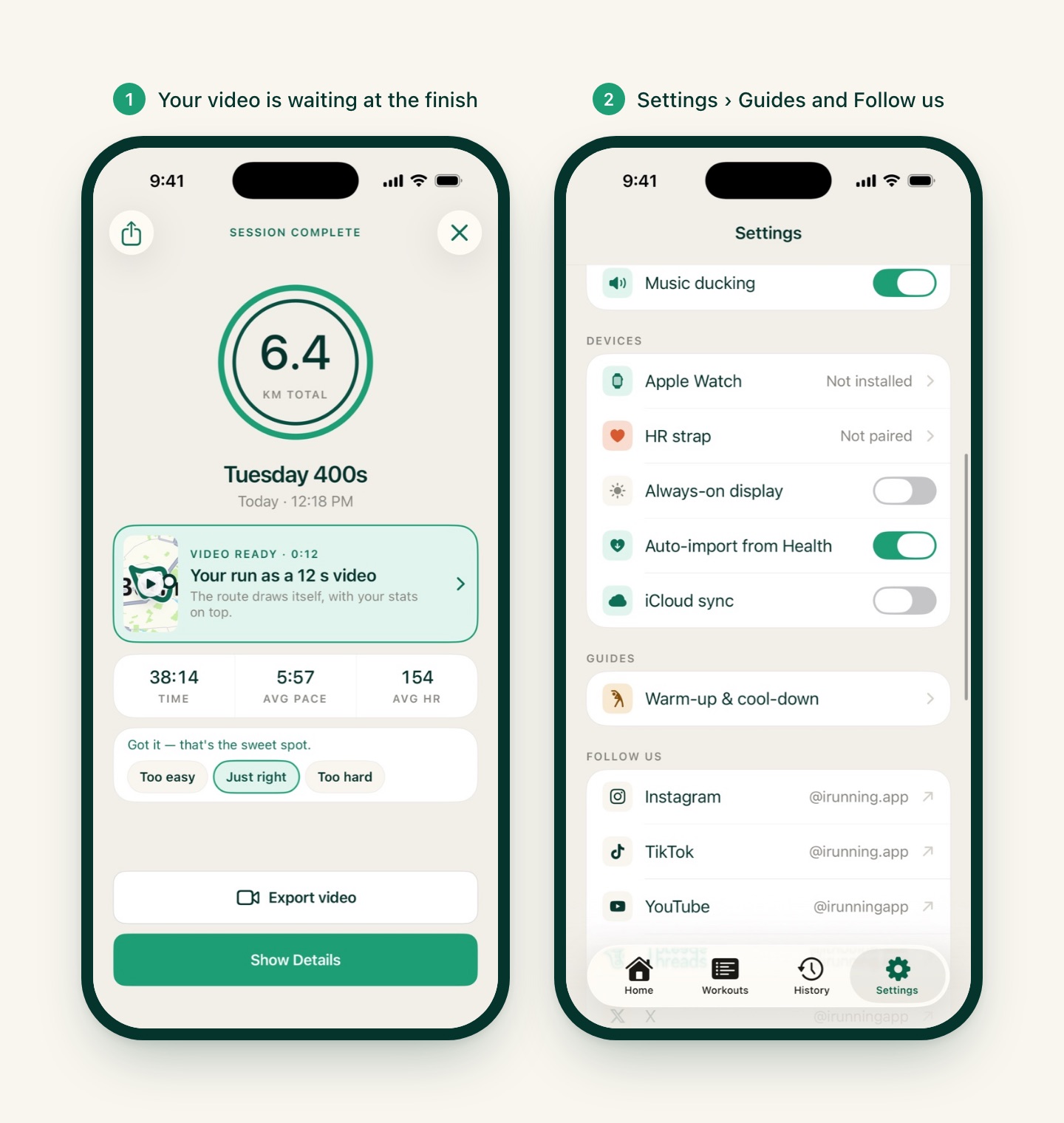
  <li>Or anytime from <strong>Settings › Guides › Warm-up &amp; cool-down</strong>.</li>
</ol>

<figure class="post-figure">
  <img src="/assets/images/blog/v125-guides.jpg" width="1440" height="1520" loading="lazy" alt="A workout's Overview in iRunning with the Before and after section listing Warm-up and Cool-down, and the warm-up guide showing photo cards for leg swings and walking lunges, each with a dose, instructions and a mistake to avoid" />
  <figcaption>Left: Before &amp; after under the workout's structure. Right: every move has a photo, a dose and an "Avoid" line.</figcaption>
</figure>

<p>The guides are free for everyone. Why no static stretching before the run? Holding long stretches on cold muscles does little to prepare them; dynamic moves raise your heart rate and loosen the hips and calves instead. The stretches belong after.</p>

<h2 id="your-run-video-ready-when-you-finish">Your run video, ready when you finish</h2>

<p>The <strong>Workout complete</strong> screen now has a <strong>Video ready</strong> card: your route drawing itself in a 12-second video, with your stats on top. Tap the card or <strong>Export video</strong> to open it in the video editor and share it in one go.</p>

<ul>
  <li><strong>Share</strong> (top left on the same screen) now opens every export option, the same list as in History: <strong>image, video, GPX, FIT and Strava</strong>.</li>
  <li><strong>In dark mode</strong>, video and photo cards now open on a dark map instead of always a light one.</li>
</ul>

<p>Video export is still free. The full walkthrough is in <a href="/blog/2026/09/run-video-instagram-stories-tiktok/">Turn Your Run Into a Video for Instagram Stories and TikTok</a>.</p>

<figure class="post-figure">
  <img src="/assets/images/blog/v125-video-ready.jpg" width="1440" height="1520" loading="lazy" alt="The iRunning Session complete screen with a Video ready card and an Export video button, and the Settings screen with the Guides and Follow us sections" />
  <figcaption>Left: the new finish screen. Right: Guides and Follow us in Settings.</figcaption>
</figure>

<h2 id="also-in-125">Also in 1.2.5</h2>

<ul>
  <li><strong>Follow iRunning</strong> on Instagram, TikTok, YouTube, Threads, X and Facebook, straight from <strong>Settings › Follow us</strong>.</li>
  <li><strong>Translation fixes</strong> in every language.</li>
</ul>

<h2 id="how-to-get-it">How to get it</h2>

<p>Update to iRunning 1.2.5 on the App Store. Then open the workout you run most often and tap <strong>Insights</strong>: if you already have a few runs of it, your verdict is waiting. Before your next session, try the warm-up from <strong>Before &amp; after</strong>.</p>

<p>Missed the last update? <a href="/blog/2026/10/irunning-1-2-4-countdown-go-back-a-step-live-map/">iRunning 1.2.4</a> added the 3·2·1 countdown before each interval, a way to go back a step mid-run and a live map that follows you.</p>

<p>Thanks for running with us. Keep the feedback coming!</p>]]></content>


      <author>
          <name>iRunning Team</name>
        
        
      </author>


          <category term="releases" />


        <summary type="html"><![CDATA[What's new in iRunning 1.2.5 and where to find it: an Insights tab that tracks your reps across runs, a Pace screen with scrub-to-map, warm-up and cool-down guides, and your run video ready the moment you finish.]]></summary>


        <media:thumbnail xmlns:media="http://search.yahoo.com/mrss/" url="https://irunning.app/assets/images/blog/v125-hero.jpg" />
        <media:content medium="image" url="https://irunning.app/assets/images/blog/v125-hero.jpg" xmlns:media="http://search.yahoo.com/mrss/" />
      
    </entry>
  
    <entry>
      

      <title type="html">How to Watch the NYC Marathon 2026: Start Times, Tracking, Best Spots</title>
      <link href="https://irunning.app/blog/2026/10/how-to-watch-nyc-marathon/" rel="alternate" type="text/html" title="How to Watch the NYC Marathon 2026: Start Times, Tracking, Best Spots" />
      <published>2026-10-29T09:00:00+00:00</published>
      <updated>2026-10-29T09:00:00+00:00</updated>
      <id>https://irunning.app/blog/2026/10/how-to-watch-nyc-marathon</id>
      
      
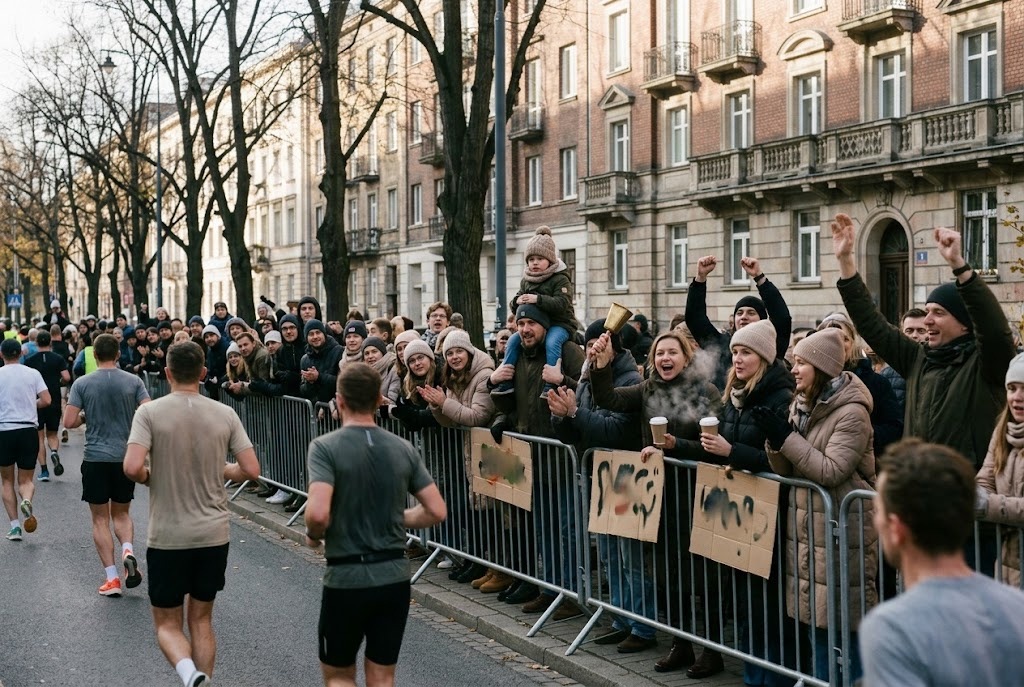
        <content type="html" xml:base="https://irunning.app/blog/2026/10/how-to-watch-nyc-marathon/"><![CDATA[<p>The TCS New York City Marathon is the best-attended race in the world on both sides of the barriers: more than 50,000 runners and, by the organisers’ count, around two million people watching from the street. It’s also one of the easiest marathons to follow if you’re not there, with a live broadcast in more than 160 countries and an app that puts a dot on the map for every runner.</p>

<p>Here’s how to watch on <strong>Sunday, 1 November 2026</strong>, whether you’re on First Avenue or on another continent.</p>

<figure class="post-figure photo">
  <img src="/assets/images/blog/nyc-watch-hero.jpg" width="1024" height="687" loading="lazy" alt="A dense crowd of spectators behind barriers on a tree-lined city avenue cheering marathon runners on a bright autumn morning, cardboard signs and coffee cups in hand" />
</figure>

<h2 id="start-times">Start times</h2>

<p>The clocks go back in the United States in the early hours of race morning, so New York is on Eastern Standard Time, five hours behind UTC. Runners get an extra hour of sleep; spectators abroad should check their maths.</p>

<table>
  <thead>
    <tr>
      <th>Start</th>
      <th>New York (EST)</th>
      <th>London (GMT)</th>
      <th>Berlin (CET)</th>
    </tr>
  </thead>
  <tbody>
    <tr>
      <td>Professional wheelchair division</td>
      <td>08:00</td>
      <td>13:00</td>
      <td>14:00</td>
    </tr>
    <tr>
      <td>Professional women</td>
      <td>08:35</td>
      <td>13:35</td>
      <td>14:35</td>
    </tr>
    <tr>
      <td>Professional men</td>
      <td>09:05</td>
      <td>14:05</td>
      <td>15:05</td>
    </tr>
    <tr>
      <td>Wave 1</td>
      <td>09:10</td>
      <td>14:10</td>
      <td>15:10</td>
    </tr>
    <tr>
      <td>Wave 2</td>
      <td>09:45</td>
      <td>14:45</td>
      <td>15:45</td>
    </tr>
    <tr>
      <td>Wave 3</td>
      <td>10:20</td>
      <td>15:20</td>
      <td>16:20</td>
    </tr>
    <tr>
      <td>Wave 4</td>
      <td>10:55</td>
      <td>15:55</td>
      <td>16:55</td>
    </tr>
    <tr>
      <td>Wave 5</td>
      <td>11:30</td>
      <td>16:30</td>
      <td>17:30</td>
    </tr>
  </tbody>
</table>

<p>The professional women reach the finish around 11:00 New York time and the men around 11:10. A four-hour runner in wave 2 finishes at about 13:45, and the last finishers come into the park after dark, around 19:30.</p>

<p>These are the 2025 wave times; NYRR confirms the 2026 schedule in the runner’s guide in the last week of October, and it rarely moves by more than a few minutes.</p>

<h2 id="watching-on-tv-and-online">Watching on TV and online</h2>

<p>The race is produced by WABC-TV and ESPN, and the 2025 pattern, which the 2026 broadcast is expected to follow, was:</p>

<ul>
  <li><strong>In the New York area:</strong> WABC-TV Channel 7, live from 08:00 to 13:00, with pre-race coverage from 07:00. The same feed streams on ABC7NY.com and the ABC 7 New York app.</li>
  <li><strong>Across the United States:</strong> ESPN2 from 08:00 to 11:30 ET, with pre- and post-race coverage on ESPN+. A Spanish-language broadcast runs on ESPN3 at the same time. ABC airs a two-hour highlights programme in the afternoon.</li>
  <li><strong>The finish line, all day:</strong> ABC7NY.com streams a fixed finish-line camera from mid-morning until the evening, so you can watch your runner cross the line even if they finish at 16:00.</li>
  <li><strong>Internationally:</strong> the race is shown live in more than 160 countries through the usual partners (TSN in Canada, Fox Sports in Australia, RAI in Italy, SuperSport in Africa, and others). NYRR publishes the country-by-country list about a week before the race. If your broadcaster isn’t carrying it, the NYRR app streams the four professional divisions.</li>
</ul>

<h2 id="tracking-a-runner">Tracking a runner</h2>

<p>The official <strong>NYRR app</strong> (the one with the Tata Consultancy Services logo) is the tool. Search for a runner by name or bib number, add as many as you like, and you’ll get a position on the course map updated at every timing mat, which are every 5 km and every mile from mile 1, plus a predicted finish time. In 2025 the app also carried live camera feeds from miles 8, 16 and 20 and from the finish, so you could see your runner go past a fixed point.</p>

<p>Two things to know:</p>

<ul>
  <li><strong>The dot is a projection, not GPS.</strong> Between mats the app estimates position from the last split, so a runner who has just slowed on the Queensboro will appear further along than they are. Give the dot a couple of minutes’ slack when you’re deciding whether to go to the barrier.</li>
  <li><strong>Phone networks on race day are saturated,</strong> especially on First Avenue and near the finish. Download the app and add your runners on Saturday, and agree a meeting point in advance rather than relying on calls.</li>
</ul>

<p>If the runner tracks their own race with iRunning, the Live Activity on their lock screen shows the current pace and distance, and after the finish the summary has every mile split. <a href="/blog/2026/09/share-berlin-marathon-finish/">How runners share the finish</a> covers the cards and route videos.</p>

<h2 id="where-to-watch-on-the-course">Where to watch on the course</h2>

<p>The course visits all five boroughs, but Staten Island and Queens are hard to reach and the Bronx is short. The practical spectator route is Brooklyn, then Manhattan, and with the subway you can see the same runner three times. Mile numbers and the <a href="/blog/2026/10/nyc-marathon-course-guide/">course guide</a> tell you what they’ll be feeling when they pass.</p>

<table>
  <thead>
    <tr>
      <th>Spot</th>
      <th>Miles</th>
      <th>Why</th>
      <th>Subway</th>
    </tr>
  </thead>
  <tbody>
    <tr>
      <td><strong>Fourth Avenue, Bay Ridge to Park Slope</strong></td>
      <td>3–7</td>
      <td>Wide, early, runners are fresh and easy to spot. Less crowded than Manhattan</td>
      <td>R train along Fourth Avenue</td>
    </tr>
    <tr>
      <td><strong>Lafayette Avenue, Fort Greene / Clinton Hill</strong></td>
      <td>8</td>
      <td>The three start colours have just merged; bands on the corners, the loudest Brooklyn stretch</td>
      <td>B, D, N, Q, R, 2, 3, 4, 5 to Atlantic Avenue–Barclays Center</td>
    </tr>
    <tr>
      <td><strong>Bedford Avenue, Williamsburg</strong></td>
      <td>11</td>
      <td>Quieter, so your runner can actually hear you. Easy to spot them</td>
      <td>L to Bedford Avenue</td>
    </tr>
    <tr>
      <td><strong>First Avenue, East 60s to 90s</strong></td>
      <td>16–18</td>
      <td>The famous wall of noise. Ten deep, hard to see a specific runner, unforgettable anyway</td>
      <td>4, 5, 6, N, Q, R to 59th Street or 6 to 68th/77th/86th</td>
    </tr>
    <tr>
      <td><strong>Fifth Avenue, East 90th to 105th</strong></td>
      <td>23</td>
      <td>The hardest climb on the course. This is where they need you</td>
      <td>6 to 96th Street, or 2, 3 to 110th</td>
    </tr>
    <tr>
      <td><strong>Central Park South and Columbus Circle</strong></td>
      <td>26</td>
      <td>The last half mile, grandstands and the turn into the park</td>
      <td>A, B, C, D, 1 to 59th Street–Columbus Circle</td>
    </tr>
  </tbody>
</table>

<p>A classic plan: see them at mile 8 in Fort Greene, take the subway to the Upper East Side for First Avenue around mile 17, then walk across the park to Central Park South for the finish. The gap between mile 8 and mile 17 is about 80 minutes for a four-hour runner, which is enough for the train if you leave as soon as they’ve passed.</p>

<p>The finish line itself is inside Central Park and the grandstands there need tickets, which NYRR sells in advance and which usually go before race week. Central Park South is free and nearly as good.</p>

<h2 id="tips-for-the-day">Tips for the day</h2>

<ul>
  <li><strong>Bring a sign with their name.</strong> Not a joke; a runner who hears their own name on First Avenue at mile 17 runs the next mile faster. Big letters, few words.</li>
  <li><strong>Tell them where you’ll be, and which side of the road.</strong> Runners drift to the side where they expect you. “First Avenue, east side, 80th Street” is a plan; “somewhere on First Avenue” isn’t.</li>
  <li><strong>Dress for standing still.</strong> Spectators get colder than runners. Early November in New York is 7–14 °C with wind on the avenues.</li>
  <li><strong>Bring their stuff.</strong> Many runners skip the bag pre-check and run with nothing. A warm layer, flip-flops and a snack at the family reunion area on Central Park West will make you very popular.</li>
  <li><strong>The reunion area is outside the runners-only zone.</strong> Runners leave the park at West 77th Street, 20–30 minutes after they finish, and the meeting points are on Central Park West between 63rd and 76th Streets. Pick a street number.</li>
</ul>

<h2 id="if-youre-running">If you’re running</h2>

<p>Our <a href="/blog/2026/10/nyc-marathon-race-week-checklist/">race-week checklist</a> has the expo, transport and start-village details, and the <a href="/blog/2026/10/how-to-pace-nyc-marathon/">pacing guide</a> has the splits. Tell your people which side of First Avenue you’ll run on. Then enjoy the loudest 26 miles in running.</p>

<p><em>Broadcast and schedule details are from NYRR’s 2025 race information as of 14 October 2026; NYRR publishes the 2026 broadcast schedule and runner’s guide in the last week of October. Check them for final times.</em></p>]]></content>


      <author>
          <name>iRunning Team</name>
        
        
      </author>


          <category term="events" />


        <summary type="html"><![CDATA[Everything for Sunday 1 November 2026: when the professionals and the five waves start (in New York, London and Berlin time), how to watch on TV and online from anywhere, how to track a runner in the NYRR app, and where to stand on the course to see them more than once.]]></summary>


        <media:thumbnail xmlns:media="http://search.yahoo.com/mrss/" url="https://irunning.app/assets/images/blog/nyc-watch-hero.jpg" />
        <media:content medium="image" url="https://irunning.app/assets/images/blog/nyc-watch-hero.jpg" xmlns:media="http://search.yahoo.com/mrss/" />
      
    </entry>
  
    <entry>
      

      <title type="html">iRunning 1.2.4: 3·2·1 Before Every Interval, Go Back a Step, a Map That Follows You</title>
      <link href="https://irunning.app/blog/2026/10/irunning-1-2-4-countdown-go-back-a-step-live-map/" rel="alternate" type="text/html" title="iRunning 1.2.4: 3·2·1 Before Every Interval, Go Back a Step, a Map That Follows You" />
      <published>2026-10-28T08:00:00+00:00</published>
      <updated>2026-10-28T08:00:00+00:00</updated>
      <id>https://irunning.app/blog/2026/10/irunning-1-2-4-countdown-go-back-a-step-live-map</id>
      
      
        <content type="html" xml:base="https://irunning.app/blog/2026/10/irunning-1-2-4-countdown-go-back-a-step-live-map/"><![CDATA[<p>iRunning 1.2.4 is on the App Store. Most of it is about the run itself: knowing when an interval is about to change, fixing a step that went wrong, and seeing where you are on the map without stopping. Below is what’s new, and where to switch each thing on.</p>

<h2 id="321-before-each-interval-ends">3·2·1 before each interval ends</h2>

<p>The countdown used to come <em>after</em> an interval ended, and the run paused for it. Now it beeps <strong>3·2·1 over the last three seconds of every interval</strong>, so you know the change is coming and the run never stops for it.</p>

<ul>
  <li><strong>Stronger haptics on iPhone</strong>, including with the screen locked, so you feel the change with the phone in a pocket or armband.</li>
  <li><strong>Your Apple Watch taps the same beats</strong>, both when it mirrors a phone run and when it runs a workout on its own.</li>
</ul>

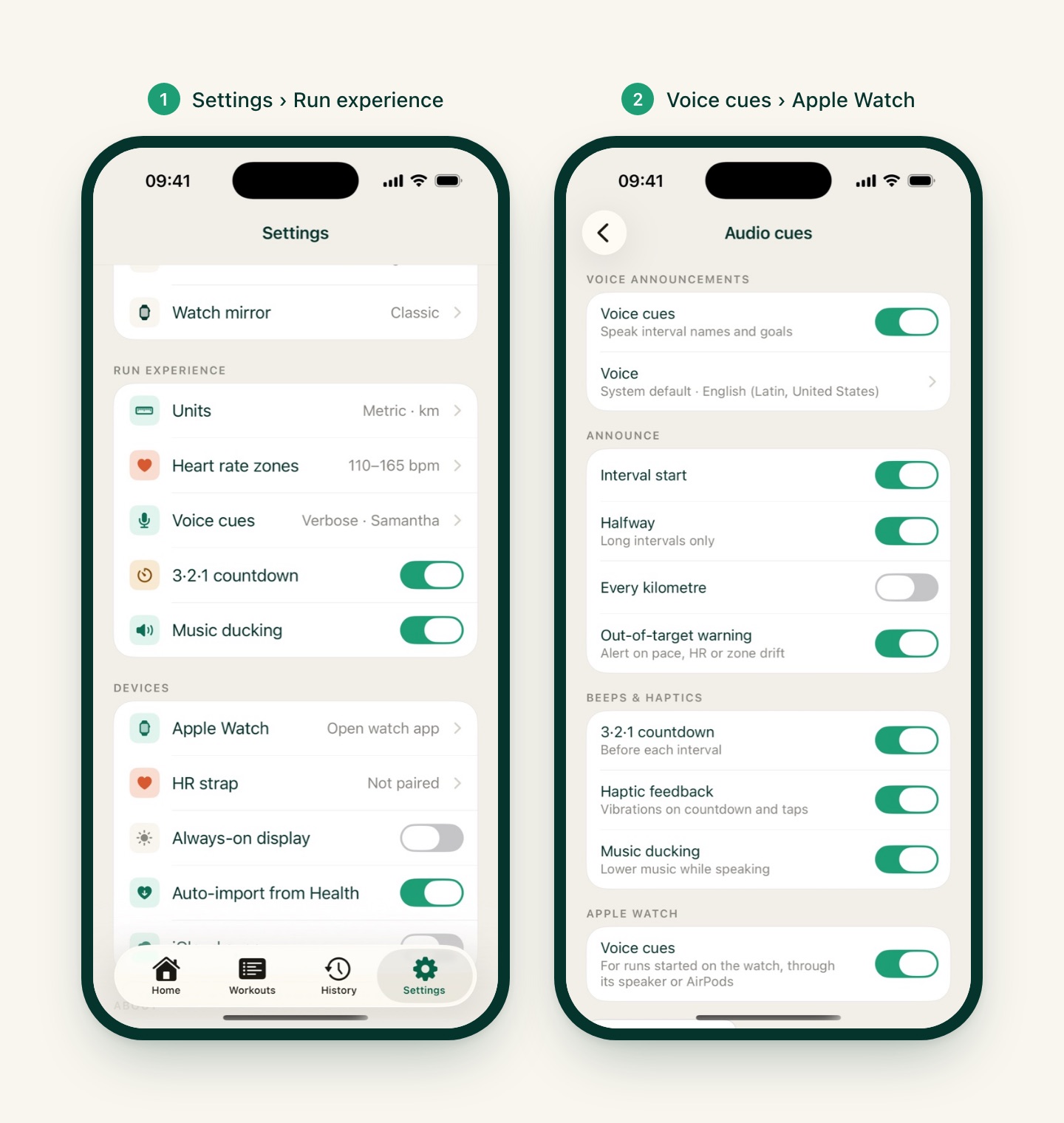
<p><strong>Where to find it:</strong> it’s on by default. The switch is <strong>Settings › Run experience › 3·2·1 countdown</strong>. The vibrations follow <strong>Haptic feedback</strong> in <strong>Settings › Voice cues › Beeps &amp; haptics</strong>.</p>

<figure class="post-figure">
  <img src="/assets/images/blog/v124-countdown-settings.jpg" width="1440" height="1520" loading="lazy" alt="Two iRunning settings screens: Run experience with the 3·2·1 countdown switch on, and Audio cues with Beeps and haptics and the new Apple Watch voice cues switch" />
  <figcaption>Left: the countdown switch. Right: the Audio cues screen, with the new Apple Watch section at the bottom.</figcaption>
</figure>

<h2 id="go-back-a-step">Go back a step</h2>

<p>Cut a rep short, or got stopped at a crossing halfway through it? You can now run it again without restarting the workout.</p>

<ol>
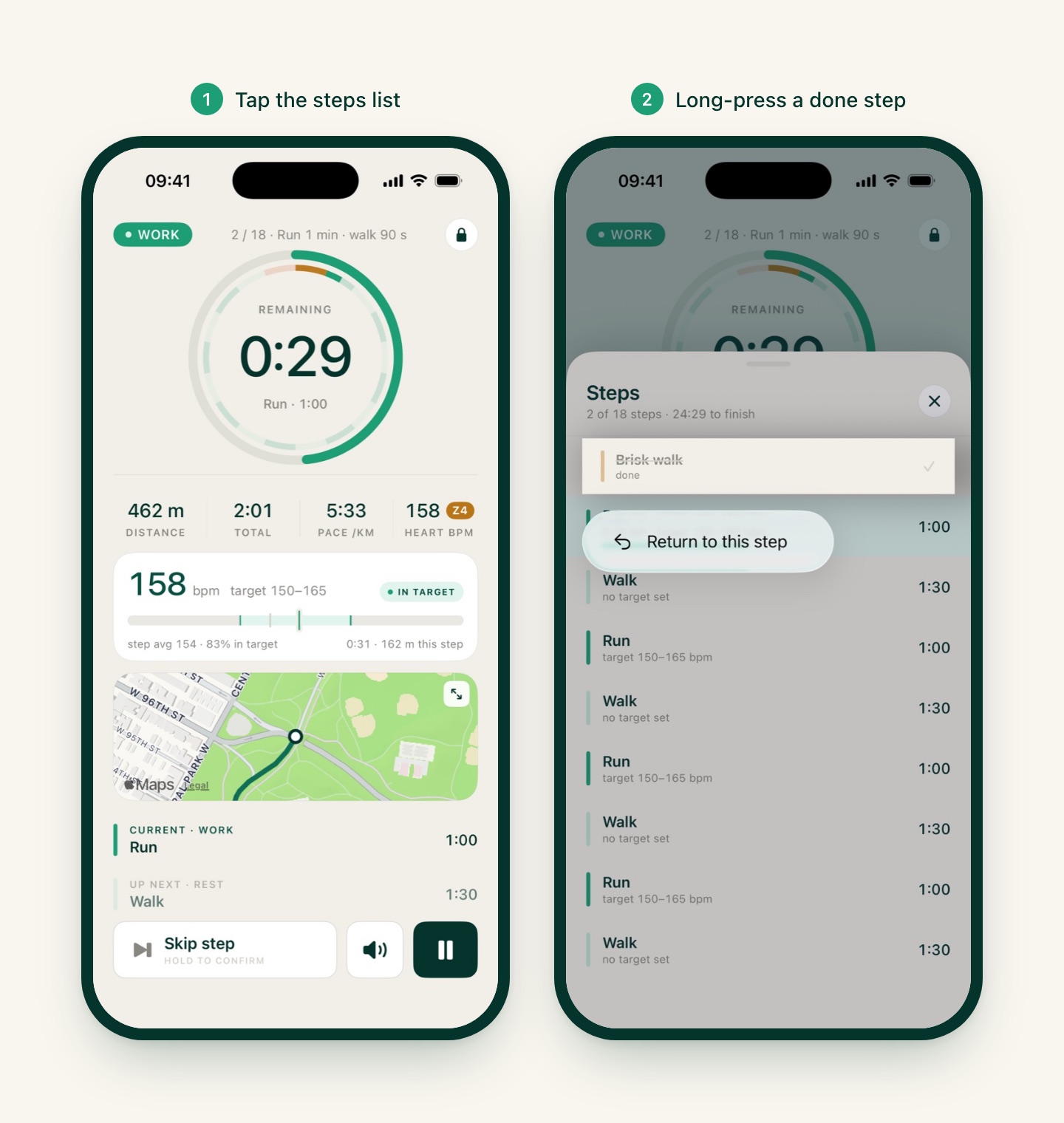
  <li>During a run (or while paused), <strong>tap the steps list</strong> at the bottom of the run screen. The full list of steps opens.</li>
  <li><strong>Long-press a finished step</strong> and tap <strong>Return to this step</strong>.</li>
</ol>

<p>The run jumps back to that step with a fresh timer, distance, heart rate and cues. Nothing is lost: <strong>splits keep both attempts</strong>, the step you were on is recorded as skipped, and the laps in <strong>Apple Health and FIT exports</strong> stay in step with the clock.</p>

<figure class="post-figure">
  <img src="/assets/images/blog/v124-return-step.jpg" width="1440" height="1520" loading="lazy" alt="The iRunning run screen during a work interval, and the steps list opened over it with the menu Return to this step on a finished warm-up" />
  <figcaption>Tap the list of steps, then long-press any step that's already done.</figcaption>
</figure>

<h2 id="a-live-map-that-follows-you">A live map that follows you</h2>

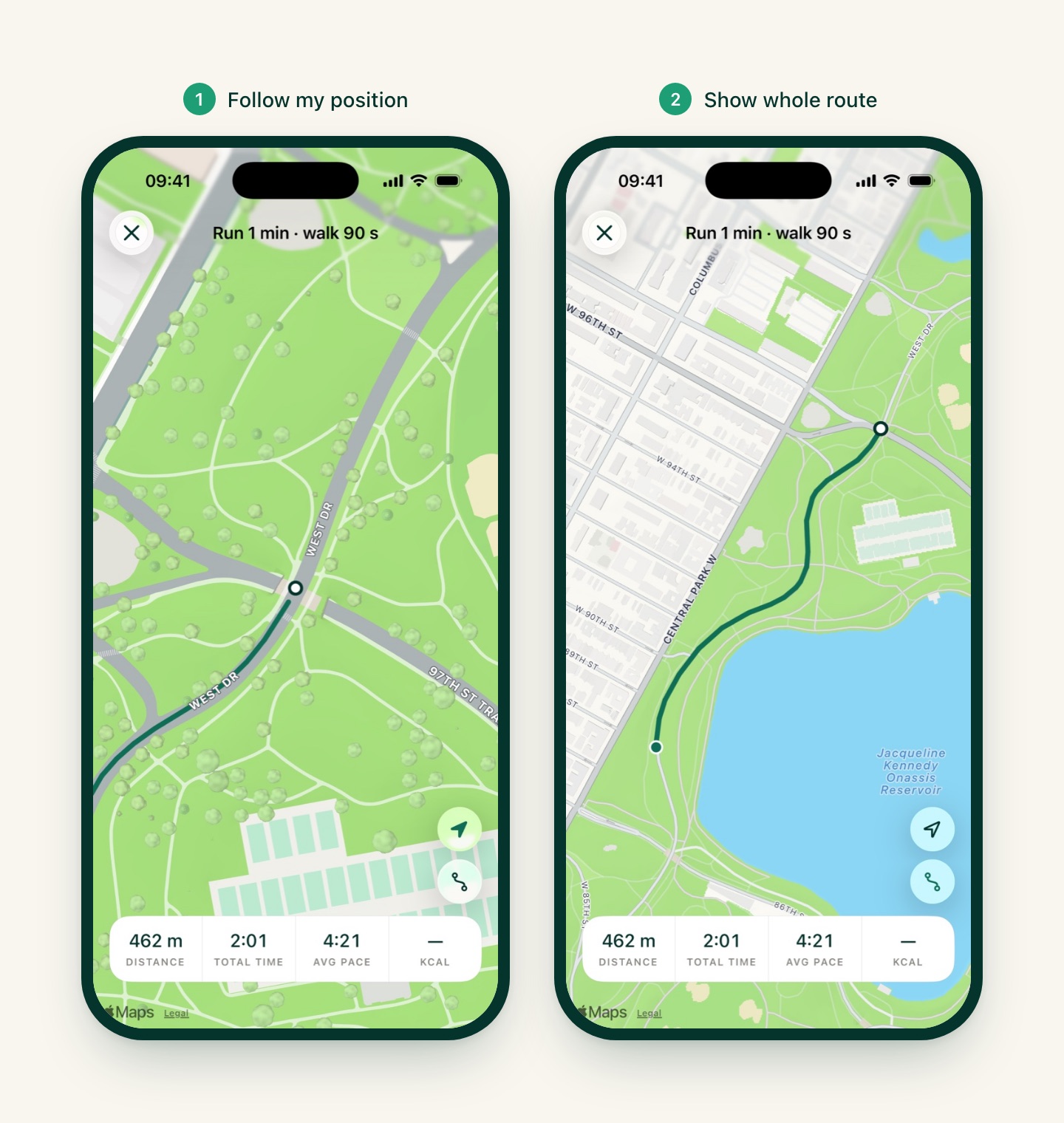
<p>Tap the map card during a run (the expand icon in its corner) and the full-screen map now <strong>stays centred on you as you move</strong>. Two buttons on the right switch between:</p>

<ul>
  <li><strong>Follow my position</strong>: the arrow. A close street-level view that moves with you.</li>
  <li><strong>Show whole route</strong>: the route icon. The camera fits everything you’ve run so far and zooms out as it grows.</li>
</ul>

<p>Pan or pinch whenever you like: the map stays where you leave it until you tap one of the buttons again.</p>

<figure class="post-figure">
  <img src="/assets/images/blog/v124-live-map.jpg" width="1440" height="1520" loading="lazy" alt="The full-screen live map during a run in Central Park: a close view following the runner, and the whole-route view along the reservoir" />
  <figcaption>The same moment in both modes. The active button is highlighted.</figcaption>
</figure>

<h2 id="voice-cues-on-apple-watch">Voice cues on Apple Watch</h2>

<p>Runs started on the watch used to be haptics only. Now they can <strong>speak their cues through the watch speaker or your AirPods</strong>, so you can leave the phone at home and still hear every interval.</p>

<p><strong>Where to turn it on:</strong> it’s <strong>off by default</strong>. On your iPhone, open <strong>Settings › Voice cues</strong> and switch on <strong>Voice cues</strong> in the <strong>Apple Watch</strong> section at the bottom (the section appears once the iRunning watch app is installed). What the watch announces follows the same <strong>Announce</strong> switches as the phone: interval start, halfway, every kilometre or mile, and out-of-target warnings.</p>

<h2 id="9-new-video-styles">9 new video styles</h2>

<p><strong>Share › Video</strong> gets nine new overlays, built around the way TikTok, Reels and Shorts lay out their buttons: stats run down a side rail, across a band at the top, or in a light corner card, so nothing important sits under the app’s own interface.</p>

<p>The new ones: <strong>Glass rail, Split rail, Hairline rail, Ink rail, Chip rail, Two-tier band, Ticker band, Glass band</strong> and <strong>Light corner</strong>. Swipe across the preview to switch between them.</p>

<figure class="post-figure">
  <picture>
    <source media="(max-width: 560px)" srcset="/assets/images/blog/v124-video-styles-mobile.jpg" width="800" height="1400" />
    <img src="/assets/images/blog/v124-video-styles.jpg" width="1440" height="800" loading="lazy" alt="Four frames from run videos in the new styles: Glass rail on a light map, Two-tier band on a dark map, Light corner on a light map and Chip rail on a dark map" />
  </picture>
  <figcaption>Four of the nine new styles, on light and dark maps.</figcaption>
</figure>

<p>Also in video:</p>

<ul>
  <li><strong>Smoother map rotation on turns.</strong> When the camera follows you heading-up, corners turn over about a second instead of snapping.</li>
  <li><strong>Story videos stay clear of YouTube Shorts cropping</strong>, so the stats never get cut off at the edges.</li>
</ul>

<p>Video export is still free for everyone. The full walkthrough is in <a href="/blog/2026/09/run-video-instagram-stories-tiktok/">Turn Your Run Into a Video for Instagram Stories and TikTok</a>.</p>

<h2 id="in-case-you-missed-123">In case you missed 1.2.3</h2>

<p>The previous update was smaller, so here it is in short:</p>

<ul>
  <li><strong>Faster GPS.</strong> The run screen no longer waits for a perfect signal: the first fix arrives in seconds, even between tall buildings. A <strong>“Searching for GPS…”</strong> chip shows on the map until the signal is ready, and outdoor distance only counts real GPS movement from that first fix.</li>
  <li><strong>Better AI workouts.</strong> The Apple Intelligence builder reads repeats, distances, rest and pace more reliably (“6 × 400 m, 90 s rest”), and dictation keeps listening until you tap stop.</li>
  <li><strong>Sharper transparent share templates</strong> over bright photos.</li>
</ul>

<h2 id="how-to-get-it">How to get it</h2>

<p>Update to iRunning 1.2.4 on the App Store. Then start any interval workout and listen for the 3·2·1 before the first change. If you run with an Apple Watch, flip on its voice cues first.</p>

<p>Thanks for running with us. Keep the feedback coming!</p>]]></content>


      <author>
          <name>iRunning Team</name>
        
        
      </author>


          <category term="releases" />


        <summary type="html"><![CDATA[What's new in iRunning 1.2.4 and where to find it: a 3·2·1 warning before each interval ends, a way to repeat a step mid-run, a live map that follows you, voice cues on Apple Watch and 9 new video styles.]]></summary>


        <media:thumbnail xmlns:media="http://search.yahoo.com/mrss/" url="https://irunning.app/assets/images/blog/v124-video-styles.jpg" />
        <media:content medium="image" url="https://irunning.app/assets/images/blog/v124-video-styles.jpg" xmlns:media="http://search.yahoo.com/mrss/" />
      
    </entry>
  
    <entry>
      

      <title type="html">12-3-30 Incline Walk: Does the Viral Treadmill Workout Work?</title>
      <link href="https://irunning.app/blog/2026/10/12-3-30-incline-walk/" rel="alternate" type="text/html" title="12-3-30 Incline Walk: Does the Viral Treadmill Workout Work?" />
      <published>2026-10-27T09:00:00+00:00</published>
      <updated>2026-10-27T09:00:00+00:00</updated>
      <id>https://irunning.app/blog/2026/10/12-3-30-incline-walk</id>
      
      
        <content type="html" xml:base="https://irunning.app/blog/2026/10/12-3-30-incline-walk/"><![CDATA[<p>Set the treadmill to a 12% incline. Set the speed to 3 miles an hour, which is 4.8 km/h. Walk for 30 minutes. That’s the whole workout, and it has been one of the most searched fitness routines in the world for five years running.</p>

<p>The numbers aren’t magic. Lauren Giraldo, who posted the routine in 2019, has said that 12 was simply the steepest her gym’s treadmill went, 3 mph felt like a brisk walk, and 30 minutes was her grandmother’s rule for daily exercise. What makes it work is more interesting than the numbers, and so is the part most people skip: how to get to 12% without wrecking your calves in week one.</p>

<figure class="post-figure photo">
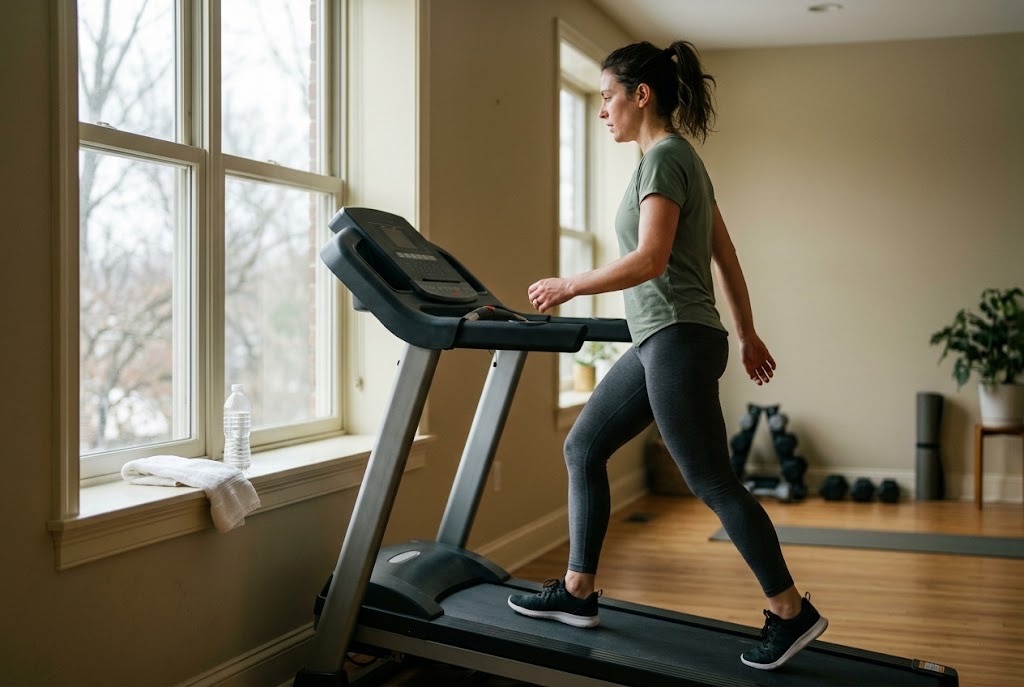
  <img src="/assets/images/blog/incline-walk-hero.jpg" width="1024" height="687" loading="lazy" alt="A woman walking briskly up a steeply inclined treadmill beside a bright window on a grey winter morning, hands off the rails" />
</figure>

<h2 id="what-the-research-says">What the research says</h2>

<p>For years 12-3-30 was a social-media phenomenon with no data behind it. In 2025 that changed: a study funded by the American Council on Exercise and published in the <em>International Journal of Exercise Science</em> put 17 healthy adults, average age 28, moderately fit but not regular exercisers, on a treadmill at exactly 12% and 3 mph for 30 minutes, and measured what happened.</p>

<table>
  <thead>
    <tr>
      <th>What they measured</th>
      <th>Result</th>
    </tr>
  </thead>
  <tbody>
    <tr>
      <td><strong>Heart rate</strong></td>
      <td>124 bpm on average, about 47% of heart-rate reserve</td>
    </tr>
    <tr>
      <td><strong>Oxygen uptake</strong></td>
      <td>44% of VO₂ reserve, roughly 5.5 METs</td>
    </tr>
    <tr>
      <td><strong>Intensity</strong></td>
      <td>Moderate, on the border of vigorous by the end</td>
    </tr>
    <tr>
      <td><strong>Calories</strong></td>
      <td>About 220 kcal in 30 minutes, on average</td>
    </tr>
    <tr>
      <td><strong>How it felt</strong></td>
      <td>Participants rated it positively and said it gave them energy</td>
    </tr>
  </tbody>
</table>

<p>In plain words: <strong>12-3-30 is a proper moderate-intensity cardio workout.</strong> It sits in the range that public-health guidelines count as exercise, it burns about as much as an easy 30-minute jog for most people, and it’s at roughly the effort of <a href="/blog/2026/09/zone-2-running-aerobic-base/">zone 2</a>, where the body gets good at burning fat and building aerobic base. A second comparison in the same study found that at matched calorie burn, the incline walk used a higher share of fat for fuel than self-paced treadmill running. That’s where the “burns more fat than running” headlines come from. It doesn’t mean it burns more calories; it doesn’t.</p>

<p>What it does better than flat walking is load the muscles. Walking up a 12% slope asks the glutes, hamstrings and calves to work far harder than walking on the flat at the same speed, which is why it feels like a workout and a flat walk doesn’t. It’s also low impact: no flight phase, no landing forces, which is why so many people who can’t run, or don’t want to, stick with it.</p>

<p>The authors’ one caution: for less-fit or older people, 12% and 3 mph straight away is too much, and they recommend building up to it. Which brings us to the part nobody posts about.</p>

<h2 id="who-shouldnt-start-at-12">Who shouldn’t start at 12%</h2>

<p>A 12% slope changes how your foot lands. Every step is on the ball of the foot with the heel dropping, which stretches the calf and the Achilles tendon under load, thirty minutes at a time, a few times a week. For a tendon that isn’t used to it, that’s a lot.</p>

<ul>
  <li><strong>If you have Achilles pain or plantar fasciitis right now</strong>, skip steep inclines until it’s settled. The plan in the app says the same thing on its first screen.</li>
  <li><strong>If you’ve never walked on an incline</strong>, start at 4–6% and 20 minutes. Your calves will tell you the next morning why.</li>
  <li><strong>If your lower back aches</strong>, you’re probably leaning from the waist to cope with the slope. Lean from the ankles, stand tall, and drop the incline until you can.</li>
  <li><strong>Hands off the rails.</strong> Holding on takes away a third of the work, flattens your posture and is the single most common 12-3-30 mistake. The rails are for balance; if you need them to keep up, the speed or the slope is too high today.</li>
</ul>

<h2 id="a-six-week-way-in">A six-week way in</h2>

<p>The plan below, which is the <strong>12-3-30 Incline Walk</strong> plan in iRunning, reaches the full 12-3-30 in week 6 by changing one dial per week: duration first, then incline, then speed. Never two at once.</p>

<figure class="post-figure">
  <picture>
    <source media="(max-width: 560px)" srcset="/assets/images/blog/incline-progression-mobile.png" width="800" height="860" />
    <img src="/assets/images/blog/incline-progression.png" width="1440" height="800" loading="lazy" alt="Bar chart of the six-week 12-3-30 plan: 20 minutes at 4% in week 1, 25 at 6%, 30 at 8%, a 25-minute cutback at 8%, 30 at 10% and 30 minutes at 12% and 3 mph in week 6" />
  </picture>
  <figcaption>One change a week, with a cutback in week 4.</figcaption>
</figure>

<table>
  <thead>
    <tr>
      <th>Week</th>
      <th>Three sessions of</th>
      <th>Incline</th>
      <th>Speed</th>
      <th>What changed</th>
    </tr>
  </thead>
  <tbody>
    <tr>
      <td>1</td>
      <td>20 min</td>
      <td>4%</td>
      <td>4.5 km/h (2.8 mph)</td>
      <td>Starting point: a gentle hill</td>
    </tr>
    <tr>
      <td>2</td>
      <td>25 min</td>
      <td>6%</td>
      <td>4.5 km/h</td>
      <td>Five minutes and 2%</td>
    </tr>
    <tr>
      <td>3</td>
      <td><strong>30 min</strong></td>
      <td>8%</td>
      <td>4.5 km/h</td>
      <td>The full half hour. Duration is set from here</td>
    </tr>
    <tr>
      <td>4 · cutback</td>
      <td>25 min</td>
      <td>8%</td>
      <td>4.5 km/h</td>
      <td>Five minutes shorter, nothing steeper</td>
    </tr>
    <tr>
      <td>5</td>
      <td>30 min</td>
      <td><strong>10%</strong></td>
      <td>4.6 km/h (2.9 mph)</td>
      <td>Two more percent</td>
    </tr>
    <tr>
      <td>6</td>
      <td>30 min</td>
      <td><strong>12%</strong></td>
      <td><strong>4.8 km/h (3 mph)</strong></td>
      <td>The real 12-3-30</td>
    </tr>
  </tbody>
</table>

<p>Each session has a 3-minute flat walk before and after, so a week-3 session is 36 minutes door to door. Three sessions a week on non-consecutive days: Monday, Wednesday, Friday is the obvious pattern.</p>

<p>A few notes on the weeks:</p>

<ul>
  <li><strong>Weeks 1–2 are about posture.</strong> Short steps, tall torso, eyes on the far wall, hands free. If you can hold that at 6% you’ll hold it at 12%.</li>
  <li><strong>Week 3 is the first milestone:</strong> 30 minutes on an incline. After this, only the slope changes, which is the point. Your body only has to adapt to one thing at a time.</li>
  <li><strong>Week 4 is a cutback, and it’s not optional.</strong> Tendons adapt more slowly than muscles and heart. The lighter week is when the first three sink in.</li>
  <li><strong>Week 5 at 10% is where the effort moves from calves to glutes.</strong> Most people find 10% harder than 12% for a session or two, because they haven’t learned to use their hips yet.</li>
  <li><strong>Week 6 is three full 12-3-30s.</strong> It doesn’t get easier. You get better at it.</li>
</ul>

<p>If your treadmill only goes to 6% or 10%, cap the incline at its maximum and hold the 30 minutes. It’s still a proper workout, and the plan asks about this in setup.</p>

<h2 id="how-it-compares-with-the-alternatives">How it compares with the alternatives</h2>

<table>
  <thead>
    <tr>
      <th> </th>
      <th>12-3-30</th>
      <th>Flat brisk walk, 30 min</th>
      <th>Easy jog, 30 min</th>
      <th>Japanese walking, 30 min</th>
    </tr>
  </thead>
  <tbody>
    <tr>
      <td><strong>Effort</strong></td>
      <td>Moderate, rising to vigorous</td>
      <td>Light to moderate</td>
      <td>Moderate</td>
      <td>Alternates moderate and light</td>
    </tr>
    <tr>
      <td><strong>Impact</strong></td>
      <td>Low</td>
      <td>Low</td>
      <td>Moderate</td>
      <td>Low</td>
    </tr>
    <tr>
      <td><strong>Calories (70 kg adult, approx.)</strong></td>
      <td>200–250</td>
      <td>120–150</td>
      <td>250–300</td>
      <td>150–200</td>
    </tr>
    <tr>
      <td><strong>Muscles</strong></td>
      <td>Glutes, hamstrings, calves</td>
      <td>Not much</td>
      <td>Legs generally</td>
      <td>Not much</td>
    </tr>
    <tr>
      <td><strong>Needs</strong></td>
      <td>A treadmill with 12%</td>
      <td>Nothing</td>
      <td>Nothing</td>
      <td>Nothing</td>
    </tr>
  </tbody>
</table>

<p>The honest summary: 12-3-30 is a good way to get a moderate-intensity session that’s low impact and leg-strengthening, and it’s much more interesting than walking on a flat belt. It’s not better than running for fitness, and it’s not a fat-loss trick. If you don’t have a treadmill, <a href="/blog/2026/09/japanese-walking-interval-walk/">Japanese walking</a> is the closest outdoor equivalent, and real hills do what the incline button does.</p>

<h2 id="doing-it-with-irunning">Doing it with iRunning</h2>

<p>The app can’t set the incline for you; no app can. What it does is run the clock, hold the plan and watch the effort:</p>

<ul>
  <li><strong>The dials are on screen.</strong> Each session shows its incline and speed as the target, with a 3-minute flat warm-up and cool-down either side. Set the treadmill, tap start, and walk.</li>
  <li><strong>Indoor mode.</strong> Treadmill sessions run without GPS, so the app doesn’t hunt for a signal in the gym. <a href="/blog/2026/09/treadmill-intervals-indoor-running/">Here’s how the Indoor mode works</a>, and why distance on a treadmill is an estimate.</li>
  <li><strong>Heart rate keeps you honest.</strong> The early sessions carry a zone 2 target and the later ones zone 3, which is roughly where the study’s participants were at 12%. With an Apple Watch or a chest strap, you’ll hear it if you’ve slipped into a stroll, or if 12% has pushed you past what the week asks for.</li>
  <li><strong>After week 6,</strong> the plan hands you on to either the Winter Treadmill Plan, if you want to run, or Brisk Walking for Weight Loss, if you’d rather keep walking.</li>
</ul>

<p><strong>12-3-30 Incline Walk</strong> is part of iRunning Premium, in the <strong>Treadmill</strong> group. Tap <strong>Choose a plan</strong> on Home, then <strong>Browse all plans</strong>. The free version still runs the clock and the warm-up and cool-down, and lets you build a 30-minute incline walk as one of two custom workouts.</p>

<p><em>Training advice, not medical advice. Check with a doctor before starting if you have a heart condition, and with a physio if you have Achilles or plantar-fascia pain.</em></p>]]></content>


      <author>
          <name>iRunning Team</name>
        
        
      </author>


          <category term="training" />


        <summary type="html"><![CDATA[Twelve percent incline, three miles an hour, thirty minutes. Where 12-3-30 came from, what a 2025 lab study found it actually does to your heart rate and calories, who shouldn't start at 12%, and a six-week way in that changes one dial at a time.]]></summary>


        <media:thumbnail xmlns:media="http://search.yahoo.com/mrss/" url="https://irunning.app/assets/images/blog/incline-walk-hero.jpg" />
        <media:content medium="image" url="https://irunning.app/assets/images/blog/incline-walk-hero.jpg" xmlns:media="http://search.yahoo.com/mrss/" />
      
    </entry>
  
    <entry>
      

      <title type="html">NYC Marathon Race Week: Expo at the Javits, Getting to Staten Island, Day-by-Day Checklist</title>
      <link href="https://irunning.app/blog/2026/10/nyc-marathon-race-week-checklist/" rel="alternate" type="text/html" title="NYC Marathon Race Week: Expo at the Javits, Getting to Staten Island, Day-by-Day Checklist" />
      <published>2026-10-25T09:00:00+00:00</published>
      <updated>2026-10-25T09:00:00+00:00</updated>
      <id>https://irunning.app/blog/2026/10/nyc-marathon-race-week-checklist</id>
      
      
        <content type="html" xml:base="https://irunning.app/blog/2026/10/nyc-marathon-race-week-checklist/"><![CDATA[<p>Seven days to go. The training is done, and New York turns the last week into a logistics exercise: a trip to the Javits, a decision about ferries and buses, a very early alarm, and a long, cold wait on Staten Island before you run a step.</p>

<p>Here’s the whole week before the TCS New York City Marathon on <strong>Sunday, 1 November 2026</strong>, in one place. The timings below are from the 2025 runner’s guide; the 2026 guide, which NYRR publishes in the last week of October, may move some of them by a few minutes. Your bib has your own transport time and wave printed on it, and those win.</p>

<figure class="post-figure photo">
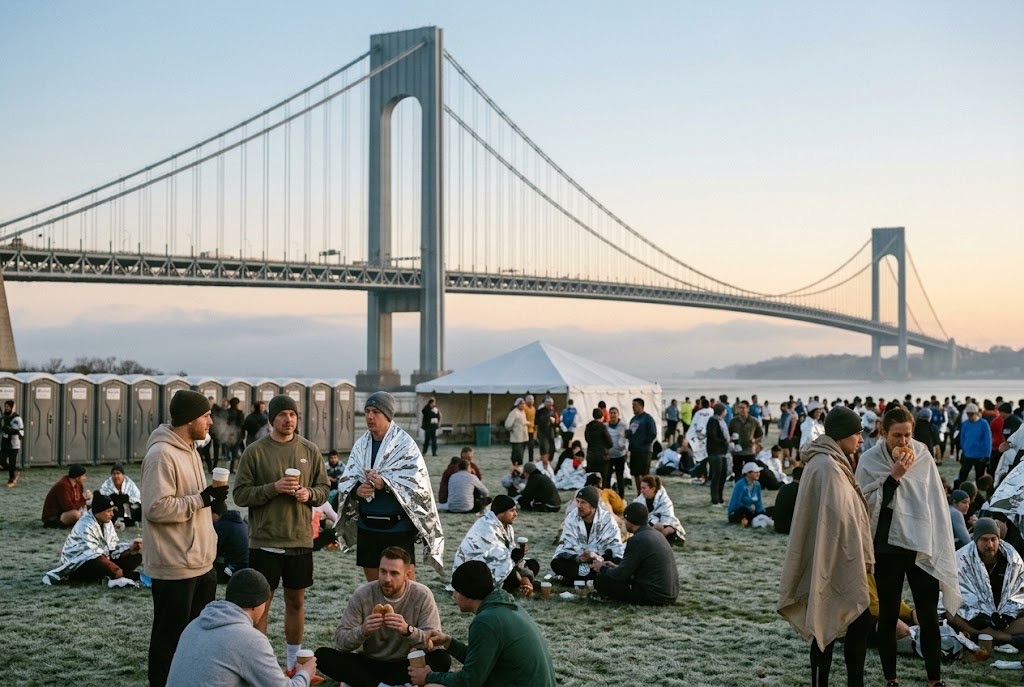
  <img src="/assets/images/blog/nyc-race-week-hero.jpg" width="1024" height="687" loading="lazy" alt="Runners wrapped in old sweatshirts and foil blankets holding coffee cups on a lawn in a marathon start village at dawn, portable toilets and a bridge in the haze behind them" />
</figure>

<h2 id="the-expo-and-your-bib">The expo and your bib</h2>

<p>Every runner collects their own bib at the <strong>TCS New York City Marathon Expo presented by New Balance</strong>. Nobody can pick it up for you, and you book a time slot in your NYRR account before you go.</p>

<table>
  <thead>
    <tr>
      <th> </th>
      <th> </th>
    </tr>
  </thead>
  <tbody>
    <tr>
      <td><strong>Where</strong></td>
      <td>Jacob K. Javits Convention Center, 11th Avenue at 35th Street, Manhattan</td>
    </tr>
    <tr>
      <td><strong>Thursday 29 Oct</strong></td>
      <td>10:00–20:00</td>
    </tr>
    <tr>
      <td><strong>Friday 30 Oct</strong></td>
      <td>10:00–20:00</td>
    </tr>
    <tr>
      <td><strong>Saturday 31 Oct</strong></td>
      <td>09:00–17:00</td>
    </tr>
    <tr>
      <td><strong>Entry</strong></td>
      <td>Free, for runners and anyone they bring</td>
    </tr>
  </tbody>
</table>

<p><strong>Bring two things:</strong> a photo ID (passport or driving licence) and your confirmation, printed or on your phone. Check your bib before you leave the hall. The bottom left corner has your name, your <strong>official transport option and departure time</strong>, and whether you booked a <strong>pre-check bag</strong>. If any of it is wrong, the Runner Support Center at the expo can fix it, but <strong>nobody can change your wave or corral</strong>.</p>

<p>Go on Thursday or Friday. Saturday at the Javits is a lot of walking and standing the day before a marathon, and the hall is at its most crowded. The expo also has the New Balance finisher collection, which sells out of popular sizes by Saturday if that matters to you.</p>

<h2 id="getting-to-staten-island">Getting to Staten Island</h2>

<p>The start is at Fort Wadsworth, at the foot of the Verrazzano-Narrows Bridge, and you can’t just turn up: you chose one of the official transport options when you entered, it’s printed on your bib, and you have to use that one. All four end at the same start village.</p>

<table>
  <thead>
    <tr>
      <th>Option</th>
      <th>Leaves from</th>
      <th>How long to the village</th>
      <th>Who it suits</th>
    </tr>
  </thead>
  <tbody>
    <tr>
      <td><strong>Staten Island Ferry</strong></td>
      <td>Whitehall Terminal, lower Manhattan (free public ferry, then free shuttle buses from St. George terminal)</td>
      <td>About 30 minutes, plus queues at both ends</td>
      <td>Anyone staying downtown or in Brooklyn. The most flexible option, and the one with toilets on board</td>
    </tr>
    <tr>
      <td><strong>Midtown Manhattan bus</strong></td>
      <td>New York Public Library, Fifth Avenue at 40th Street</td>
      <td>About 90 minutes</td>
      <td>Midtown and uptown hotels. No toilets on the bus</td>
    </tr>
    <tr>
      <td><strong>New Jersey bus</strong></td>
      <td>MetLife Stadium, Parking Lot K</td>
      <td>About 60 minutes</td>
      <td>Staying in New Jersey</td>
    </tr>
    <tr>
      <td><strong>Midtown ferry</strong></td>
      <td>Pier 79, 12th Avenue at 39th Street, behind the Javits</td>
      <td>About 60 minutes, ferry plus a bus</td>
      <td>Select groups only; if it isn’t on your bib, it isn’t for you</td>
    </tr>
  </tbody>
</table>

<p>Those times don’t include security screening at Fort Wadsworth. Your bib shows a departure time, typically between 5:00 and 7:30 depending on your wave, and the ferries and buses leave in order, so a wave 1 runner on the 5:30 ferry is at the village by 6:30 for a 9:10 start. That’s a long time in the cold, which is why the next section matters more than it sounds.</p>

<p>The Whitehall ferry terminal is on the 1 train (South Ferry) and the R/W (Whitehall Street); the Library is on the 7, B, D, F and M (42nd Street–Bryant Park). The subway runs all night, but check the MTA’s weekend service changes on Saturday.</p>

<h2 id="the-start-village">The start village</h2>

<p>Fort Wadsworth is three villages, blue, orange and green, one for each start colour on your bib. Inside: coffee, tea, hot chocolate, water, Gatorade and bagels, more than 1,700 toilets, medical tents, and a lot of grass to sit on. There’s a quiet zone, interfaith services and even therapy dogs. What there isn’t is anywhere warm.</p>

<p><strong>Dress for two hours outdoors in November,</strong> not for a marathon. An old sweatshirt and sweatpants, a hat, gloves, something to sit on and a throwaway top layer. All of it goes into the donation bins when you move to your corral, and NYRR gives it to charity. Many runners add a cheap poncho or a bin bag for wind, and a foil blanket is on the permitted list.</p>

<p><strong>The bag rules are strict.</strong> The only bag allowed in the village and on official transport is the clear <strong>Start Village bag</strong> from your expo pack. No backpacks, no opaque bags, no hydration vests with a bladder in the back (front bottles up to a litre are fine). Everything in the bag is subject to search. <strong>There is no bag check at the start:</strong> whatever you don’t run with, you throw away before the corral.</p>

<p>If you want something at the finish, you needed to book <strong>bag pre-check</strong> when you registered (it closed in early September). Pre-check bags are dropped at Central Park West between 69th and 70th Street on the Friday and Saturday before the race, 09:00–17:00, and collected at the same spot after you finish, until 19:00. Everyone else gets a poncho and a recovery bag at the finish and no stored clothes, so think about what you’ll wear home.</p>

<h2 id="day-by-day">Day by day</h2>

<table>
  <thead>
    <tr>
      <th>Day</th>
      <th>Run</th>
      <th>Do</th>
    </tr>
  </thead>
  <tbody>
    <tr>
      <td><strong>Mon 26</strong></td>
      <td>Rest, or a 20-minute walk</td>
      <td>Book your expo slot if you haven’t. Check the forecast for Sunday once, then stop checking</td>
    </tr>
    <tr>
      <td><strong>Tue 27</strong></td>
      <td>30 minutes easy</td>
      <td>Plan your race: flat pace, bridge miles, halfway and 20-mile targets. Our <a href="/blog/2026/10/how-to-pace-nyc-marathon/">pacing guide</a> has the tables</td>
    </tr>
    <tr>
      <td><strong>Wed 28</strong></td>
      <td>Rest</td>
      <td>Try on your full race kit, including the start-village layers. Charge your watch</td>
    </tr>
    <tr>
      <td><strong>Thu 29</strong></td>
      <td>20 minutes easy + <strong>4 × 20-second strides</strong>, with a minute of easy jogging between</td>
      <td>Expo opens at 10:00. Collect your bib and check the transport line on it</td>
    </tr>
    <tr>
      <td><strong>Fri 30</strong></td>
      <td>Rest</td>
      <td><strong>Start carb-loading.</strong> Drop a pre-check bag if you booked one. Trim your toenails</td>
    </tr>
    <tr>
      <td><strong>Sat 31</strong></td>
      <td>20 minutes very easy, in the morning</td>
      <td>Stay off your feet; no sightseeing. Lay out two outfits: race kit and village kit. Pin on the bib, set two alarms</td>
    </tr>
    <tr>
      <td><strong>Sun 1</strong></td>
      <td><strong>Race day</strong></td>
      <td>Breakfast about three hours before your wave, which may mean on the ferry</td>
    </tr>
  </tbody>
</table>

<p>The strides on Thursday are the only fast running of the week. They keep your legs sharp without costing anything. Everything else is easy or nothing.</p>

<h2 id="carb-loading-from-friday">Carb-loading, from Friday</h2>

<p>Two days is enough, and the aim is more carbohydrate, not more food. Shift each meal towards rice, pasta, bread, potatoes and fruit juice, cut back on fat and fibre, and eat a little more often rather than a lot more at once. A big pasta dinner on Saturday is tradition, not science; a normal-sized one eaten early is better.</p>

<p>Saturday night in New York has a specific trap: dinner reservations at 20:00, a long walk back, bed at 23:00, alarm at 04:00. Eat early, near the hotel, and be in bed by 21:00.</p>

<h2 id="race-morning-by-wave">Race morning, by wave</h2>

<table>
  <thead>
    <tr>
      <th>Wave</th>
      <th>Corrals open</th>
      <th>Corrals close</th>
      <th>Start</th>
    </tr>
  </thead>
  <tbody>
    <tr>
      <td><strong>1</strong></td>
      <td>08:10</td>
      <td>08:45</td>
      <td>09:10</td>
    </tr>
    <tr>
      <td><strong>2</strong></td>
      <td>09:05</td>
      <td>09:25</td>
      <td>09:45</td>
    </tr>
    <tr>
      <td><strong>3</strong></td>
      <td>09:45</td>
      <td>10:00</td>
      <td>10:20</td>
    </tr>
    <tr>
      <td><strong>4</strong></td>
      <td>10:25</td>
      <td>10:40</td>
      <td>10:55</td>
    </tr>
    <tr>
      <td><strong>5</strong></td>
      <td>11:00</td>
      <td>11:15</td>
      <td>11:30</td>
    </tr>
  </tbody>
</table>

<p>The professional wheelchair division goes at 08:00, the professional women at 08:35 and the men at 09:05. If you miss your corral close, you start with the next wave; you can’t start earlier.</p>

<p>A rough morning for a wave 2 runner on the Staten Island Ferry: alarm 04:30, breakfast 05:00, subway to Whitehall for a 06:00 ferry, village by 07:15, donation bins and corral by 09:05, start 09:45. Build your own version backwards from your wave, and add 20 minutes to everything.</p>

<p>One more thing: <strong>cell service near the finish is unreliable</strong> with 50,000 phones in one park. Agree a meeting point with family before the race, outside the runners-only zone on Central Park West, and a time. You’ll walk about 20–30 minutes from the finish line to the park exit at West 77th Street.</p>

<h2 id="your-kit-list">Your kit list</h2>

<p><strong>To race:</strong> bib (pinned the night before), timing tag on the back untouched, trained-in shoes and socks, race kit, gels for the whole race (the course has gels only at miles 12 and 18), anti-chafe balm, a hat or sunglasses for the First Avenue sun.</p>

<p><strong>For the village:</strong> the clear Start Village bag, old warm layers to donate, a foil blanket or poncho, something to sit on, a bagel or your own breakfast, water, a portable charger (it goes in the e-waste bin at the start, not the trash), toilet paper.</p>

<p><strong>Leave behind:</strong> a backpack, anything opaque, a hydration vest with a bladder, anything you want to see again that doesn’t fit in a pre-check bag.</p>

<h2 id="how-irunning-helps-this-week">How iRunning helps this week</h2>

<ul>
  <li><strong>Taper runs, with brakes.</strong> Set a pace band for the easy runs with the top end at your easy pace, and the app will tell you to slow down when race-week nerves turn 30 easy minutes into a tempo.</li>
  <li><strong>Build your race.</strong> A custom workout with distance steps and a heart-rate or pace band for each: wider on the Verrazzano, the Queensboro and Fifth Avenue, narrow on the avenues. The <a href="/blog/2026/10/how-to-pace-nyc-marathon/">pacing guide</a> has the segments.</li>
  <li><strong>Watch, charged.</strong> Charge the watch on Saturday, not Sunday morning. On race morning, start the workout on the watch in the corral so the GPS has a fix before the cannon.</li>
  <li><strong>Announce the splits.</strong> <em>By distance</em> every mile, with <em>Avg pace</em>, <em>Distance</em> and <em>Total time</em>, so you never have to look down on a crowded bridge.</li>
</ul>

<p>Good luck. See you in the park.</p>

<p><em>Expo, transport and start details are from the 2025 TCS New York City Marathon runner’s guide and NYRR’s 2026 announcements as of 14 October 2026. Check the 2026 runner’s guide and your bib for your own times.</em></p>]]></content>


      <author>
          <name>iRunning Team</name>
        
        
      </author>


          <category term="events" />


        <summary type="html"><![CDATA[The last seven days before the TCS New York City Marathon on 1 November 2026: expo hours and bib pick-up, the four ways to the start, what the start village is like, the clear-bag rules, how much to run each day, and race-morning timings for every wave.]]></summary>


        <media:thumbnail xmlns:media="http://search.yahoo.com/mrss/" url="https://irunning.app/assets/images/blog/nyc-race-week-hero.jpg" />
        <media:content medium="image" url="https://irunning.app/assets/images/blog/nyc-race-week-hero.jpg" xmlns:media="http://search.yahoo.com/mrss/" />
      
    </entry>
  
    <entry>
      

      <title type="html">What’s a Good 5K Time? By Age, Sex and Experience</title>
      <link href="https://irunning.app/blog/2026/10/what-is-a-good-5k-time/" rel="alternate" type="text/html" title="What’s a Good 5K Time? By Age, Sex and Experience" />
      <published>2026-10-22T09:00:00+00:00</published>
      <updated>2026-10-22T09:00:00+00:00</updated>
      <id>https://irunning.app/blog/2026/10/what-is-a-good-5k-time</id>
      
      
        <content type="html" xml:base="https://irunning.app/blog/2026/10/what-is-a-good-5k-time/"><![CDATA[<p>The honest answer to “what’s a good 5K time?” is “good compared with whom?” A 25-minute 5K is a strong result for a 55-year-old woman who started running last year, an ordinary one for a 25-year-old man who runs three times a week, and a slow jog for a club runner. Age, sex and how long you’ve been running move the goalposts by ten minutes or more.</p>

<p>So instead of one number, here are the real ones: where recreational runners actually finish, by age and sex, what the usual labels mean in minutes, and how to decide what <em>your</em> good time is.</p>

<figure class="post-figure photo">
  <img src="/assets/images/blog/good-5k-time-hero.jpg" width="1024" height="687" loading="lazy" alt="A small group of amateur runners of different ages finishing a weekend 5K on a tree-lined park path in autumn, a few spectators with coffee cups clapping at the side" />
</figure>

<h2 id="the-short-version">The short version</h2>

<p>For adults who run regularly but don’t race seriously:</p>

<table>
  <thead>
    <tr>
      <th> </th>
      <th>Women</th>
      <th>Men</th>
    </tr>
  </thead>
  <tbody>
    <tr>
      <td><strong>A typical finish</strong> (about half of runners are faster, half slower)</td>
      <td>26–30 min</td>
      <td>22–26 min</td>
    </tr>
    <tr>
      <td><strong>A good time</strong> (faster than about 80% of runners)</td>
      <td>23–26 min</td>
      <td>20–23 min</td>
    </tr>
    <tr>
      <td><strong>A very good time</strong> (faster than about 95%)</td>
      <td>21–24 min</td>
      <td>18–20 min</td>
    </tr>
    <tr>
      <td><strong>A first-ever 5K</strong>, run-walking</td>
      <td>35–45 min</td>
      <td>30–40 min</td>
    </tr>
  </tbody>
</table>

<p>The ranges cover ages from 20 to about 50. Over 50 the numbers move, which is the next section.</p>

<p>For comparison, the road world records are 12:49 for men and 14:13 for women. Nobody you’ll meet at a weekend 5K is within ten minutes of them, and that’s fine.</p>

<h2 id="by-age-and-sex">By age and sex</h2>

<p>The tables below come from Running Level, which compiles finish times from large numbers of recreational race results and splits them into percentiles. “Median” is the runner in the middle: half the field is faster, half is slower. “Advanced” is faster than 80% of runners of that age and sex, “elite” faster than 95%, and “novice” faster than 20%.</p>

<figure class="post-figure">
  <picture>
    <source media="(max-width: 560px)" srcset="/assets/images/blog/good-5k-by-age-mobile.png" width="800" height="1000" />
    <img src="/assets/images/blog/good-5k-by-age.png" width="1440" height="940" loading="lazy" alt="Line chart of median 5K finish time by age for men and women from 20 to 70, with shaded bands from the novice to the advanced level: men's median from about 22:30 at 20 to 30:30 at 70, women's from about 26:00 to 37:20" />
  </picture>
  <figcaption>Flat until the mid-30s, then about a minute slower every five years. The bands show how wide "normal" is at any age.</figcaption>
</figure>

<p><strong>Women</strong></p>

<table>
  <thead>
    <tr>
      <th>Age</th>
      <th>Novice (top 80%)</th>
      <th>Median</th>
      <th>Advanced (top 20%)</th>
      <th>Elite (top 5%)</th>
    </tr>
  </thead>
  <tbody>
    <tr>
      <td>20–30</td>
      <td>30:08</td>
      <td><strong>26:07</strong></td>
      <td>23:04</td>
      <td>20:47</td>
    </tr>
    <tr>
      <td>35</td>
      <td>30:20</td>
      <td><strong>26:17</strong></td>
      <td>23:13</td>
      <td>20:56</td>
    </tr>
    <tr>
      <td>40</td>
      <td>30:58</td>
      <td><strong>26:49</strong></td>
      <td>23:42</td>
      <td>21:22</td>
    </tr>
    <tr>
      <td>45</td>
      <td>32:04</td>
      <td><strong>27:47</strong></td>
      <td>24:33</td>
      <td>22:07</td>
    </tr>
    <tr>
      <td>50</td>
      <td>33:43</td>
      <td><strong>29:13</strong></td>
      <td>25:49</td>
      <td>23:16</td>
    </tr>
    <tr>
      <td>55</td>
      <td>35:40</td>
      <td><strong>30:54</strong></td>
      <td>27:18</td>
      <td>24:36</td>
    </tr>
    <tr>
      <td>60</td>
      <td>37:50</td>
      <td><strong>32:47</strong></td>
      <td>28:58</td>
      <td>26:06</td>
    </tr>
    <tr>
      <td>65</td>
      <td>40:18</td>
      <td><strong>34:54</strong></td>
      <td>30:51</td>
      <td>27:48</td>
    </tr>
    <tr>
      <td>70</td>
      <td>43:05</td>
      <td><strong>37:20</strong></td>
      <td>32:59</td>
      <td>29:43</td>
    </tr>
  </tbody>
</table>

<p><strong>Men</strong></p>

<table>
  <thead>
    <tr>
      <th>Age</th>
      <th>Novice (top 80%)</th>
      <th>Median</th>
      <th>Advanced (top 20%)</th>
      <th>Elite (top 5%)</th>
    </tr>
  </thead>
  <tbody>
    <tr>
      <td>20–30</td>
      <td>26:19</td>
      <td><strong>22:31</strong></td>
      <td>19:44</td>
      <td>17:40</td>
    </tr>
    <tr>
      <td>35</td>
      <td>26:45</td>
      <td><strong>22:53</strong></td>
      <td>20:03</td>
      <td>17:57</td>
    </tr>
    <tr>
      <td>40</td>
      <td>27:43</td>
      <td><strong>23:43</strong></td>
      <td>20:46</td>
      <td>18:36</td>
    </tr>
    <tr>
      <td>45</td>
      <td>28:47</td>
      <td><strong>24:38</strong></td>
      <td>21:34</td>
      <td>19:19</td>
    </tr>
    <tr>
      <td>50</td>
      <td>29:55</td>
      <td><strong>25:36</strong></td>
      <td>22:26</td>
      <td>20:05</td>
    </tr>
    <tr>
      <td>55</td>
      <td>31:10</td>
      <td><strong>26:40</strong></td>
      <td>23:21</td>
      <td>20:55</td>
    </tr>
    <tr>
      <td>60</td>
      <td>32:31</td>
      <td><strong>27:49</strong></td>
      <td>24:22</td>
      <td>21:49</td>
    </tr>
    <tr>
      <td>65</td>
      <td>33:59</td>
      <td><strong>29:05</strong></td>
      <td>25:28</td>
      <td>22:48</td>
    </tr>
    <tr>
      <td>70</td>
      <td>35:43</td>
      <td><strong>30:34</strong></td>
      <td>26:46</td>
      <td>23:58</td>
    </tr>
  </tbody>
</table>

<p>Two things stand out. First, the gap between the sexes is about 3.5 minutes at the median and stays roughly constant with age. Second, <strong>ageing is slow and then steady</strong>: the numbers barely move between 20 and 35, then slip by about a minute every five years, and a little faster after 60. A 60-year-old running the median time for their age is running the same <em>relative</em> performance as a 25-year-old at theirs.</p>

<p>These are race results, so they’re biased towards people who enter races. If you’ve never raced and run on your own, you’re more likely to be in the novice column than the median one, and that’s the normal starting point, not a bad one.</p>

<h2 id="what-beginner-intermediate-and-advanced-mean">What “beginner”, “intermediate” and “advanced” mean</h2>

<p>The labels get used loosely, so here’s a practical version for someone aged 20–45:</p>

<ul>
  <li><strong>Beginner: 35–45 minutes.</strong> You run-walk, or you run slowly without stopping. The achievement is the distance, not the time. A first 5K at any pace puts you ahead of most of the adult population, who couldn’t do it.</li>
  <li><strong>Novice: 28–32 minutes (women) or 25–29 (men).</strong> You can run 5K without stopping and you run two or three times a week. The 30-minute barrier lives here, and it’s the most common first time goal in running.</li>
  <li><strong>Intermediate: 24–28 minutes (women) or 21–25 (men).</strong> You’ve been running for a year or more and you do some faster running, even if it’s unplanned. This is the median at a well-attended 5K.</li>
  <li><strong>Advanced: under 24 (women) or under 21 (men).</strong> Structured training with intervals and tempo runs, most weeks, for a few years.</li>
  <li><strong>Elite, in the recreational sense: under 21 (women) or under 18 (men).</strong> Club runners who race regularly. Actual elites are a different sport.</li>
</ul>

<p>Add roughly a minute per five years of age after 35.</p>

<h2 id="age-grading-one-number-for-everyone">Age grading: one number for everyone</h2>

<p>If you want a fairer comparison than raw minutes, use <strong>age grading</strong>. It expresses your time as a percentage of the world-best time for your exact age and sex. A 60-year-old woman running 30:00 and a 25-year-old man running 20:00 both score around 60%, and that’s the right way to compare them.</p>

<p>The usual thresholds: 60% and above is a solid club runner, 70% is regionally competitive, 80% is national class, 90% is world class. Most race-results sites show your age grade next to your time, and it’s the number worth tracking from year to year, because it keeps improving long after your raw time has stopped.</p>

<h2 id="how-to-pick-your-next-target">How to pick your next target</h2>

<p>Take your current 5K time, find your row in the table, and look one column to the left. That’s the next sensible goal: not “advanced” if you’re at “novice”, but the median. In minutes, that usually means:</p>

<ul>
  <li><strong>Over 30 minutes:</strong> aim for 30. The sub-30 5K is a big, satisfying barrier, and it’s the goal of our <a href="/blog/2026/09/sub-30-5k-training-plan/">8-week sub-30 plan</a>, which teaches the pace with short reps and makes it feel normal with tempo runs.</li>
  <li><strong>26–30 minutes:</strong> aim for 2 minutes off. At this level most people have never done a structured interval session, and the first six weeks of one are worth more than any other training they’ll do.</li>
  <li><strong>22–26 minutes:</strong> aim for 1 minute off. The gains come from running easy runs easier and the hard sessions harder, and from a proper race-pace rehearsal.</li>
  <li><strong>Under 22:</strong> 30–45 seconds a season. This is where mileage, consistency and patience matter more than any single workout.</li>
</ul>

<p>Whatever the goal, the method is the same: one session a week at or slightly faster than goal pace, one at a steady “comfortably hard” effort, and the rest genuinely easy. For a 5K that’s roughly 6–8 weeks of work.</p>

<h2 id="race-day-maths">Race-day maths</h2>

<p>A 5K is short enough that pacing mistakes are cheap, but they’re still mistakes. The common one is running the first kilometre 20–30 seconds too fast on fresh legs and adrenaline. To finish in a given time, you need an even pace per kilometre:</p>

<table>
  <thead>
    <tr>
      <th>Goal</th>
      <th>Pace per km</th>
      <th>Pace per mile</th>
      <th>1 km</th>
      <th>2 km</th>
      <th>3 km</th>
      <th>4 km</th>
    </tr>
  </thead>
  <tbody>
    <tr>
      <td><strong>20:00</strong></td>
      <td>4:00</td>
      <td>6:26</td>
      <td>4:00</td>
      <td>8:00</td>
      <td>12:00</td>
      <td>16:00</td>
    </tr>
    <tr>
      <td><strong>22:30</strong></td>
      <td>4:30</td>
      <td>7:15</td>
      <td>4:30</td>
      <td>9:00</td>
      <td>13:30</td>
      <td>18:00</td>
    </tr>
    <tr>
      <td><strong>25:00</strong></td>
      <td>5:00</td>
      <td>8:03</td>
      <td>5:00</td>
      <td>10:00</td>
      <td>15:00</td>
      <td>20:00</td>
    </tr>
    <tr>
      <td><strong>27:30</strong></td>
      <td>5:30</td>
      <td>8:51</td>
      <td>5:30</td>
      <td>11:00</td>
      <td>16:30</td>
      <td>22:00</td>
    </tr>
    <tr>
      <td><strong>30:00</strong></td>
      <td>6:00</td>
      <td>9:39</td>
      <td>6:00</td>
      <td>12:00</td>
      <td>18:00</td>
      <td>24:00</td>
    </tr>
    <tr>
      <td><strong>35:00</strong></td>
      <td>7:00</td>
      <td>11:16</td>
      <td>7:00</td>
      <td>14:00</td>
      <td>21:00</td>
      <td>28:00</td>
    </tr>
  </tbody>
</table>

<p>Run the first kilometre at exactly that pace, even if it feels too easy, and the last one as hard as you can.</p>

<h2 id="timing-your-own-5k-with-irunning">Timing your own 5K with iRunning</h2>

<p>You don’t need a race to find out where you stand. A solo 5K time trial on a flat, measured route does the job, and the app makes the pacing part easy:</p>

<ul>
  <li><strong>Set a pace target.</strong> Build a 5 km workout with a pace band around your goal pace, and you’ll hear <em>“Speed up”</em> or <em>“Slow down”</em> when you drift out of it. On a time trial the first kilometre is the one where that voice earns its keep.</li>
  <li><strong>Hear your splits.</strong> With <em>By distance</em> set to every 1 km in <strong>Settings › Customise › Run screen › What to announce</strong>, you get your pace at each kilometre without looking at your wrist.</li>
  <li><strong>Follow a plan.</strong> The <strong>Sub-30 5K</strong> plan is eight weeks with one number on it; <strong>Faster 5K</strong> is six weeks for runners already under 30 who want to take a chunk off, with a time trial at each end so the progress is measured. Both are part of iRunning Premium. If you can’t yet run 5K without stopping, <strong>0 → 5K</strong> is nine weeks of walk-run intervals that get you there, and the first plan, <strong>From Walk to Run</strong>, is free.</li>
</ul>

<p>Then put your new time in the table, and look one column to the left.</p>

<p><em>Finish-time percentiles are from Running Level’s published tables, which are compiled from recreational race results and updated periodically; the exact figures move a little from year to year.</em></p>]]></content>


      <author>
          <name>iRunning Team</name>
        
        
      </author>


          <category term="training" />


        <summary type="html"><![CDATA[Average and good 5K times for men and women from 20 to 70, what 'beginner', 'intermediate' and 'advanced' actually mean in minutes, why the median runner slows about a minute every five years after 35, and how to pick your next target.]]></summary>


        <media:thumbnail xmlns:media="http://search.yahoo.com/mrss/" url="https://irunning.app/assets/images/blog/good-5k-time-hero.jpg" />
        <media:content medium="image" url="https://irunning.app/assets/images/blog/good-5k-time-hero.jpg" xmlns:media="http://search.yahoo.com/mrss/" />
      
    </entry>
  
    <entry>
      

      <title type="html">How to Pace the NYC Marathon: Bridges, Hills and the Last 10K</title>
      <link href="https://irunning.app/blog/2026/10/how-to-pace-nyc-marathon/" rel="alternate" type="text/html" title="How to Pace the NYC Marathon: Bridges, Hills and the Last 10K" />
      <published>2026-10-20T09:00:00+00:00</published>
      <updated>2026-10-20T09:00:00+00:00</updated>
      <id>https://irunning.app/blog/2026/10/how-to-pace-nyc-marathon</id>
      
      
        <content type="html" xml:base="https://irunning.app/blog/2026/10/how-to-pace-nyc-marathon/"><![CDATA[<p>For Berlin we wrote a <a href="/blog/2026/09/negative-split-marathon-pacing/">guide to the negative split</a>: run the second half a minute or two faster than the first. It’s the right plan for a flat course, and New York is not a flat course.</p>

<p>The TCS New York City Marathon has a bridge at the start, a bridge at halfway, the Queensboro at mile 15, two more bridges around mile 20 and a long climb up Fifth Avenue at mile 23. Its second half is slower than its first for almost everyone, including the professionals. If you try to force a negative split on this course, you’ll either start too slowly or blow up trying to speed up on the hills.</p>

<p>So the plan for New York is different: <strong>even effort, not even pace.</strong> Here’s what that means mile by mile, with split tables that already have the hills built in.</p>

<h2 id="the-shape-of-the-course">The shape of the course</h2>

<p>Our <a href="/blog/2026/10/nyc-marathon-course-guide/">course guide</a> walks through the whole route. For pacing, it boils down to five places where the terrain changes your pace, whether you like it or not:</p>

<table>
  <thead>
    <tr>
      <th>Where</th>
      <th>Mile</th>
      <th>What happens to your pace</th>
    </tr>
  </thead>
  <tbody>
    <tr>
      <td><strong>Verrazzano-Narrows Bridge</strong></td>
      <td>1–2</td>
      <td>Mile 1 is uphill, about 45 m. Expect 30–45 s slower. Mile 2 is downhill and gives it back</td>
    </tr>
    <tr>
      <td><strong>Pulaski Bridge</strong></td>
      <td>13</td>
      <td>A short, gentle climb at halfway. Costs a few seconds</td>
    </tr>
    <tr>
      <td><strong>Queensboro Bridge</strong></td>
      <td>15–16</td>
      <td>A kilometre of climbing, enclosed, no crowd. 30–60 s slower, then a steep ramp down onto First Avenue</td>
    </tr>
    <tr>
      <td><strong>Willis and Madison Avenue Bridges</strong></td>
      <td>20–21</td>
      <td>Two short climbs in a row, at the point where legs are tired. 10–20 s each</td>
    </tr>
    <tr>
      <td><strong>Fifth Avenue and Central Park</strong></td>
      <td>23–25</td>
      <td>A mile and a half of steady climbing, then rolling hills. Mile 23 is the slowest mile of the day for most runners</td>
    </tr>
  </tbody>
</table>

<p>Everything else is flat or slightly downhill, including the long avenues in Brooklyn and First Avenue, which is the dangerous part.</p>

<figure class="post-figure">
  <picture>
    <source media="(max-width: 560px)" srcset="/assets/images/blog/nyc-pace-profile-mobile.png" width="800" height="1000" />
    <img src="/assets/images/blog/nyc-pace-profile.png" width="1440" height="940" loading="lazy" alt="Chart of planned pace per mile for a 4-hour New York City Marathon over the course elevation profile: slower on the Verrazzano, the Queensboro and Fifth Avenue, slightly faster on the descents, flat on First Avenue, against a dashed even-pace line" />
  </picture>
  <figcaption>The plan is bumpy on purpose. The average works out to the goal; the individual miles don't.</figcaption>
</figure>

<h2 id="why-even-effort-and-not-even-pace">Why “even effort” and not “even pace”</h2>

<p>On a flat course, an even pace is an even effort. On a hilly one, holding the same pace up a bridge means running harder, and running harder at mile 15 of a marathon has a price you pay at mile 22.</p>

<p>The physics is simple. Running uphill costs more energy per metre, and running downhill saves less than the uphill cost, so a hill is never free. If you try to hold goal pace up the Queensboro, you’ll spend fuel and heart-rate headroom you need later. If you let the pace drop and keep the breathing the same, you reach the top a little behind schedule and almost untouched. Over the whole race, the runner who gave away 40 seconds on the Queensboro usually finishes minutes ahead of the one who didn’t.</p>

<p>So the rule for New York: <strong>on every climb, keep the effort and let the pace go. On every descent, let the pace come back without pushing. Everywhere else, run flat and bored.</strong></p>

<h2 id="the-three-mistakes-in-order">The three mistakes, in order</h2>

<p>New York marathons go wrong in three specific places, and they’re all on the flat.</p>

<p><strong>1. Mile 2 to 8: Fourth Avenue.</strong> You’ve just come down the Verrazzano, the road is wide and slightly downhill, and the whole of Brooklyn is screaming. Your goal pace feels like a jog. This is where runners “bank” a minute or two without noticing. Check your watch at mile 3: if you’re more than 10 seconds per mile ahead of plan, slow down now. The time you bank here is paid back with interest after mile 20.</p>

<p><strong>2. Mile 16 to 19: First Avenue.</strong> The Queensboro is silent, and then you turn onto First Avenue and the noise hits you like weather. Your heart rate jumps before your legs do anything. The avenue is wide, straight and slightly downhill at first, and you’ve just lost a minute on the bridge that your brain wants back. This is the single most common place to lose a New York marathon. <strong>Don’t try to recover the Queensboro time here.</strong> Run the pace you ran in Brooklyn, no faster. If you’re still fresh at mile 20, you’ll have your chance.</p>

<p><strong>3. Mile 20 to 22: the Bronx and Harlem.</strong> The crowd thins, the bridges come, and this is where the first two mistakes present their bill. If you’ve paced it right, this stretch feels hard but steady. If you haven’t, it’s where you start walking. There’s no pacing fix at mile 21; the fix was at mile 5.</p>

<h2 id="where-to-spend-what-you-have-left">Where to spend what you have left</h2>

<p>If you reach the Madison Avenue Bridge at mile 21 feeling in control, you have about 5 miles to race, and they’re not equal:</p>

<ul>
  <li><strong>Mile 22 (Harlem):</strong> flat. Hold your pace. Take your last gel.</li>
  <li><strong>Mile 23–24 (Fifth Avenue):</strong> uphill. Effort up, pace down. This is the hardest mile for everyone around you too.</li>
  <li><strong>Mile 25 (Central Park):</strong> a drop, then Cat Hill, then down again. Let the descents carry you; don’t attack Cat Hill.</li>
  <li><strong>Mile 26 (Central Park South and the finish):</strong> flat along the park, then a short rise to the line. Whatever’s left goes here.</li>
</ul>

<p>A good New York race has a second half that’s <strong>one to three minutes slower than the first</strong>. That isn’t a failed negative split. That’s the course.</p>

<h2 id="split-tables-330-to-500">Split tables: 3:30 to 5:00</h2>

<p>These tables already include the hills: slower miles on the Verrazzano, the Queensboro and Fifth Avenue, slightly faster miles on the descents, and a flat pace everywhere else. The two halves come out almost equal in time, because the first half has the Verrazzano and the second has everything else. Times are cumulative at the 5 km timing mats; the “flat pace” is what you run on the avenues.</p>

<table>
  <thead>
    <tr>
      <th>Goal</th>
      <th>Flat pace</th>
      <th>5 km</th>
      <th>10 km</th>
      <th>15 km</th>
      <th>20 km</th>
      <th>Half</th>
    </tr>
  </thead>
  <tbody>
    <tr>
      <td><strong>3:30</strong></td>
      <td>8:01 /mi · 4:59 /km</td>
      <td>25:12</td>
      <td>50:03</td>
      <td>1:14:51</td>
      <td>1:39:34</td>
      <td>1:45:01</td>
    </tr>
    <tr>
      <td><strong>4:00</strong></td>
      <td>9:10 /mi · 5:42 /km</td>
      <td>28:45</td>
      <td>57:10</td>
      <td>1:25:31</td>
      <td>1:53:48</td>
      <td>2:00:02</td>
    </tr>
    <tr>
      <td><strong>4:30</strong></td>
      <td>10:18 /mi · 6:24 /km</td>
      <td>32:18</td>
      <td>1:04:17</td>
      <td>1:36:12</td>
      <td>2:08:02</td>
      <td>2:15:02</td>
    </tr>
    <tr>
      <td><strong>5:00</strong></td>
      <td>11:27 /mi · 7:07 /km</td>
      <td>35:52</td>
      <td>1:11:24</td>
      <td>1:46:52</td>
      <td>2:22:16</td>
      <td>2:30:03</td>
    </tr>
  </tbody>
</table>

<table>
  <thead>
    <tr>
      <th>Goal</th>
      <th>25 km</th>
      <th>30 km</th>
      <th>35 km</th>
      <th>40 km</th>
      <th>Finish</th>
    </tr>
  </thead>
  <tbody>
    <tr>
      <td><strong>3:30</strong></td>
      <td>2:04:45</td>
      <td>2:29:14</td>
      <td>2:54:07</td>
      <td>3:19:14</td>
      <td>3:30:00</td>
    </tr>
    <tr>
      <td><strong>4:00</strong></td>
      <td>2:22:33</td>
      <td>2:50:34</td>
      <td>3:19:01</td>
      <td>3:47:42</td>
      <td>4:00:00</td>
    </tr>
    <tr>
      <td><strong>4:30</strong></td>
      <td>2:40:20</td>
      <td>3:11:55</td>
      <td>3:43:55</td>
      <td>4:16:09</td>
      <td>4:30:00</td>
    </tr>
    <tr>
      <td><strong>5:00</strong></td>
      <td>2:58:07</td>
      <td>3:33:16</td>
      <td>4:08:49</td>
      <td>4:44:37</td>
      <td>5:00:00</td>
    </tr>
  </tbody>
</table>

<p>And the miles that matter most, for a 4:00 runner: mile 1 in about 9:43, mile 15 (the Queensboro) in about 9:43, mile 17 (First Avenue, slightly downhill) in 9:03 and no faster, mile 23 (Fifth Avenue) in about 9:28. If you run those four miles like that, the rest of the race mostly takes care of itself.</p>

<p>One honest caveat: your watch will measure long in Manhattan. The avenues are canyons and the bridges have steel all around you, so GPS adds distance and the pace it shows on the Queensboro can be wrong by a minute. Use the mile markers and the course clocks, which are at every mile, and treat the tables above as mat times, not watch times.</p>

<h2 id="pacing-new-york-with-irunning">Pacing New York with iRunning</h2>

<p>The official pace teams run in every wave, with flags for finish times from 3:00 upwards. They’re a good anchor on First Avenue, when your judgement is least reliable, and they spread out on the bridges. For the rest, your own cues:</p>

<ul>
  <li><strong>Pace by effort, with a heart-rate target.</strong> A custom workout can have distance steps with a heart-rate target instead of a pace band, and on this course that’s the better tool. Set the whole race to the zone you ran your long runs in, usually the top of <a href="/blog/2026/06/heart-rate-zones-explained/">zone 2 or the bottom of zone 3</a>. On the Queensboro you’ll hear <em>“Heart rate too high”</em> if you push, and nothing at all if you let the pace drop and keep the effort. On First Avenue, the same alert catches the adrenaline before it costs you.</li>
  <li><strong>Or pace by distance, with wider bands on the hills.</strong> If you’d rather run by pace, build the race as distance steps with a pace band for each: a wide band for miles 1, 15 and 23–24, a narrow one for the avenues. You’ll hear <em>“Slow down”</em> in Brooklyn and on First Avenue, which is the alert most New York runners need.</li>
  <li><strong>Hear your splits every mile.</strong> In <strong>Settings › Customise › Run screen › What to announce</strong>, set <em>By distance</em> to every mile and pick <em>Avg pace</em>, <em>Distance</em> and <em>Total time</em>. You’ll get the number without looking down on a crowded road.</li>
  <li><strong>Run it from the wrist.</strong> Send the workout to Apple’s Workout app with <strong>Add to Apple Watch</strong> or run it in the iRunning Watch app, with haptics for each alert. Keep the phone for the finish-line photo.</li>
</ul>

<h2 id="after-the-race-read-your-splits">After the race: read your splits</h2>

<p>Your run summary shows your pace per mile and your heart rate for the whole race. Check two things. Was mile 17 faster than mile 10? If so, First Avenue got you, and it’ll be the first thing to fix next time. And how much did miles 23 and 24 drop compared with mile 22? On this course, 20–30 seconds per mile is the hill. More than a minute is the pacing.</p>

<p>Then take <a href="/blog/2026/09/after-marathon-recovery-first-two-weeks/">two easy weeks</a>. You’ve earned them twice over: once for the distance, and once for the bridges.</p>

<p><em>Training advice, not medical advice. The split tables are planning guides built on the course profile; your own race will differ.</em></p>]]></content>


      <author>
          <name>iRunning Team</name>
        
        
      </author>


          <category term="training" />


        <summary type="html"><![CDATA[New York is not a negative-split course. How to run it by effort instead of pace: what to give away on the Verrazzano and the Queensboro, why First Avenue is where the race is lost, and split tables for 3:30 to 5:00 that already include the hills.]]></summary>


        <media:thumbnail xmlns:media="http://search.yahoo.com/mrss/" url="https://irunning.app/assets/images/blog/nyc-pace-profile.png" />
        <media:content medium="image" url="https://irunning.app/assets/images/blog/nyc-pace-profile.png" xmlns:media="http://search.yahoo.com/mrss/" />
      
    </entry>
  
    <entry>
      

      <title type="html">NYC Marathon 2026 Course Guide: Five Boroughs, Mile by Mile</title>
      <link href="https://irunning.app/blog/2026/10/nyc-marathon-course-guide/" rel="alternate" type="text/html" title="NYC Marathon 2026 Course Guide: Five Boroughs, Mile by Mile" />
      <published>2026-10-18T09:00:00+00:00</published>
      <updated>2026-10-18T09:00:00+00:00</updated>
      <id>https://irunning.app/blog/2026/10/nyc-marathon-course-guide</id>
      
      
        <content type="html" xml:base="https://irunning.app/blog/2026/10/nyc-marathon-course-guide/"><![CDATA[<p>The TCS New York City Marathon is the biggest marathon in the world, with more than 50,000 finishers, and it is not a fast one. There’s no world record to chase here. The course crosses five bridges, climbs about 50 m in the last 10 km, and turns more often than any other Major. What it has instead is the crowd: about two million people along the route, and a stretch on First Avenue that runners describe as a wall of sound.</p>

<p>The race is on <strong>Sunday, 1 November 2026</strong>. It’s the 50th anniversary of the five-borough course, which first left Central Park in 1976, and this year the route changes for the first time since 2011, in the Bronx. Here’s what the course looks like, where you’ll get water, and how to run a marathon that is really two different races: a flat first half and a hilly second one.</p>

<h2 id="race-weekend-at-a-glance">Race weekend at a glance</h2>

<table>
  <thead>
    <tr>
      <th>What</th>
      <th>When and where</th>
    </tr>
  </thead>
  <tbody>
    <tr>
      <td><strong>Expo and bib pick-up</strong></td>
      <td>Jacob K. Javits Convention Center, 11th Avenue at 35th Street. Thu 29 Oct 10:00–20:00, Fri 30 Oct 10:00–20:00, Sat 31 Oct 09:00–17:00. You pick a time slot in your NYRR account, and you must collect your own bib</td>
    </tr>
    <tr>
      <td><strong>Start</strong></td>
      <td>Fort Wadsworth, Staten Island. Professional wheelchair division from 08:00, professional women 08:35, professional men 09:05, then five waves from about 09:10 to 11:30</td>
    </tr>
    <tr>
      <td><strong>Finish</strong></td>
      <td>Central Park, on West Drive near 67th Street, just past Tavern on the Green</td>
    </tr>
    <tr>
      <td><strong>Time limit</strong></td>
      <td>You have until the course closes on a rolling basis, at about a 16-minute-per-mile pace counted from the last wave. In practice that’s 8 h 30 min for the final wave</td>
    </tr>
    <tr>
      <td><strong>Course</strong></td>
      <td>26.2 miles (42.195 km), one way, through Staten Island, Brooklyn, Queens, Manhattan and the Bronx</td>
    </tr>
  </tbody>
</table>

<p>Your wave and start colour (blue, orange or green) are on your bib. The three colours run slightly different routes for the first few miles, on different levels and sides of the Verrazzano-Narrows Bridge and on different avenues in Brooklyn, and merge around mile 8. The wave times above are from the 2025 schedule and the runner’s guide confirms them a week before the race.</p>

<p>Collect your bib on Thursday or Friday if you can. The Javits is enormous and Saturday is the busiest day.</p>

<h2 id="the-course-in-one-line">The course in one line</h2>

<figure class="post-figure">
  <picture>
    <source media="(max-width: 560px)" srcset="/assets/images/blog/nyc-course-strip-mobile.png" width="800" height="1832" />
    <img src="/assets/images/blog/nyc-course-strip.png" width="1440" height="848" loading="lazy" alt="The New York City Marathon course drawn as one line from Staten Island to Central Park, with landmarks on stems above it, the five bridges marked on it and fluid stations marked below with their miles" />
  </picture>
  <figcaption>Five bridges, fluid every mile from mile 3, gels at 12 and 18. Landmark miles are approximate.</figcaption>
</figure>

<p>New York measures itself in miles, so this guide does too. One mile is 1.6 km; the half is at mile 13.1, and mile 20 is km 32.</p>

<p><strong>Mile 1–2: the Verrazzano-Narrows Bridge.</strong> The race starts on the bridge itself, with a cannon and Sinatra, and the first mile is almost all uphill: about 45 m of climbing to the top of the span. Then mile 2 gives it all back on the way down into Brooklyn. Two things to know. The wind up there can be strong and cold; keep a throwaway layer on until Brooklyn. And the first mile will be 30–45 seconds slower than your goal pace, which is correct. Don’t try to make it up on the downhill.</p>

<p><strong>Mile 3–8: Fourth Avenue, Brooklyn.</strong> Bay Ridge, Sunset Park, Park Slope. A long, wide, nearly flat avenue with crowds on both sides from the first block. This is the easiest running of the day and the most dangerous: everyone around you is fresh, the road is slightly downhill, and the noise pulls you along. If your pace here is quicker than planned, slow down now, not at mile 18. The three start colours merge around mile 8 at Lafayette Avenue, which is one of the loudest spots in Brooklyn, with bands on the corners.</p>

<p><strong>Mile 9–13: Clinton Hill, Williamsburg, Greenpoint.</strong> Bedford Avenue through Williamsburg is noticeably quieter: the Hasidic neighbourhood doesn’t turn out to cheer, and for a couple of miles you’ll hear your own feet. Use it. Check your breathing, take a gel, settle. Then Greenpoint, the <strong>Pulaski Bridge</strong> at mile 13 and the halfway mark on the bridge itself. The Pulaski is short and gentle, but it’s the first climb since the Verrazzano, and it’s a reminder that the second half is the hilly one.</p>

<p><strong>Mile 14–15: Long Island City and the Queensboro Bridge.</strong> Two quick miles through Queens, then the course turns onto the lower deck of the <strong>Queensboro Bridge</strong> at about mile 15. This is the mile every New York veteran warns you about. It’s a kilometre of steady climbing, enclosed, with no spectators allowed on the bridge, and it comes at exactly the point where a marathon starts to feel long. Run it by effort, not pace. Expect to lose 30–60 seconds on this mile and don’t chase them.</p>

<p><strong>Mile 16–19: First Avenue.</strong> You come off the bridge down a tight ramp and turn onto First Avenue, and the noise hits you physically. Crowds stand ten deep for three miles, and this is where more New York marathons are lost than anywhere else. The avenue is wide, slightly downhill at first, and your body is flooded with adrenaline after the silence of the bridge. Hold your pace. Nearly everyone who runs mile 17 at their 10K pace is walking by mile 22. The <strong>Poland Spring hydration zone</strong> at mile 17, with sponges and music, and the <strong>gel station at mile 18</strong> are both here.</p>

<p><strong>Mile 20–21: the Bronx.</strong> The <strong>Willis Avenue Bridge</strong> at mile 20 takes you into the Bronx, a short climb and descent on a metal-grate surface that’s covered with carpet. The Bronx section is only about a mile, and this year it’s new: after community requests, NYRR straightened the loop so that runners go up Alexander Avenue and East 141st Street instead of round the block at East 138th, which cuts the turns here from seven to five. The crowd is thinner but very loud. The <strong>Madison Avenue Bridge</strong> brings you back to Manhattan just after mile 21.</p>

<p><strong>Mile 22–24: Harlem and Fifth Avenue.</strong> Through Harlem, past Marcus Garvey Park, and then the course turns onto Fifth Avenue for the hardest mile on the route. From about 110th Street down to 90th, Fifth Avenue climbs for a mile and a half, about 25 m in total, which doesn’t sound like much until you’re at mile 23. The crowds are big again, and the museums on your left tell you how far you have to go.</p>

<p><strong>Mile 24–26.2: Central Park.</strong> You enter the park at Engineers’ Gate at 90th Street and the road starts rolling. There’s a drop first, then <strong>Cat Hill</strong> at about mile 25, a short but mean climb past the bronze cat, then down to the south end of the park. You leave the park at 59th Street, run west along Central Park South with grandstands on both sides, turn at Columbus Circle, re-enter the park and climb a small rise to the finish near 67th Street. Save something for it. It’s only a couple of hundred metres, but it’s uphill.</p>

<h2 id="fluid-and-fuel-stations">Fluid and fuel stations</h2>

<p>New York’s support is dense and simple:</p>

<table>
  <thead>
    <tr>
      <th>What’s handed out</th>
      <th>Where</th>
    </tr>
  </thead>
  <tbody>
    <tr>
      <td><strong>Water and Gatorade Endurance</strong></td>
      <td>Every mile from mile 3 to mile 25, tables on both sides of the road</td>
    </tr>
    <tr>
      <td><strong>Energy gels</strong></td>
      <td>Miles 12 and 18</td>
    </tr>
    <tr>
      <td><strong>Hydration zone</strong></td>
      <td>Mile 17: water, sponges, music</td>
    </tr>
    <tr>
      <td><strong>Bananas and snacks</strong></td>
      <td>Miles 21 and 23</td>
    </tr>
  </tbody>
</table>

<p>There’s a lot more water here than in Berlin, and the stations are long, so there’s no need to fight for the first table. The two gel stations are a long way apart: if you take a gel every 25–30 minutes, you’ll need to carry most of your own. Train with the brand on the course or bring yours, and don’t try the race-day gel for the first time at mile 12.</p>

<p>Check the official 2026 course guide for the exact products; the pattern has been stable for years, but the brands change.</p>

<h2 id="how-hilly-is-new-york">How hilly is New York?</h2>

<p>Moderately, and in the wrong places. The total climbing is around 100 m over the whole race, with a net drop of about 25 m, which looks easy on paper. The problem is where the climbs are:</p>

<ul>
  <li><strong>Mile 1:</strong> the Verrazzano, about 45 m up. You’re fresh; it costs time but nothing else.</li>
  <li><strong>Mile 15:</strong> the Queensboro, about 30 m up over a kilometre, after 24 km of running.</li>
  <li><strong>Miles 23–24:</strong> Fifth Avenue, about 25 m up, after 37 km.</li>
  <li><strong>Mile 25 and the finish:</strong> Cat Hill and the final rise in the park.</li>
</ul>

<p>The first half is flat except for the bridge at the start. The second half has a climb every five miles. So the course rewards a first half that feels too easy, and punishes a first half that feels “about right”.</p>

<p>The practical version: run the first half 1–2% slower than your goal pace, expect to give back time on the Queensboro and Fifth Avenue, and plan to run even effort, not even splits. We’ll go through the pacing in detail, with numbers, in a <a href="/blog/2026/10/how-to-pace-nyc-marathon/">separate guide to pacing New York</a>.</p>

<h2 id="the-weather">The weather</h2>

<p>Early November in New York is usually 7–14 °C, which is good marathon weather, but it varies more than Berlin’s late September. Recent editions have had everything from cold wind to a humid 20 °C. Two things specific to this course:</p>

<ul>
  <li><strong>The start is cold.</strong> You’ll be in the start village at Fort Wadsworth for an hour or two before your wave, outside, with wind off the water. Bring old clothes to throw away and a bin bag or poncho; the bridge is exposed.</li>
  <li><strong>The afternoon can be warm.</strong> Wave 5 starts at 11:30 and finishes in mid-afternoon sun. If you’re in a later wave, treat the forecast high as your race temperature.</li>
</ul>

<p>Check the forecast on Thursday and decide then: in the cold, dress for the second half, not the start; above 18 °C, add five to ten seconds per kilometre and drink at every station.</p>

<h2 id="pacing-new-york-with-irunning">Pacing New York with iRunning</h2>

<p>The official pacers run in every wave with flags for finish times from 3:00 upwards, and they’re a good anchor on First Avenue when your own judgement is unreliable. Your own cues help on the bridges, where the pace groups stretch out.</p>

<ul>
  <li><strong>Hear your pace every mile.</strong> In <strong>Settings › Customise › Run screen › What to announce</strong>, set <em>By distance</em> to every 1 mile (or 1 km) and pick <em>Avg pace</em>, <em>Distance</em> and <em>Total time</em>. A calm voice every mile is easier to follow than a watch face on a crowded avenue.</li>
  <li><strong>Build the race as a workout with an effort band, not a pace band.</strong> A custom workout can have distance steps with a heart-rate target, which is the better tool on a hilly course: you’ll hear <em>“Heart rate too high”</em> on the Queensboro if you push, and nothing at all if you let the pace drop and the effort stay. Our <a href="/blog/2026/06/heart-rate-zones-explained/">heart-rate zones guide</a> explains which zone a marathon lives in.</li>
  <li><strong>Run phone-free.</strong> Send the workout to Apple’s Workout app with <strong>Add to Apple Watch</strong>, or run it in the iRunning Watch app. Both give you haptic alerts.</li>
  <li><strong>Don’t trust GPS in Manhattan.</strong> The avenues are canyons and the bridges have steel above and around you. Your watch will measure long, probably 42.5 km or more, and the pace it shows on the Queensboro can be nonsense. Pace by the mile markers and the clocks, which are at every mile.</li>
</ul>

<h2 id="if-youre-not-running">If you’re not running</h2>

<p>New York is the best marathon in the world to watch. The TCS NYC Marathon app tracks runners live, and the course passes close to subway lines for most of its length, so you can see your runner in Brooklyn, on First Avenue and in Central Park with some planning. Good spots: Fourth Avenue in Park Slope (miles 6–8), Bedford Avenue in Williamsburg (mile 11, quieter, easy to spot your runner), First Avenue in the 70s and 80s (miles 17–18, loud, hard to spot anyone), Fifth Avenue along the park (mile 23, where they need you), and Central Park South (mile 26). We’ll publish a full spectator guide with start times and tracking on the Thursday before the race.</p>

<h2 id="after-sunday">After Sunday</h2>

<p>Whatever the clock says, the week after is for walking. Our <a href="/blog/2026/09/after-marathon-recovery-first-two-weeks/">first two weeks after a marathon</a> covers it, and the <a href="/blog/2026/09/share-berlin-marathon-finish/">Berlin finish-sharing guide</a> works just as well for a Central Park finish.</p>

<p>Good luck in New York. See you at Columbus Circle.</p>

<p><em>Race details are from New York Road Runners’ announcements and the 2025 runner’s guide as of 14 October 2026; the 2026 runner’s guide is published in the last week of October. Check it for the final schedule.</em></p>]]></content>


      <author>
          <name>iRunning Team</name>
        
        
      </author>


          <category term="events" />


        <summary type="html"><![CDATA[Where the TCS New York City Marathon goes, bridge by bridge: the Verrazzano climb, the quiet Queensboro, the wall of noise on First Avenue, the Fifth Avenue hill and the rolling finish in Central Park. Fuel stations, the 2026 Bronx change, and how to pace a course that isn't flat.]]></summary>


        <media:thumbnail xmlns:media="http://search.yahoo.com/mrss/" url="https://irunning.app/assets/images/blog/nyc-course-strip.png" />
        <media:content medium="image" url="https://irunning.app/assets/images/blog/nyc-course-strip.png" xmlns:media="http://search.yahoo.com/mrss/" />
      
    </entry>
  
</feed>