Seven days to go. The training is done, and New York turns the last week into a logistics exercise: a trip to the Javits, a decision about ferries and buses, a very early alarm, and a long, cold wait on Staten Island before you run a step.
Here’s the whole week before the TCS New York City Marathon on Sunday, 1 November 2026, in one place. The timings below are from the 2025 runner’s guide; the 2026 guide, which NYRR publishes in the last week of October, may move some of them by a few minutes. Your bib has your own transport time and wave printed on it, and those win.
The expo and your bib
Every runner collects their own bib at the TCS New York City Marathon Expo presented by New Balance. Nobody can pick it up for you, and you book a time slot in your NYRR account before you go.
| Where | Jacob K. Javits Convention Center, 11th Avenue at 35th Street, Manhattan |
| Thursday 29 Oct | 10:00–20:00 |
| Friday 30 Oct | 10:00–20:00 |
| Saturday 31 Oct | 09:00–17:00 |
| Entry | Free, for runners and anyone they bring |
Bring two things: a photo ID (passport or driving licence) and your confirmation, printed or on your phone. Check your bib before you leave the hall. The bottom left corner has your name, your official transport option and departure time, and whether you booked a pre-check bag. If any of it is wrong, the Runner Support Center at the expo can fix it, but nobody can change your wave or corral.
Go on Thursday or Friday. Saturday at the Javits is a lot of walking and standing the day before a marathon, and the hall is at its most crowded. The expo also has the New Balance finisher collection, which sells out of popular sizes by Saturday if that matters to you.
Getting to Staten Island
The start is at Fort Wadsworth, at the foot of the Verrazzano-Narrows Bridge, and you can’t just turn up: you chose one of the official transport options when you entered, it’s printed on your bib, and you have to use that one. All four end at the same start village.
| Option | Leaves from | How long to the village | Who it suits |
|---|---|---|---|
| Staten Island Ferry | Whitehall Terminal, lower Manhattan (free public ferry, then free shuttle buses from St. George terminal) | About 30 minutes, plus queues at both ends | Anyone staying downtown or in Brooklyn. The most flexible option, and the one with toilets on board |
| Midtown Manhattan bus | New York Public Library, Fifth Avenue at 40th Street | About 90 minutes | Midtown and uptown hotels. No toilets on the bus |
| New Jersey bus | MetLife Stadium, Parking Lot K | About 60 minutes | Staying in New Jersey |
| Midtown ferry | Pier 79, 12th Avenue at 39th Street, behind the Javits | About 60 minutes, ferry plus a bus | Select groups only; if it isn’t on your bib, it isn’t for you |
Those times don’t include security screening at Fort Wadsworth. Your bib shows a departure time, typically between 5:00 and 7:30 depending on your wave, and the ferries and buses leave in order, so a wave 1 runner on the 5:30 ferry is at the village by 6:30 for a 9:10 start. That’s a long time in the cold, which is why the next section matters more than it sounds.
The Whitehall ferry terminal is on the 1 train (South Ferry) and the R/W (Whitehall Street); the Library is on the 7, B, D, F and M (42nd Street–Bryant Park). The subway runs all night, but check the MTA’s weekend service changes on Saturday.
The start village
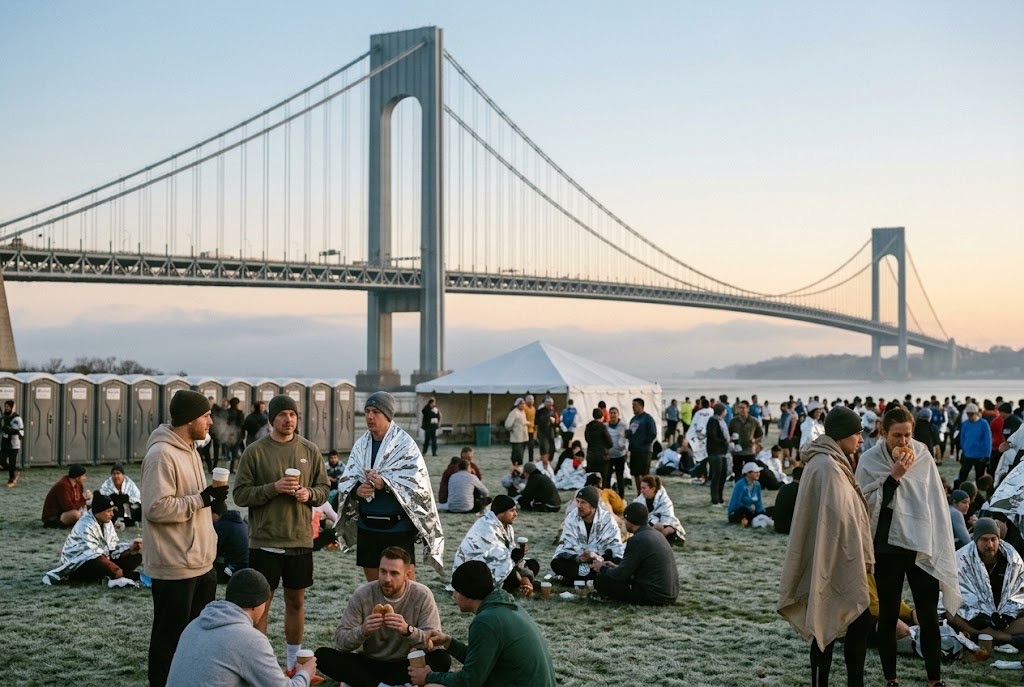
Fort Wadsworth is three villages, blue, orange and green, one for each start colour on your bib. Inside: coffee, tea, hot chocolate, water, Gatorade and bagels, more than 1,700 toilets, medical tents, and a lot of grass to sit on. There’s a quiet zone, interfaith services and even therapy dogs. What there isn’t is anywhere warm.
Dress for two hours outdoors in November, not for a marathon. An old sweatshirt and sweatpants, a hat, gloves, something to sit on and a throwaway top layer. All of it goes into the donation bins when you move to your corral, and NYRR gives it to charity. Many runners add a cheap poncho or a bin bag for wind, and a foil blanket is on the permitted list.
The bag rules are strict. The only bag allowed in the village and on official transport is the clear Start Village bag from your expo pack. No backpacks, no opaque bags, no hydration vests with a bladder in the back (front bottles up to a litre are fine). Everything in the bag is subject to search. There is no bag check at the start: whatever you don’t run with, you throw away before the corral.
If you want something at the finish, you needed to book bag pre-check when you registered (it closed in early September). Pre-check bags are dropped at Central Park West between 69th and 70th Street on the Friday and Saturday before the race, 09:00–17:00, and collected at the same spot after you finish, until 19:00. Everyone else gets a poncho and a recovery bag at the finish and no stored clothes, so think about what you’ll wear home.
Day by day
| Day | Run | Do |
|---|---|---|
| Mon 26 | Rest, or a 20-minute walk | Book your expo slot if you haven’t. Check the forecast for Sunday once, then stop checking |
| Tue 27 | 30 minutes easy | Plan your race: flat pace, bridge miles, halfway and 20-mile targets. Our pacing guide has the tables |
| Wed 28 | Rest | Try on your full race kit, including the start-village layers. Charge your watch |
| Thu 29 | 20 minutes easy + 4 × 20-second strides, with a minute of easy jogging between | Expo opens at 10:00. Collect your bib and check the transport line on it |
| Fri 30 | Rest | Start carb-loading. Drop a pre-check bag if you booked one. Trim your toenails |
| Sat 31 | 20 minutes very easy, in the morning | Stay off your feet; no sightseeing. Lay out two outfits: race kit and village kit. Pin on the bib, set two alarms |
| Sun 1 | Race day | Breakfast about three hours before your wave, which may mean on the ferry |
The strides on Thursday are the only fast running of the week. They keep your legs sharp without costing anything. Everything else is easy or nothing.
Carb-loading, from Friday
Two days is enough, and the aim is more carbohydrate, not more food. Shift each meal towards rice, pasta, bread, potatoes and fruit juice, cut back on fat and fibre, and eat a little more often rather than a lot more at once. A big pasta dinner on Saturday is tradition, not science; a normal-sized one eaten early is better.
Saturday night in New York has a specific trap: dinner reservations at 20:00, a long walk back, bed at 23:00, alarm at 04:00. Eat early, near the hotel, and be in bed by 21:00.
Race morning, by wave
| Wave | Corrals open | Corrals close | Start |
|---|---|---|---|
| 1 | 08:10 | 08:45 | 09:10 |
| 2 | 09:05 | 09:25 | 09:45 |
| 3 | 09:45 | 10:00 | 10:20 |
| 4 | 10:25 | 10:40 | 10:55 |
| 5 | 11:00 | 11:15 | 11:30 |
The professional wheelchair division goes at 08:00, the professional women at 08:35 and the men at 09:05. If you miss your corral close, you start with the next wave; you can’t start earlier.
A rough morning for a wave 2 runner on the Staten Island Ferry: alarm 04:30, breakfast 05:00, subway to Whitehall for a 06:00 ferry, village by 07:15, donation bins and corral by 09:05, start 09:45. Build your own version backwards from your wave, and add 20 minutes to everything.
One more thing: cell service near the finish is unreliable with 50,000 phones in one park. Agree a meeting point with family before the race, outside the runners-only zone on Central Park West, and a time. You’ll walk about 20–30 minutes from the finish line to the park exit at West 77th Street.
Your kit list
To race: bib (pinned the night before), timing tag on the back untouched, trained-in shoes and socks, race kit, gels for the whole race (the course has gels only at miles 12 and 18), anti-chafe balm, a hat or sunglasses for the First Avenue sun.
For the village: the clear Start Village bag, old warm layers to donate, a foil blanket or poncho, something to sit on, a bagel or your own breakfast, water, a portable charger (it goes in the e-waste bin at the start, not the trash), toilet paper.
Leave behind: a backpack, anything opaque, a hydration vest with a bladder, anything you want to see again that doesn’t fit in a pre-check bag.
How iRunning helps this week
- Taper runs, with brakes. Set a pace band for the easy runs with the top end at your easy pace, and the app will tell you to slow down when race-week nerves turn 30 easy minutes into a tempo.
- Build your race. A custom workout with distance steps and a heart-rate or pace band for each: wider on the Verrazzano, the Queensboro and Fifth Avenue, narrow on the avenues. The pacing guide has the segments.
- Watch, charged. Charge the watch on Saturday, not Sunday morning. On race morning, start the workout on the watch in the corral so the GPS has a fix before the cannon.
- Announce the splits. By distance every mile, with Avg pace, Distance and Total time, so you never have to look down on a crowded bridge.
Good luck. See you in the park.
Expo, transport and start details are from the 2025 TCS New York City Marathon runner’s guide and NYRR’s 2026 announcements as of 14 October 2026. Check the 2026 runner’s guide and your bib for your own times.