The half marathon is the most popular race goal for a reason. At 21.1 km it’s long enough to feel like a real achievement, but short enough that you can train for it on four runs a week without your whole life turning into running.
Twelve weeks is the classic runway. It gives you time to build up the long run safely, to learn what race effort feels like, and to arrive at the start line rested rather than wrecked. It’s also about the gap between now and the late-autumn and early-winter races, so if you’re reading this in September, you’re right on time.

This article walks through a 12-week plan in kilometres, using the Half Marathon plan in iRunning as the example. You can follow the structure on paper and with any watch. The app just saves you from doing the maths and remembering what today’s session is.
Are you ready for 12 weeks?
This plan is for finishing a half marathon, not for chasing a time. It fits you if:
- You can run 8 km nonstop today. It doesn’t matter how slowly.
- Three runs a week already feel routine. The plan asks for four.
- You have one 90–120 minute window each weekend. The long run gets up to about two hours.
Your longest run in the last three weeks is the best guide:
| Longest recent run | Where to start |
|---|---|
| Under 6 km | Build up first. A 10K plan gets you there, and the half comes easier afterwards |
| 8 km or more | Week 1 |
| 14 km or more | You can skip ahead and start at week 4 |
The shape of the plan
Twelve weeks, counted back from race day, in four phases:
| Weeks | Phase | What happens |
|---|---|---|
| 1–4 | Base | Get used to four runs a week. Strides, one hill session, one fartlek. Week 4 is a lighter cutback |
| 5–8 | Build | Tempo running starts and the long run passes 15 km. Week 8 is another cutback |
| 9–11 | Peak | Blocks at half-marathon pace, and the longest run of the plan: 18 km |
| 12 | Taper | Volume drops by about half, a little pace stays in, then race day |
A typical week takes about four hours: two easy runs of 30–45 minutes, one quality session of 40–60 minutes, and the long run.
About 65% of the running is easy, 20% is tempo and 15% is intervals and hills. That easy two-thirds isn’t filler. It’s where most of the aerobic fitness comes from, and it’s what lets you run the hard sessions properly. If every run drifts into “moderately hard”, you end up too tired for the tempo and not rested enough to absorb it.
The long run: from 11 to 18 km
The long run is the backbone of any half marathon plan. Here it grows in steps, with a lighter week every fourth week so your body can catch up:

| Week | Long run | Approx. distance |
|---|---|---|
| 1 | 68 min, all easy | 11 km (6.7 mi) |
| 2 | 83 min, last 8 min a touch quicker | 13 km (8.2 mi) |
| 3 | 85 min | 13.5 km (8.4 mi) |
| 4 · cutback | 55 min | 9 km (5.4 mi) |
| 5 | 98 min, with a fuelling rehearsal | 16 km (9.8 mi) |
| 6 | 88 min | 14 km (8.7 mi) |
| 7 | 105 min, fuel every 25 minutes | 17 km (10.6 mi) |
| 8 · cutback | 70 min | 11 km (7 mi) |
| 9 | 105 min, last 20 min at race pace | 17 km (10.6 mi) |
| 10 | 108 min, a kit and breakfast rehearsal | 17 km (10.7 mi) |
| 11 | 112 min | 18 km (11.2 mi) |
| 12 | Race day | 21.1 km (13.1 mi) |
Distances are estimates at an easy pace. The long run is set by time, not distance, so a slower runner covers less ground in the same minutes. That’s fine. Time on your feet is what builds endurance.
Two things people often ask:
- “So I never run 21 km before race day?” Right. Eighteen kilometres in week 11 is enough. The last three kilometres come from the taper, the crowd and the fact that you’re rested.
- “Why does week 6 go down?” It’s a consolidation week: shorter than week 5, but still long. Going up every single week is how people get hurt.
Quality sessions, week by week
One run a week has a job beyond easy mileage. Every quality session starts with an easy warm-up jog and ends with an easy cool-down.
| Week | Quality session |
|---|---|
| 1 | Easy run + 6 strides |
| 2 | Hills: 8 × 45 s uphill, walk back down |
| 3 | Fartlek: 10 × 1 min quick, 1 min easy jog |
| 4 · cutback | Easy run + 8 strides |
| 5 | Tempo: 2 × 10 min, 3 min jog between |
| 6 | Tempo: 3 × 8 min, 2 min jog between |
| 7 | Tempo: 25 min continuous |
| 8 · cutback | Light hills: 6 × 45 s |
| 9 | Half-marathon pace: 2 × 15 min |
| 10 | Half-marathon pace: 25 min continuous |
| 11 | Sharpener: 3 × 10 min at half-marathon pace |
| 12 · race week | Race-pace touch: 2 × 5 min |
Strides are 20-second relaxed accelerations with a minute of easy jogging between them. Tempo is “comfortably hard”: you could say a few words, but you wouldn’t want a conversation.
The tempo work follows a simple pattern: first split it up, then join it together. Twenty minutes in two pieces in week 5 becomes 25 unbroken minutes in week 7. By the peak phase, the tempo turns into half-marathon pace itself, so by race day you’ve already spent over an hour at race effort.
How hard is “half-marathon pace”?
This plan doesn’t give you a fixed pace in minutes per kilometre, because it’s a finishing plan and everyone’s finish time is different. Instead, every run is written in heart-rate zones:
- Easy and long runs: zone 2. Conversational. If you can’t chat, you’re going too fast.
- Tempo and half-marathon pace: zone 4. Hard, but controlled enough to hold for 15–25 minutes.
- The race itself: zone 3. Steady and sustainable. Start one gear slower than your excitement wants.
A zone is a range based on your own maximum heart rate, so the same session adjusts to you. You can read more in our heart rate zones guide.
How the plan works in iRunning
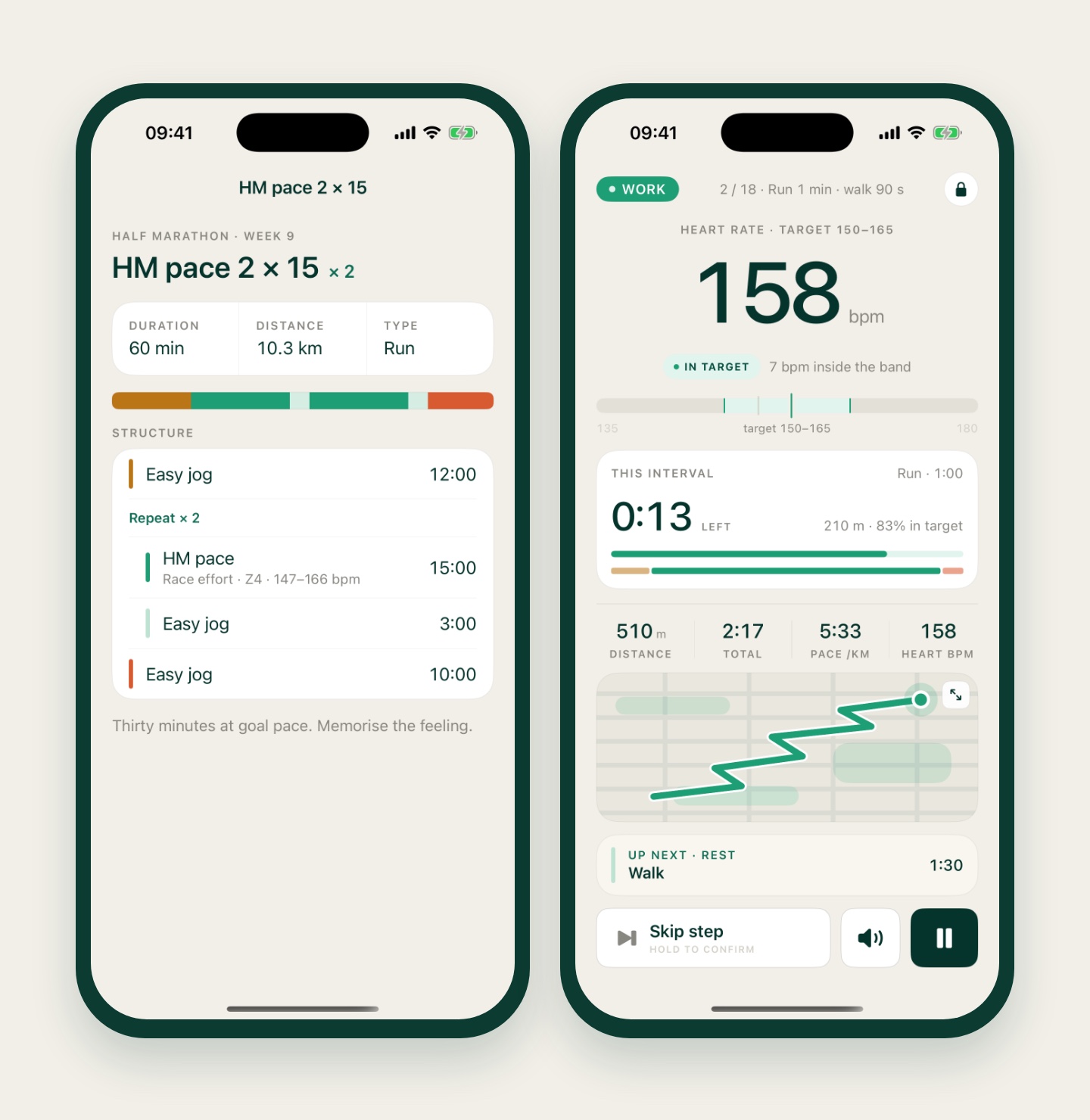
- Every run has a heart-rate target. Easy runs, long runs, tempos and race-pace blocks each carry a zone, and the zone turns into a bpm range from your own zone settings. With an Apple Watch or a Bluetooth chest strap, you hear “Heart rate too high” when an easy run quietly turns into a tempo.
- The session is read to you. Voice cues tell you when each block starts and ends, so you don’t need to look at your wrist mid-tempo.
- Setup checks where you are. Tell it your longest recent run and it starts you at week 1 or week 4, or suggests the First 10K plan instead.
- Missed a run? That’s normal. Move a session to another day, pause the plan for a week of illness, or restart a week you missed. Twelve weeks is long, and life will happen at least once.
- After the race, the app suggests what’s next: Post-Race Recovery, or Half: Improve Your Time if you want to go faster next time.
Race week and race day
In week 12 you run about half your usual volume, but you keep a little pace: two 5-minute blocks at race effort midweek, then a short easy run with four strides the day before.
On race day:
- Change nothing. Use the fuel you practised on the week 5 and 7 long runs, and the kit and breakfast you rehearsed in week 10.
- Start slower than feels right. The first 5 km should feel almost too easy. Adrenaline lies.
- Aim for a negative split. Run the second half a little faster than the first. If you’re still feeling good at 15 km, that’s the time to pick it up.
Twelve weeks from now, you’ll be a half marathoner.
Get the plan
Half Marathon is part of iRunning Premium, alongside 40 other training plans. You’ll find it in the Race distances group, next to First 10K, Run-Walk Half Marathon and Half: Improve Your Time. If you already have a goal time, Sub-2h Half Marathon is in the Chase a time group. In the app, tap Choose a plan on Home (or Show other plans if you’re already on one).
Not ready to subscribe? The free version still gives you heart-rate zones and alerts, voice cues, the Apple Watch app and two custom workouts, so you can build a tempo or long run from the tables above yourself.
Training advice, not medical advice. Check with a doctor before starting if you have a health condition or have been inactive for a while.