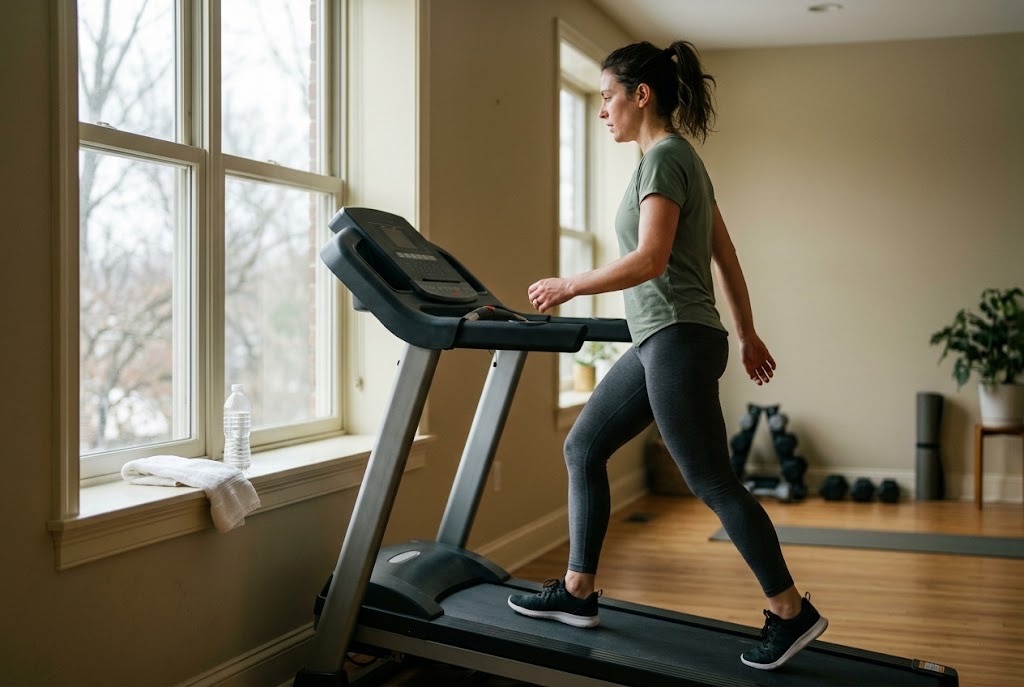
Set the treadmill to a 12% incline. Set the speed to 3 miles an hour, which is 4.8 km/h. Walk for 30 minutes. That’s the whole workout, and it has been one of the most searched fitness routines in the world for five years running.
The numbers aren’t magic. Lauren Giraldo, who posted the routine in 2019, has said that 12 was simply the steepest her gym’s treadmill went, 3 mph felt like a brisk walk, and 30 minutes was her grandmother’s rule for daily exercise. What makes it work is more interesting than the numbers, and so is the part most people skip: how to get to 12% without wrecking your calves in week one.
What the research says
For years 12-3-30 was a social-media phenomenon with no data behind it. In 2025 that changed: a study funded by the American Council on Exercise and published in the International Journal of Exercise Science put 17 healthy adults, average age 28, moderately fit but not regular exercisers, on a treadmill at exactly 12% and 3 mph for 30 minutes, and measured what happened.
| What they measured | Result |
|---|---|
| Heart rate | 124 bpm on average, about 47% of heart-rate reserve |
| Oxygen uptake | 44% of VO₂ reserve, roughly 5.5 METs |
| Intensity | Moderate, on the border of vigorous by the end |
| Calories | About 220 kcal in 30 minutes, on average |
| How it felt | Participants rated it positively and said it gave them energy |
In plain words: 12-3-30 is a proper moderate-intensity cardio workout. It sits in the range that public-health guidelines count as exercise, it burns about as much as an easy 30-minute jog for most people, and it’s at roughly the effort of zone 2, where the body gets good at burning fat and building aerobic base. A second comparison in the same study found that at matched calorie burn, the incline walk used a higher share of fat for fuel than self-paced treadmill running. That’s where the “burns more fat than running” headlines come from. It doesn’t mean it burns more calories; it doesn’t.
What it does better than flat walking is load the muscles. Walking up a 12% slope asks the glutes, hamstrings and calves to work far harder than walking on the flat at the same speed, which is why it feels like a workout and a flat walk doesn’t. It’s also low impact: no flight phase, no landing forces, which is why so many people who can’t run, or don’t want to, stick with it.
The authors’ one caution: for less-fit or older people, 12% and 3 mph straight away is too much, and they recommend building up to it. Which brings us to the part nobody posts about.
Who shouldn’t start at 12%
A 12% slope changes how your foot lands. Every step is on the ball of the foot with the heel dropping, which stretches the calf and the Achilles tendon under load, thirty minutes at a time, a few times a week. For a tendon that isn’t used to it, that’s a lot.
- If you have Achilles pain or plantar fasciitis right now, skip steep inclines until it’s settled. The plan in the app says the same thing on its first screen.
- If you’ve never walked on an incline, start at 4–6% and 20 minutes. Your calves will tell you the next morning why.
- If your lower back aches, you’re probably leaning from the waist to cope with the slope. Lean from the ankles, stand tall, and drop the incline until you can.
- Hands off the rails. Holding on takes away a third of the work, flattens your posture and is the single most common 12-3-30 mistake. The rails are for balance; if you need them to keep up, the speed or the slope is too high today.
A six-week way in
The plan below, which is the 12-3-30 Incline Walk plan in iRunning, reaches the full 12-3-30 in week 6 by changing one dial per week: duration first, then incline, then speed. Never two at once.

| Week | Three sessions of | Incline | Speed | What changed |
|---|---|---|---|---|
| 1 | 20 min | 4% | 4.5 km/h (2.8 mph) | Starting point: a gentle hill |
| 2 | 25 min | 6% | 4.5 km/h | Five minutes and 2% |
| 3 | 30 min | 8% | 4.5 km/h | The full half hour. Duration is set from here |
| 4 · cutback | 25 min | 8% | 4.5 km/h | Five minutes shorter, nothing steeper |
| 5 | 30 min | 10% | 4.6 km/h (2.9 mph) | Two more percent |
| 6 | 30 min | 12% | 4.8 km/h (3 mph) | The real 12-3-30 |
Each session has a 3-minute flat walk before and after, so a week-3 session is 36 minutes door to door. Three sessions a week on non-consecutive days: Monday, Wednesday, Friday is the obvious pattern.
A few notes on the weeks:
- Weeks 1–2 are about posture. Short steps, tall torso, eyes on the far wall, hands free. If you can hold that at 6% you’ll hold it at 12%.
- Week 3 is the first milestone: 30 minutes on an incline. After this, only the slope changes, which is the point. Your body only has to adapt to one thing at a time.
- Week 4 is a cutback, and it’s not optional. Tendons adapt more slowly than muscles and heart. The lighter week is when the first three sink in.
- Week 5 at 10% is where the effort moves from calves to glutes. Most people find 10% harder than 12% for a session or two, because they haven’t learned to use their hips yet.
- Week 6 is three full 12-3-30s. It doesn’t get easier. You get better at it.
If your treadmill only goes to 6% or 10%, cap the incline at its maximum and hold the 30 minutes. It’s still a proper workout, and the plan asks about this in setup.
How it compares with the alternatives
| 12-3-30 | Flat brisk walk, 30 min | Easy jog, 30 min | Japanese walking, 30 min | |
|---|---|---|---|---|
| Effort | Moderate, rising to vigorous | Light to moderate | Moderate | Alternates moderate and light |
| Impact | Low | Low | Moderate | Low |
| Calories (70 kg adult, approx.) | 200–250 | 120–150 | 250–300 | 150–200 |
| Muscles | Glutes, hamstrings, calves | Not much | Legs generally | Not much |
| Needs | A treadmill with 12% | Nothing | Nothing | Nothing |
The honest summary: 12-3-30 is a good way to get a moderate-intensity session that’s low impact and leg-strengthening, and it’s much more interesting than walking on a flat belt. It’s not better than running for fitness, and it’s not a fat-loss trick. If you don’t have a treadmill, Japanese walking is the closest outdoor equivalent, and real hills do what the incline button does.
Doing it with iRunning
The app can’t set the incline for you; no app can. What it does is run the clock, hold the plan and watch the effort:
- The dials are on screen. Each session shows its incline and speed as the target, with a 3-minute flat warm-up and cool-down either side. Set the treadmill, tap start, and walk.
- Indoor mode. Treadmill sessions run without GPS, so the app doesn’t hunt for a signal in the gym. Here’s how the Indoor mode works, and why distance on a treadmill is an estimate.
- Heart rate keeps you honest. The early sessions carry a zone 2 target and the later ones zone 3, which is roughly where the study’s participants were at 12%. With an Apple Watch or a chest strap, you’ll hear it if you’ve slipped into a stroll, or if 12% has pushed you past what the week asks for.
- After week 6, the plan hands you on to either the Winter Treadmill Plan, if you want to run, or Brisk Walking for Weight Loss, if you’d rather keep walking.
12-3-30 Incline Walk is part of iRunning Premium, in the Treadmill group. Tap Choose a plan on Home, then Browse all plans. The free version still runs the clock and the warm-up and cool-down, and lets you build a 30-minute incline walk as one of two custom workouts.
Training advice, not medical advice. Check with a doctor before starting if you have a heart condition, and with a physio if you have Achilles or plantar-fascia pain.