
“Japanese walking” turned into one of the big fitness trends of 2026. Unlike most viral workouts, this one has about twenty years of research behind it, and it’s almost suspiciously simple:
Walk fast for 3 minutes. Walk easy for 3 minutes. Repeat five times.
That’s 30 minutes, no equipment, no running, and no gym. Here’s what the method is, why it works better than an ordinary walk, and how to build it into a routine that sticks.

Where it comes from
The method’s proper name is interval walking training (IWT). It was developed by Hiroshi Nose, Shizue Masuki and colleagues at Shinshu University in Matsumoto, Japan, who were looking for a way to get real fitness gains in middle-aged and older adults without asking them to run.
In their best-known study, published in Mayo Clinic Proceedings in 2007, participants did alternating 3-minute blocks of fast and slow walking for about five months. Compared with people who walked continuously at a moderate pace, the interval group improved more in:
- aerobic fitness (peak oxygen uptake up by roughly 14%)
- thigh strength (up by around 13–17%)
- blood pressure (systolic down by about 9 mmHg)
The continuous walkers saw much smaller changes. The difference was the fast blocks.
What “fast” and “easy” actually mean
This is where most people get it wrong. “Fast” doesn’t mean a power-walking race, and “easy” doesn’t mean stopping.
- Fast walk: you can still talk, but you couldn’t sing. Your breathing is clearly up. In the research this was around 70% of each person’s peak aerobic capacity, which for most people feels like “somewhat hard”.
- Easy walk: relaxed enough to speak in full sentences. Your breathing settles, but you keep moving.
Speed doesn’t come from shuffling your feet faster. Swing your arms, and lengthen your stride slightly. Stand tall, keep your shoulders relaxed.

How much is enough?
The research counted fast minutes rather than total minutes. Five rounds give you 15 fast minutes a session, and three sessions a week give you 45.
Two findings matter for planning:
- The benefit levels off at around 50 fast minutes a week. Doing more doesn’t add much, so there’s no reason to walk intervals every single day.
- Consistency beats heroics. The gains came from months of doing it several times a week, not from any single hard session.
The original studies asked for interval walks on four or more days a week. For a habit that survives real life, a sensible target is about 45 fast minutes a week, spread over three interval walks, plus one longer easy walk.
An 8-week plan to make it a habit
Starting at five rounds, three times a week, is a lot for someone who mostly strolls. So the Japanese Walking plan in iRunning builds up to it:
| Weeks | What changes | Fast minutes a week |
|---|---|---|
| 1 | 3 rounds per interval walk | 27 |
| 2 | 4 rounds | 36 |
| 3 | The full 5 rounds, as in the original studies | 45 |
| 4 | Cutback: back to 3 rounds, a longer weekend walk | 27 |
| 5–6 | 5 rounds every interval day. This is your normal now | 45 |
| 7 | One 6-round day | 48 |
| 8 | 5 rounds, and a 60-minute easy walk to finish | 45 |
Every interval walk starts and ends with 5 minutes of easy walking, so sessions run from 28 minutes (3 rounds) to 46 minutes (6 rounds). The fourth session each week is a long easy walk that grows from 30 minutes in week 1 to a full hour in week 8.
Already walk briskly for 45 minutes or more? Answer that in the plan’s short quiz and you start at week 2.
What it’s like in the app
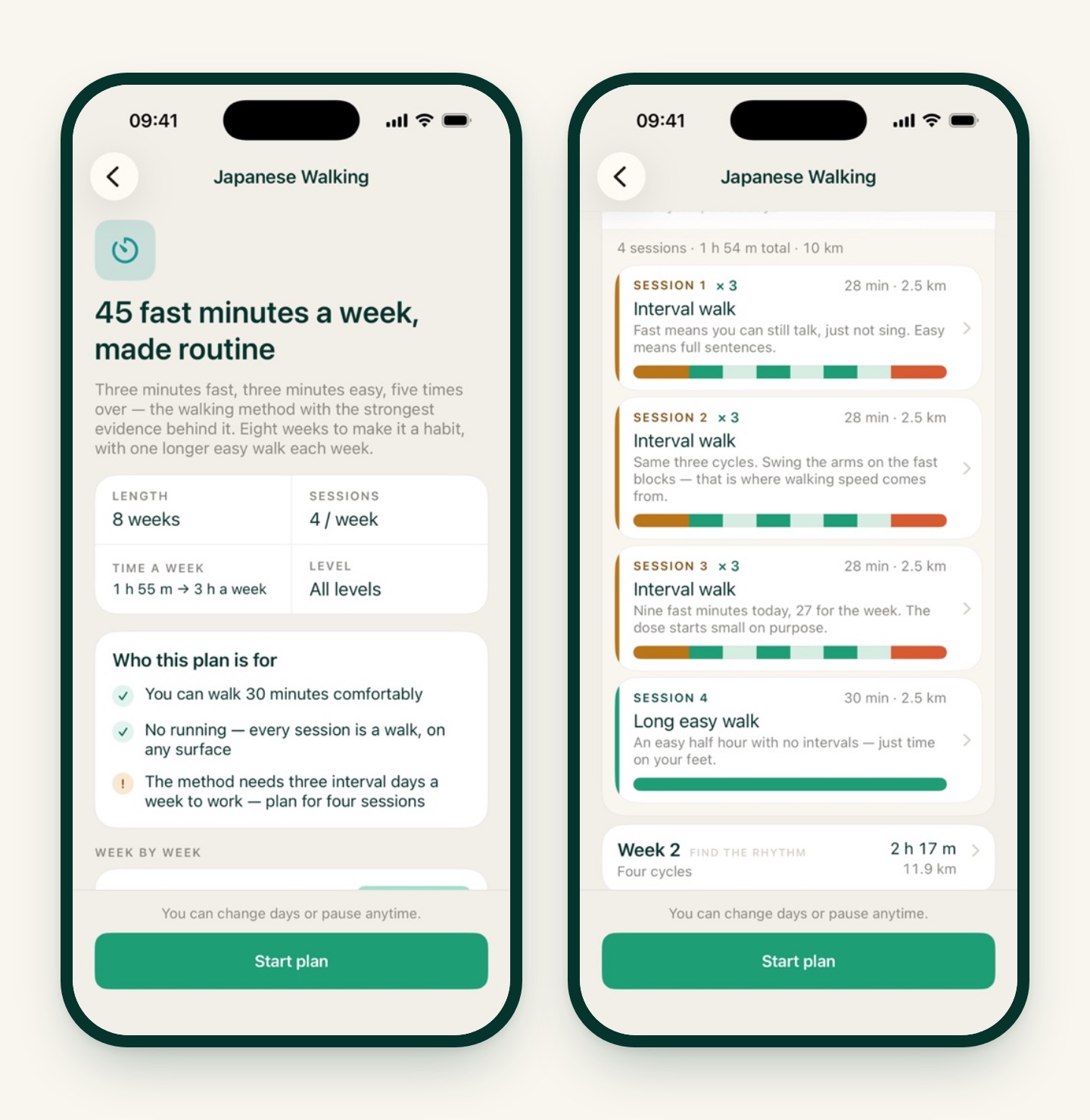
- You don’t need a timer. A voice tells you when to switch: “Next: Fast walk, 3 minutes”, then “Next: Easy walk, 3 minutes”. Countdown beeps warn you three seconds before each change. Keep your phone in your pocket and your music playing.
- “Fast” is measured, not guessed. With an Apple Watch or a heart-rate strap, each fast block carries a zone 3 heart-rate alert. If you drift below it, you hear that your heart rate is too low, which usually means your walk slowed into a stroll.
- It works anywhere. Treadmill included, since every session is a walk.
- Life happens. Move a walk to another day, or pause the plan for a holiday. Resume where you stopped; nothing is lost.
Common questions
Is it only for older adults? No. The original studies focused on middle-aged and older people, but the principle of alternating hard and easy efforts works at any age. The plan is marked “All levels”: a fit 30-year-old just walks the fast blocks faster.
Can I do it every day? You can walk every day, but the interval dose tops out around 50 fast minutes a week. Three interval days plus easy walks is plenty.
Will it help me lose weight? Interval walking raises fitness and burns more energy than strolling, but weight loss depends mostly on total activity and diet. If that’s your main goal, the Brisk Walking for Weight Loss plan uses the same 3-minute intervals alongside longer walks.
What comes after the eight weeks? Keep the rhythm: three interval walks a week is a routine you can hold for years. If you’re curious about running, the free From Walk to Run plan is the natural next step.
Get the plan
Japanese Walking is part of iRunning Premium. In the app, tap Choose a plan on Home and look under Walking. You’ll need to be able to walk 30 minutes comfortably. If you can’t yet, start with Start Walking, a four-week plan that builds to exactly that.
Training advice, not medical advice. Check with a doctor before starting if you have a health condition or have been inactive for a while.