
Almost every marathoner has the same story. The first half felt wonderful. Around 30 km, the pace started slipping. The last 5 km were a shuffle, and the finish time was minutes slower than the fitness deserved.
The fix is almost boring: run the second half a little faster than the first. That’s a negative split. It sounds backwards when you’re fresh and the crowd is loud, but many of the fastest marathons ever run were paced this way, and it’s the safest way for the rest of us to run a good time.
With Berlin on 27 September, here’s how it works and how to plan it.
Why a slow start is faster
In a marathon, the mistakes you make early cost you much more later on. Three reasons:
- Fuel. Your body stores only a limited amount of carbohydrate. Every kilometre that’s a little too fast burns it quicker, and when it runs low, usually after 30 km, your pace drops whether you like it or not.
- Heart-rate drift. Over a few hours your heart rate creeps up even at a steady pace, because of heat, fluid loss and fatigue. If you start at the top of your comfortable range, you’ll be over it by halfway.
- Maths. Banking 10 seconds per kilometre for 20 km saves 3 minutes and 20 seconds. Slowing by 60 seconds per kilometre for the last 10 km costs 10 minutes. The trade almost never pays off.

How big should the difference be?
Small. You’re not planning a slow jog followed by a sprint. For most runners, the second half should be about 1–2 minutes faster than the first. That’s only 3–5 seconds per kilometre.
In practice, a good negative split feels like this:
- Km 0–5: hold back. The start is crowded and you’re full of adrenaline. Your goal pace will feel far too easy. Stay 5–10 seconds per kilometre slower than it, and don’t weave through the crowd.
- Km 5–21: settle. Run your first-half pace. It should feel relaxed enough that you could say a full sentence.
- Km 21–30: stay patient. Move to your second-half pace, which is only a touch quicker. The urge to push is strong here. Hold it back.
- Km 30–42: race. If you still feel good at 30 km, this is where you speed up and start passing people. If you don’t, holding your pace is already a win.
Split tables: 3:00 to 5:00
These tables put 50.4% of your goal time in the first half and 49.6% in the second. Times are cumulative, at each 5 km mat.
| Goal | 1st half pace | 2nd half pace | 5 km | 10 km | 15 km | 20 km | Half |
|---|---|---|---|---|---|---|---|
| 3:00 | 4:18 /km | 4:14 /km | 21:30 | 43:00 | 1:04:30 | 1:26:00 | 1:30:43 |
| 3:30 | 5:01 /km | 4:56 /km | 25:05 | 50:10 | 1:15:15 | 1:40:20 | 1:45:50 |
| 4:00 | 5:44 /km | 5:39 /km | 28:40 | 57:20 | 1:26:00 | 1:54:40 | 2:00:58 |
| 4:30 | 6:27 /km | 6:21 /km | 32:15 | 1:04:30 | 1:36:45 | 2:09:00 | 2:16:05 |
| 5:00 | 7:10 /km | 7:03 /km | 35:50 | 1:11:40 | 1:47:30 | 2:23:20 | 2:31:12 |
And the second half:
| Goal | 25 km | 30 km | 35 km | 40 km | Finish |
|---|---|---|---|---|---|
| 3:00 | 1:47:14 | 2:08:24 | 2:29:33 | 2:50:43 | 3:00:00 |
| 3:30 | 2:05:06 | 2:29:48 | 2:54:29 | 3:19:10 | 3:30:00 |
| 4:00 | 2:22:59 | 2:51:11 | 3:19:24 | 3:47:37 | 4:00:00 |
| 4:30 | 2:40:51 | 3:12:35 | 3:44:20 | 4:16:04 | 4:30:00 |
| 5:00 | 2:58:43 | 3:33:59 | 4:09:15 | 4:44:31 | 5:00:00 |
Write your 10 km, halfway and 30 km times on your arm or your bib. Those three checkpoints are enough.
A word on drink stations. Walking a few steps to drink costs 10–20 seconds each time, and that’s fine. Don’t sprint the next kilometre to win it back. Spread it over the next few.
Why Berlin suits a negative split
Berlin is one of the easiest courses to pace well. It’s almost completely flat, so an even effort gives an even pace, and there’s no hill to explain away a slow kilometre.
The course also rewards patience. The crowds are huge in the first 10 km through Mitte, halfway comes soon after the loud stretch through Kreuzberg and Neukölln, and the best support is in the last third: the Wilder Eber, the Kurfürstendamm and Potsdamer Platz. It’s a lot nicer to pass people there than to be passed. Our Berlin course guide goes through the route section by section.
Build your race plan in iRunning
You can turn the table into a workout that talks to you on race day.
- Create a custom workout and add distance steps with a pace alert. A distance step can be up to 50 km. For a 4:00 goal, you could use:
- 5 km at 5:45–5:55 /km, the patient start
- 16 km at 5:40–5:48 /km
- 21 km at 5:35–5:43 /km
- an open step for the final 195 metres
- Keep the bands about 8–10 seconds wide. Narrower than that and GPS wobble will set off alerts all the time.
- Let the voice do the work. When a step starts, you hear something like “Run, 16 kilometres, pace 5:40 to 5:48”. If you drift out of the band, you’ll hear “Pick up the pace” or “Slow down”, at most once every 20 seconds.
- Add a check-in every kilometre. In Settings › Customise › Run screen › What to announce, set By distance to every 1 km and choose Avg pace and Total time.
- Run it from your wrist. Open the workout on your iPhone and tap Add to Apple Watch to send it to Apple’s Workout app with the pace alerts included, or start it in the iRunning Watch app.
Pace alerts, voice cues and the Apple Watch app are all free. If you’re following the Sub-4 Marathon plan, it already has goal-pace bands of 5:36–5:46 /km on its race-pace sessions.
After the race: check your splits
If you recorded the race on a Garmin, COROS or another watch, import the file into iRunning (History › import button › GPX or FIT file, or Apple Health). An imported run without laps gets a split for every kilometre, with pace and heart rate for each one.
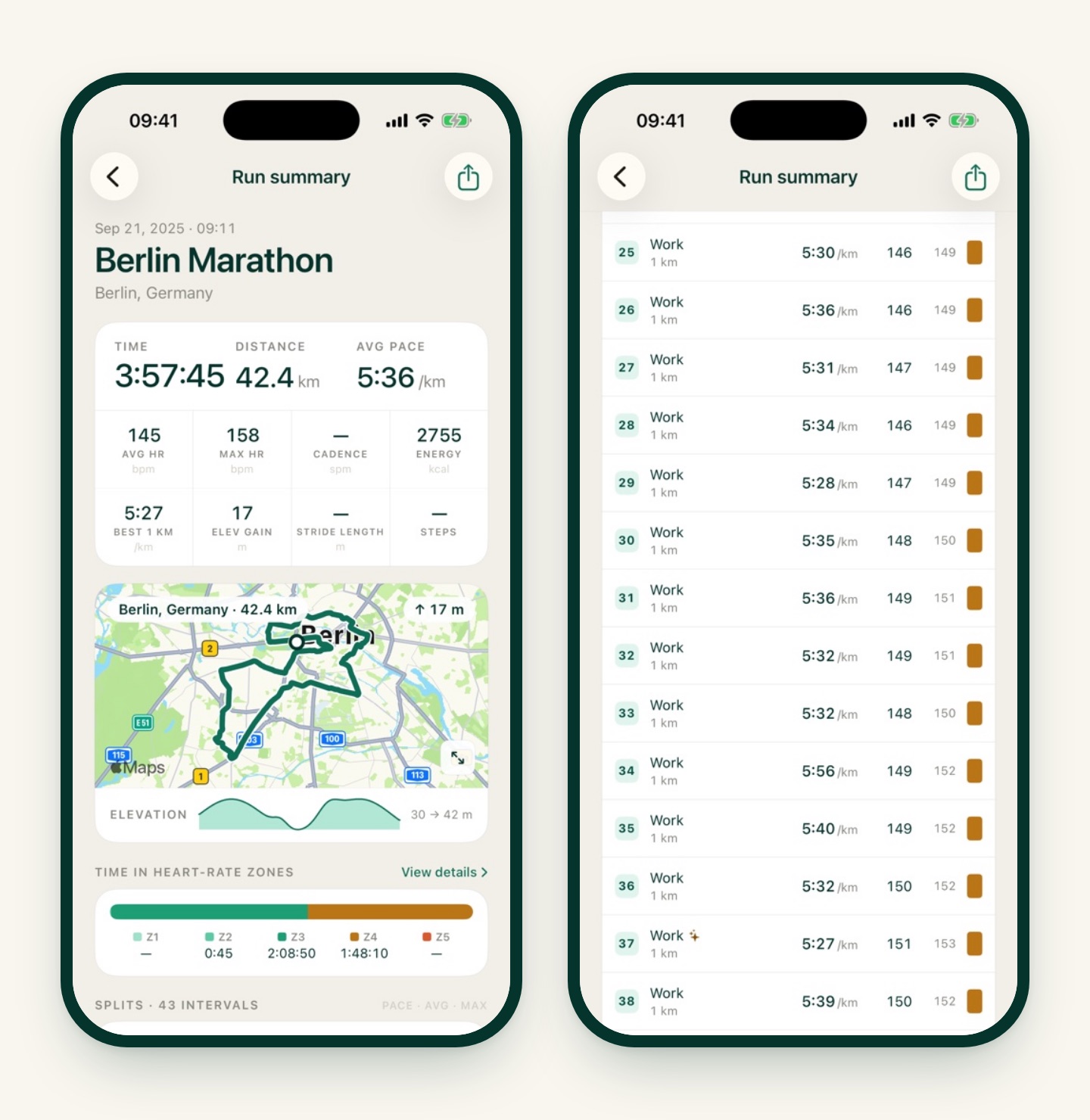
iRunning doesn’t split the race into halves for you, but the per-kilometre list makes it easy to check yourself. Compare your average pace for kilometres 1–21 with 22–42. Also look at the heart-rate column: if your pace held steady while your heart rate climbed slowly, you paced it well.
Training advice, not medical advice. In hot weather, slow down and drink more.