
Thirty minutes is the most popular goal in running. It’s a clean number, it’s within reach for a lot of people, and it’s the first time many runners feel like they’re racing rather than finishing.
It’s also very specific. To run 29:59 for 5K you need an average pace of 6:00 per kilometre (about 9:39 per mile), held for five kilometres in a row. That precision is good news, because a fixed target means a fixed set of workouts. You don’t need a fitness test or an algorithm to set your paces: they all orbit 6:00.

This article walks through how an eight-week sub-30 plan is built, using the Sub-30 5K plan in iRunning as the example. You can follow the structure with any watch, but having the pace targets on your wrist or in your ears makes it much easier.
Are you ready for a sub-30 block?
Eight weeks is enough to go from “close” to “under”. It isn’t enough to go from the couch. This kind of plan fits you if:
- Your current 5K is somewhere between 31 and 36 minutes. Already under 31? You’ll get more from a plan that chases your next number rather than a fixed one. Slower than 36, or not sure? Build some base first. A 10K plan is a good way to get there, and sub-30 comes easier afterwards.
- You can run 30 minutes without stopping, most weeks. The plan asks for four runs a week, and the long run starts at 45 minutes.
- You can find a flat, open loop. Pace targets come from GPS. Tall buildings, tree cover and hills all make them noisier.
The shape of the eight weeks
The plan has four sessions a week, about 2 h 50 m of running on an average week, in four phases:
| Weeks | Phase | What happens |
|---|---|---|
| 1–2 | Base | Meet the pace: 400 m reps and short tempos |
| 3–6 | Build | Longer reps (800 m, then 1 km) and tempos up to 20 minutes. Week 4 is a lighter cutback |
| 7 | Peak | Sharpen, don’t add: back to short reps with less rest |
| 8 | Time trial | Two easy days, then the 5K that proves it |
Every normal week has the same four slots: one rep session, one tempo, one easy run and one long run. The mix works out to roughly 45% easy running, 35% reps and tempo, and 20% long runs.
That 45% is the part people skip. It’s also the part that makes the other 55% work. Most recreational runners who stall do so because every run drifts to “moderately hard”. You end up too tired to run the reps properly and not rested enough to absorb them.
Every workout sits a few seconds either side of 6:00
Here’s the core idea: each type of workout has its own pace band, and all of them cluster around goal pace.

- Reps run slightly faster than goal pace. 400 m reps sit at 5:35–5:50 per km, 800s at 5:40–5:55, and kilometre reps at 5:45–5:58. You rehearse 6:00 with a little speed in hand, so race pace feels controlled rather than desperate.
- Tempos run slightly slower than goal pace, at 6:05–6:20. They teach you to hold “comfortably hard” for a long time. The tempo grows from 10 minutes in week 1 to 20 unbroken minutes in week 6.
- Easy and long runs have no pace band at all. They’re capped by heart rate, in zone 2, instead. Easy pace changes with heat, sleep and hills. Easy effort doesn’t.
- The volume of fast running stays small. Reps stay under about 8% of the week, a common cap in Jack Daniels’ training model, so you finish sessions wanting a little more.
Week by week
| Week | Reps | Tempo | Easy | Long |
|---|---|---|---|---|
| 1 | 6 × 400 m, 90 s jog | 10 min | 30 min | 45 min |
| 2 | 8 × 400 m, 90 s jog | 12 min | 30 min | 50 min |
| 3 | 5 × 800 m, 2 min jog | 15 min | 35 min | 55 min |
| 4 · cutback | 6 × 1 min fartlek | easy run + 6 strides | 25 min | 40 min |
| 5 | 4 × 1 km, 2 min jog | 2 × 10 min, 3 min jog | 35 min | 60 min |
| 6 | 5 × 1 km, 1:45 jog | 20 min | 28 min + 6 strides | 45 min + 10 min at goal pace |
| 7 | 6 × 400 m, 75 s jog | 15 min | 30 min | 50 min |
| 8 | 4 × 400 m sharpener | easy 25 min | 15 min + 4 strides | 5K time trial |
Rep and tempo days start with an easy jog (usually 12 minutes) and finish with an easy cool-down (usually 10). Strides are 20-second relaxed accelerations with a minute of easy jogging between them.
Three sessions are worth circling:
- Week 2: 8 × 400 m. Eight reps add up to your first 3.2 km of goal-pace work. The last rep should look like the first.
- Week 6: 5 × 1 km. Five kilometres at just under goal pace, with short breaks. It’s the hardest session of the plan, and it’s the race with rest stops.
- Week 6, long run. 45 easy minutes, then 10 minutes at goal pace on tired legs. That’s the last 2K of the race, rehearsed.
How the plan feels in iRunning
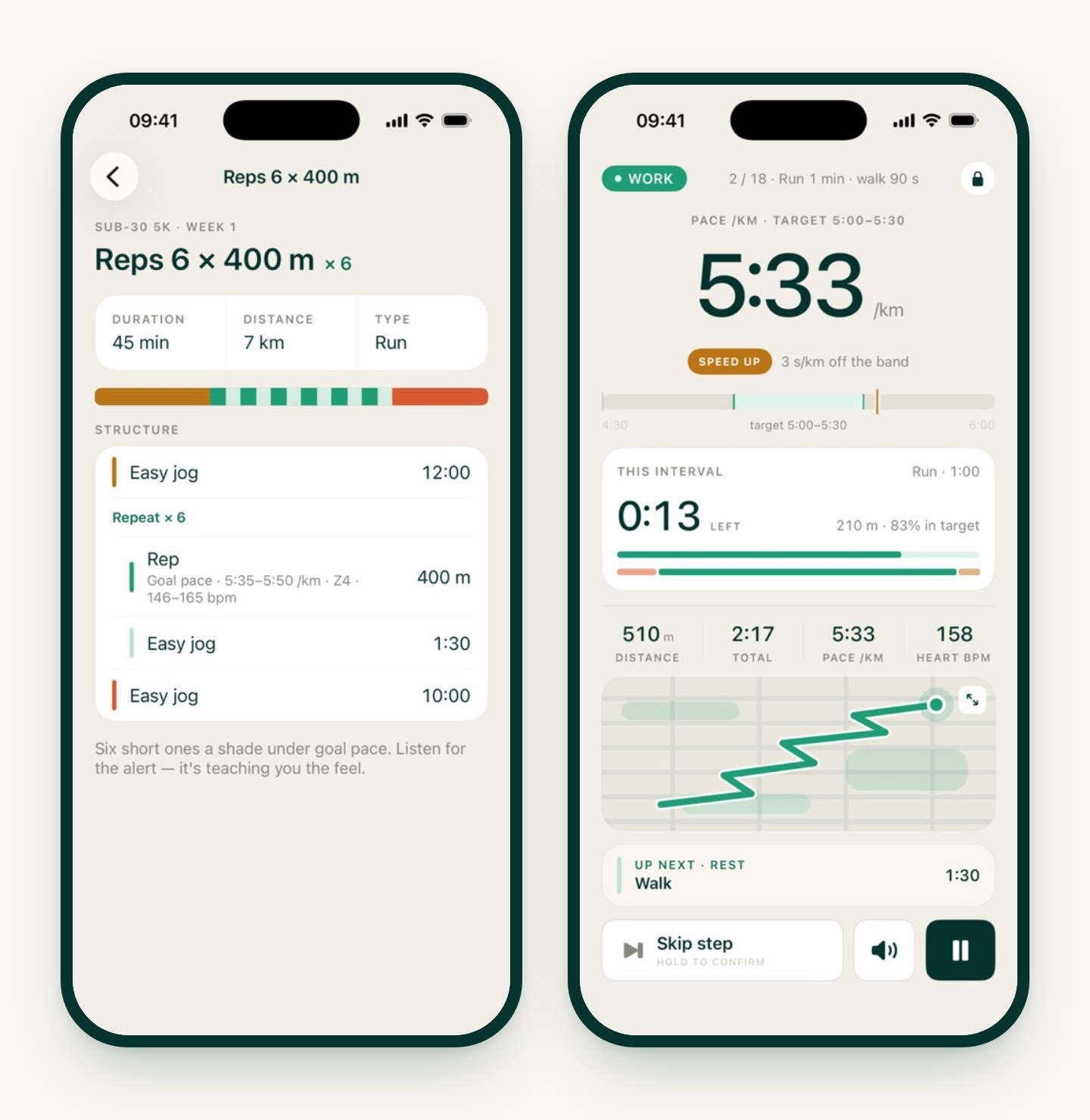
- The pace is in your ear. At the start of each rep you hear its name, distance and band, for example “Rep, 400 meters, pace 5:35 to 5:50”. Drift out of the band and you hear “Pick up the pace” or “Slow down”. You never need to look at your wrist mid-rep.
- Easy days guard themselves. Easy and long runs carry a zone 2 heart-rate alert. With an Apple Watch or a chest strap, the app tells you when “easy” quietly turned into “tempo”.
- Miles work too. Switch units to miles and every band is shown per mile instead: 400 m reps become 8:59–9:23 per mile.
- Life gets in the way. That’s fine. Move any session to another day, pause the plan for a week of illness, or redo a week you missed. A missed run is not a reset.
Race day: the week 8 time trial
The last session is a 5K time trial: a 10-minute easy jog, 5 km with a goal-pace band of 5:50–6:00, then a 5-minute cool-down.
The plan’s advice is simple: stay inside the band for the first 3K, then spend what’s left. Most failed sub-30 attempts go out at 5:30, feel great for two kilometres, and pay for it at kilometre four. Holding back for 3K feels too easy. It’s supposed to.
29:59 is the door. Walk through it.
Get the plan
Sub-30 5K is part of iRunning Premium, alongside 40 other training plans. It sits in its own “Chase a time” group with Sub-60 10K, Sub-2h Half Marathon and Sub-4 Marathon. In the app, tap Choose a plan on Home (or Show other plans if you’re already on one) and scroll to Chase a time.
Training advice, not medical advice. Check with a doctor before starting if you have a health condition or have been inactive for a while.