
Nobody dreams of a 40-minute treadmill run. Same view, same belt, a clock that seems to slow down after minute twelve. But the treadmill has two things the road doesn’t: perfect control of pace and incline, and zero excuses about weather. Used well, it’s the best interval tool you own.
The trick is structure. A belt run with no plan is a hamster wheel. A belt run with eight one-minute surges is a workout that’s over before you notice.

First, switch to Indoor
Before you start a treadmill session in iRunning, tap Indoor on the workout screen, right above the Start button. The app remembers the choice for next time.
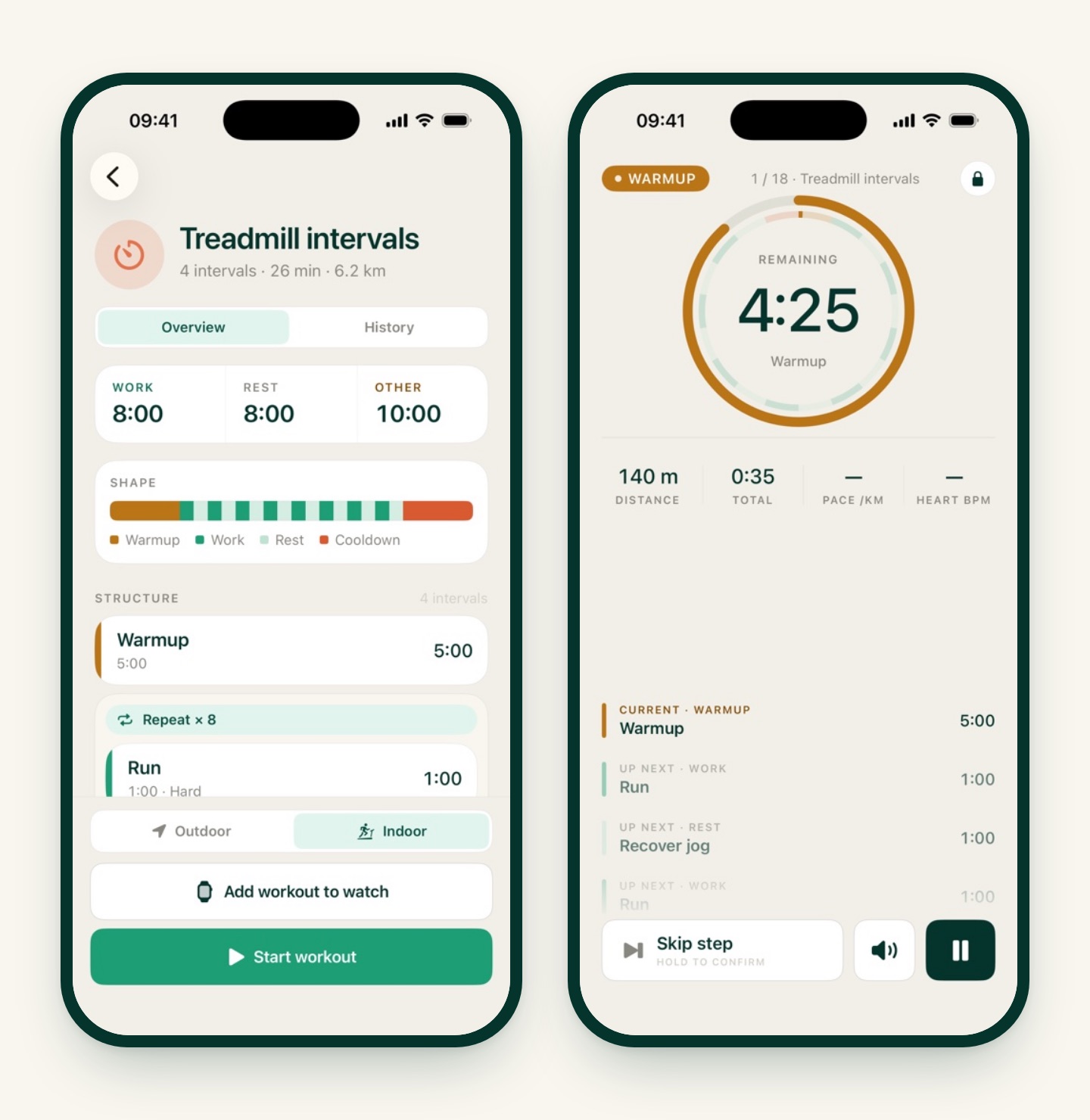
Here’s what Indoor changes:
- No GPS. The phone doesn’t search for satellites, which saves battery and avoids the “0.00 km” confusion of an outdoor run in a basement gym.
- Time-based intervals work exactly as outdoors. Voice cues, countdown beeps and haptics call every change. Put the phone in the cup holder and run by ear.
- Distance intervals count by time. With no GPS, a “400 m” step ends after a fixed estimate at a brisk pace, not after 400 m on the belt. So on a treadmill, build your intervals in minutes, not metres, and trust the belt’s display for distance. The treadmill presets below are all time-based for this reason.
- Heart rate and cadence still work. Apple Watch or a chest strap for heart rate; the phone’s motion sensors for cadence if it’s in a pocket or armband.
- The run is saved to Apple Health as an indoor run, so your Fitness app doesn’t show a phantom route.
Eight belt workouts, ready to go
Search Treadmill on the Workouts tab and you’ll find eight presets built for the belt. Every interval one has a 5-minute warm-up and cool-down, and “Incline” targets are reminders for you: iRunning can’t drive the treadmill, so you set the dial.
| Workout | Length | Structure | Use it for |
|---|---|---|---|
| Treadmill easy | 30 min | One open block | Easy day, podcast on |
| Treadmill intervals | 25 min | 8 × 1:00 hard / 1:00 easy | The classic. Hard enough to count, short enough to repeat |
| Treadmill hills | 30 min | 6 × 1:30 on an incline / 1:30 flat | Leg strength without a real hill |
| Treadmill tempo | 30 min | 20 min steady, “comfortably hard” | One pace, held. The belt keeps you honest |
| Treadmill progression | 30 min | 10 min easy → 10 steady → 10 hard | Finishing strong |
| Treadmill pyramid | 25 min | 1 · 2 · 3 · 2 · 1 min hard, 1 min easy between | Variety, and the middle rep hurts |
| Treadmill long | 60 min | One open block | The long run when it’s −10 °C outside |
| Treadmill walk-run | 30 min | 10 × 1:30 run / 1:30 walk | Beginners, or a recovery day |

The presets are part of iRunning Premium. On the free plan you can build the same structure yourself: the workout builder is free, with two saved custom workouts, and Tabata and Free run are free presets too.
Three treadmill habits that make intervals work
- Change speed early. A belt takes several seconds to reach the new pace. When the 3·2·1 countdown beeps for a hard interval, start pressing the speed button on the first beep, not after the voice says “Run”.
- Set 1% incline as your default. It roughly makes up for the missing wind resistance, so belt effort matches road effort. Save the steep settings for the hills session.
- Point a fan at yourself. Indoors you lose the cooling of moving air, and a hot runner slows down long before a tired one. If the gym has a fan, that’s your treadmill.
A six-week winter plan
If the treadmill is going to be home until spring, the Winter Treadmill Plan turns it into a block rather than a series of random sessions. Six weeks, four sessions a week, all indoors, about 2½ hours a week:
- Easy belt run, 25–32 minutes at 1% incline. Easy means easy: it’s zone 2, and the plan checks your heart rate.
- Belt intervals, one a week. It starts at 6 × 1 minute and builds to 6 × 2 minutes in week 3 and 5 × 3 minutes in week 5, the plan’s hardest day.
- Incline climbs, one a week: 4 to 6 repeats of 1:30–2:00 at a 5–6% incline, with two flat minutes between.
- Long belt run, growing from 40 minutes to a full hour in week 6.
Week 4 is a cutback, on purpose. Fitness lands in the lighter weeks.
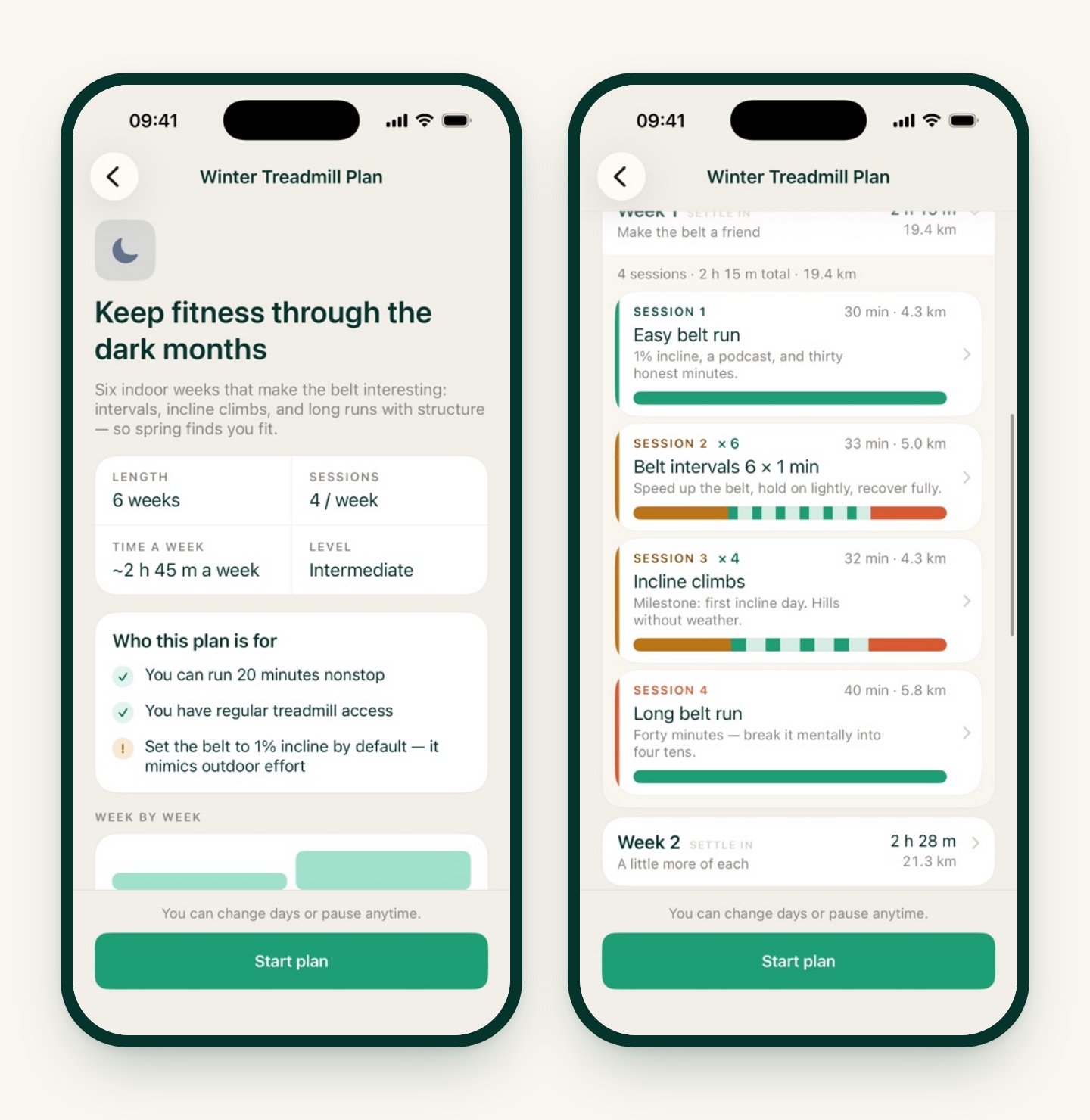
To start it, you should be able to run 20 minutes without stopping. If you can’t yet, the plan’s quiz points you to 0 → 5K, which is treadmill-friendly too.
Prefer to walk? The same Treadmill group has 12-3-30 Incline Walk, a six-week build-up to the viral 12% incline, 3 mph, 30-minute walk that adds minutes first, then incline, then speed, so calves and lower back arrive ready rather than wrecked.
Winter isn’t wasted
Runners who keep a rhythm through the dark months come out in March with the same engine they had in October, sometimes a better one, because belt intervals are so easy to hit precisely. Pick a preset, tap Indoor, and let the app do the counting.
Training advice, not medical advice. Check with a doctor before starting if you have a health condition or have been inactive for a while.