
Zone 2 is the most talked-about idea in endurance training right now, and the most overcomplicated. Lab tests, lactate meters, arguments about formulas.
Here’s the short version: zone 2 is running easy enough to hold a conversation, for long enough that your body adapts. Do enough of it, and the same effort gets you further. Everything else is detail.

What zone 2 is
Most apps, iRunning included, split heart rate into five zones. Zone 2 is the second one up: above a recovery jog, below anything that makes you breathe hard.
In practice, zone 2 means:
- You can talk in full sentences. Not gasping between words, but not chatting as if you were sitting down either.
- You could keep going for a long time. An hour or more, if your legs are used to it.
- It feels slower than you’d like. This is the part everyone notices first.
That last point is the whole challenge. Most recreational runners run their easy days too fast, somewhere in the grey area between easy and hard. It feels productive, but it’s tiring enough to blunt your hard days and not easy enough to build the base underneath them. Well-trained endurance athletes typically do around 80% of their training at low intensity. Zone 2 is where most of that 80% lives.
Why slow running makes you faster
Easy running, done consistently, builds the machinery that endurance depends on: a stronger heart, more capillaries feeding your muscles, and muscles that are better at using oxygen. None of it happens in a single run. All of it depends on accumulating easy hours without getting hurt or burned out, which is exactly what zone 2 lets you do.
The payoff shows up as aerobic efficiency: over weeks, you run faster at the same heart rate.
How to find your zone 2
You have three options, from simplest to most precise.
- The talk test. If you can speak comfortably in full sentences, you’re in the right place. If you can only get out a few words, slow down. It’s free and it works surprisingly well.
- An estimate from your age. iRunning estimates your maximum heart rate from your age and sex, and sets zone 2 at 60–70% of that maximum. With a max of 190, that’s about 114–133 bpm.
- Your own numbers. If you know your real max heart rate from a lab test or a hard race, enter it, and the zones rescale. You can also drag each zone boundary yourself.
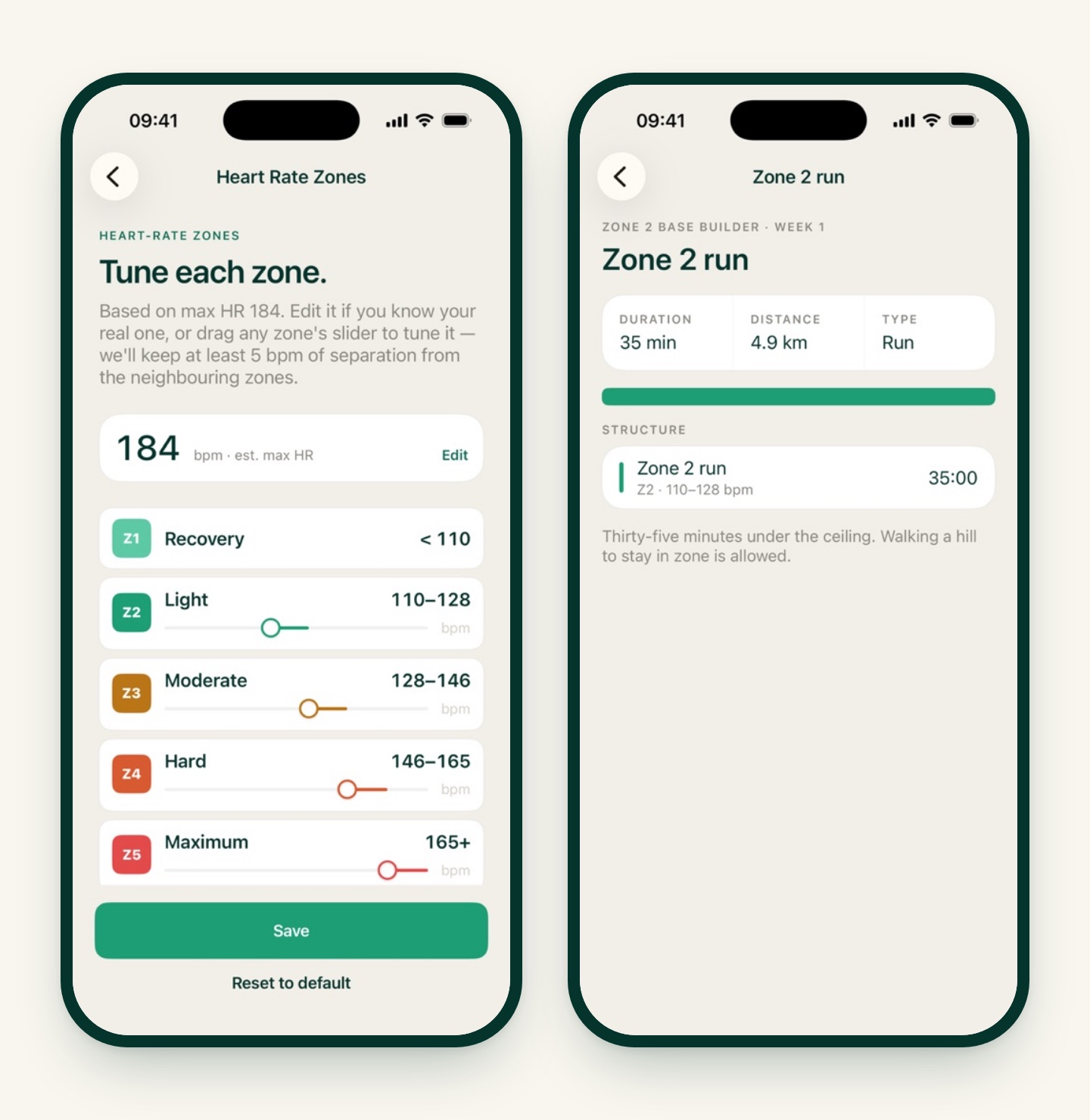
Whichever you choose, you need a heart-rate source for options 2 and 3: an Apple Watch or a Bluetooth chest strap. Chest straps react faster and are more accurate at the start of a run; a watch is more than good enough for steady easy running.
How iRunning keeps you in zone
Knowing your zone is one thing. Staying in it while your pride tells you to speed up is another.

- A voice tells you when you drift. Go above zone 2 and you hear “Heart rate too high”. Drop below and you hear “Heart rate too low”. Warnings repeat at most every 20 seconds, so they nudge rather than nag.
- The target is always your own zone. Sessions don’t store fixed numbers. They read your current zones at run time, so if you update your max heart rate, every workout follows.
- After the run, you see the proof. The run summary shows time in each heart-rate zone, a heart-rate chart, and how this run compares with your last seven days.
The 8-week Zone 2 Base Builder
The hardest part of zone 2 isn’t the running; it’s believing it works while you’re doing it. So the Zone 2 Base Builder plan builds the proof into the plan.
- Week 1: aerobic test #1. After a 10-minute warm-up, you run 5K with your heart rate capped at zone 2. Every time the alert fires, you slow down. The time you get is your honest baseline.
- Weeks 2–7: the base. Four runs a week, about three hours in total. Two zone 2 runs of 35–50 minutes, one easy run with 4–6 relaxed strides (the only intensity all week), and a zone 2 long run that grows to 80 minutes by week 7. Week 4 is a lighter cutback.
- Week 8: aerobic test #2. The same 5K, the same zone 2 cap. Compare the times. That difference is your new engine.
Some advice that comes straight from the plan’s sessions:
- Walking a hill to stay in zone is allowed. So is a walk break late in a long run.
- On a warm day the alert fires sooner. Slow down; don’t argue with it.
- Start slower than feels right. Heart rate drifts upward in the second half of a long run anyway.
- Run the test on the same flat route both times, in similar weather, so the comparison is fair.
Is it right for you?
The plan fits if you already run about 30 minutes, three times a week, and you’re willing to run slower than feels natural for eight weeks. Not running three times a week yet? Start with Run 30 Minutes and come back. No heart-rate source? The plan still works on the talk test; the alerts just won’t fire.
When you finish, you have a base to spend: First 10K, Half Marathon or Sub-60 10K are the natural next plans.
Get started
- Set your zones: Settings › Heart rate zones. Enter your real max heart rate if you know it.
- Try one run: a zone 2 run is just an easy run with a ceiling. Put on your watch, run by feel, and check your time in zones afterwards.
- Commit to eight weeks: the Zone 2 Base Builder is part of iRunning Premium. Tap Choose a plan on Home and look under Health & lifestyle.
Training advice, not medical advice. Check with a doctor before starting if you have a health condition or have been inactive for a while.