Rucking is walking with a weighted backpack. That’s the whole definition. The word comes from the military “ruck march”, but the thing itself is older and simpler than any training trend: people have carried loads on foot for as long as there have been loads.
It’s popular now for a reason that’s easy to miss. Walking is the exercise most people can actually do and keep doing, and a few kilos in a pack turn it into something that also builds legs, back and shoulders, burns noticeably more than an empty-handed walk, and still lets you hold a conversation. No running, no gym, no technique to learn. The only things that can go wrong are carrying too much too soon, or carrying it badly.

This article covers the three questions every beginner asks (how heavy, how far, how fast), the one rule that keeps backs and knees happy, and an eight-week plan you can follow on paper or with the Rucking: First 8 Weeks plan in iRunning.
How heavy?
Lighter than you think. The usual beginner advice, and the number this plan starts from, is 10% of your body weight, or 5 kg (10 lb), whichever is less. For most adults that’s 5 kg. It will feel like nothing for the first ten minutes. By minute forty you’ll understand why it’s the right number.
Where the weight comes from doesn’t matter much: full water bottles, a few books in a tea towel, a bag of rice, a sandbag. Anything that packs tight and doesn’t shift. You don’t need a special rucksack or weight plates to start; you need a pack with a hip belt and something heavy that isn’t going to rattle.
Over eight weeks the weight grows to 12–15% of body weight, which is nine to eleven kilos for most people. That’s a sensible ceiling for recreational rucking. Military load-carriage studies go far beyond it, and so do the injury rates.
| Body weight | Week 1 pack | Week 8 pack (12–15%) |
|---|---|---|
| 60 kg (132 lb) | 5 kg | 7–9 kg |
| 75 kg (165 lb) | 5 kg | 9–11 kg |
| 90 kg (198 lb) | 5 kg | 11–13 kg |
If you’re well under 50 kg, start at 10% rather than 5 kg.
How to pack it
A badly packed 5 kg feels heavier than a well-packed 8 kg. Three things matter:
- High and close to your spine. Weight that sits low in the pack, or far from your back, pulls your shoulders backwards and makes you lean forward to compensate. Put the heavy items at the top, against the back panel, and fill the rest with something soft so nothing moves.
- Hip belt snug. A hip belt moves most of the load from your shoulders to your hips, which are built for it. Tighten it first, then the shoulder straps, then the small straps at the top if your pack has them.
- Nothing that sways. A pack that swings with every step costs energy and rubs. Check the straps at the halfway point of every long walk; they loosen.
If your lower back complains, the fix is almost always the same: cinch the hip belt and take weight off the shoulders.
How fast?
Rucking pace is walking pace, a little slower. A talking pace, where you can hold a conversation but would rather not sing, is about right. If you’re breathing hard, slow down or stop and check the pack. The point of the weight is to make an easy walk productive, not to turn it into a workout you dread.
In heart-rate terms, loaded walks sit in zone 2, the same calm effort as an easy run. The pack raises your heart rate by itself. You don’t need to add speed on top.
A few posture cues that make the first weeks easier:
- Shorter steps than feel natural. Long strides with weight on your back land hard on the heel and tire the hips.
- Tall, not leaning. Shoulders back, chest open. If you’re bending forward at the waist, the pack is too heavy or too low.
- Arms free. Thumbs under the shoulder straps is fine; carrying things in your hands is not.
The one rule: change one thing at a time
This is the idea the whole plan is built on, and it comes from load-carriage research and from how experienced ruckers actually progress: add distance or add weight, never both in the same week.
So the plan alternates. Odd weeks make the long walk longer with the same pack. Even weeks put a kilo or two more in the pack and keep the distance exactly where it was. Each change is small enough that your body absorbs it, and if something starts to hurt you know which change caused it.
The other half of the rule is a cutback week after the first block. Week 4 is shorter in everything, and nothing goes into the pack. Shoulders, calves and feet adapt during that week, not during the long walks.
The eight-week plan
Three sessions a week: a brisk walk or interval walk with no pack on Tuesday, a midweek ruck on Thursday, and a long ruck on Saturday. Roughly two hours a week at the start and three and a half by the end. You can move the days; just keep a gap between the two loaded walks.
| Weeks | Phase | What happens |
|---|---|---|
| 1–4 | Base | Find your load. The first 5K with a pack, the first loaded hour in week 3, a cutback in week 4 |
| 5–7 | Build | Tuesdays become interval walks. The long ruck goes 8, 8, 10 km. Weight steps up once, in week 6 |
| 8 | Peak | Final weight step to 12–15% of body weight, then 10K with the full pack |
The long ruck, week by week

| Week | Tuesday (no pack) | Thursday ruck | Saturday long ruck | Pack |
|---|---|---|---|---|
| 1 | Brisk 24 min | 30 min | 5 km, about 55 min | 5 kg or 10% |
| 2 | Brisk 29 min | 30 min | 5 km | +1–2 kg |
| 3 | Brisk 34 min | 35 min | 6.5 km, your first loaded hour | same |
| 4 · cutback | Brisk 24 min | 25 min | 5 km | same, nothing added |
| 5 | Interval walk 5 × (3 fast / 3 easy) | 40 min | 8 km, about 90 min | same |
| 6 | Interval walk 6 × | 40 min | 8 km | +1–2 kg |
| 7 | Interval walk 6 × | 50 min | 10 km, about 1 h 55 | same |
| 8 · peak | Brisk 24 min | 40 min | 10 km at full weight | 12–15% of body weight |
Times are estimates at a talking pace. Every ruck starts and ends with five easy minutes to settle the pack and to cool down.
What the three days do:
- Tuesday is unloaded on purpose. A brisk walk keeps the walking habit without adding to the load on your shoulders. From week 5 it becomes a 3-minutes-fast, 3-minutes-easy interval walk, which raises your fitness ceiling while the pack days raise your strength.
- Thursday is the rehearsal. A short loaded walk where you meet any new weight for the first time, on a day when the distance is small. The week 8 weight step happens here, not on the 10K.
- Saturday is the milestone day. First 5K with a pack in week 1, the first loaded hour in week 3, the first 10K in week 7, and 10K at full weight in week 8.
Things that go wrong, and what to do
- Sore shoulders in week 1 or 2. Normal if it’s a dull ache that fades by the next day. Check the hip belt is doing its share. Sharp or one-sided pain is a reason to stop and re-pack, not push through.
- Lower back ache. Weight is too low in the pack or the hip belt is loose. Fix the pack before you reduce the distance.
- Hot spots on your feet. Weight changes how your feet land, and shoes that are fine for a walk can rub on a ruck. Tape the spot before the next long walk, and lace a little tighter around the ankle.
- Hungry at 8 km. Eat something at the halfway point of the long rucks from week 5. A loaded walk burns more than it feels like.
- Tempted to skip the cutback. Don’t. Week 4 is the week the first three sink in. Ruckers who skip it tend to meet week 7 with tired calves and a sore back.
How the plan works in iRunning
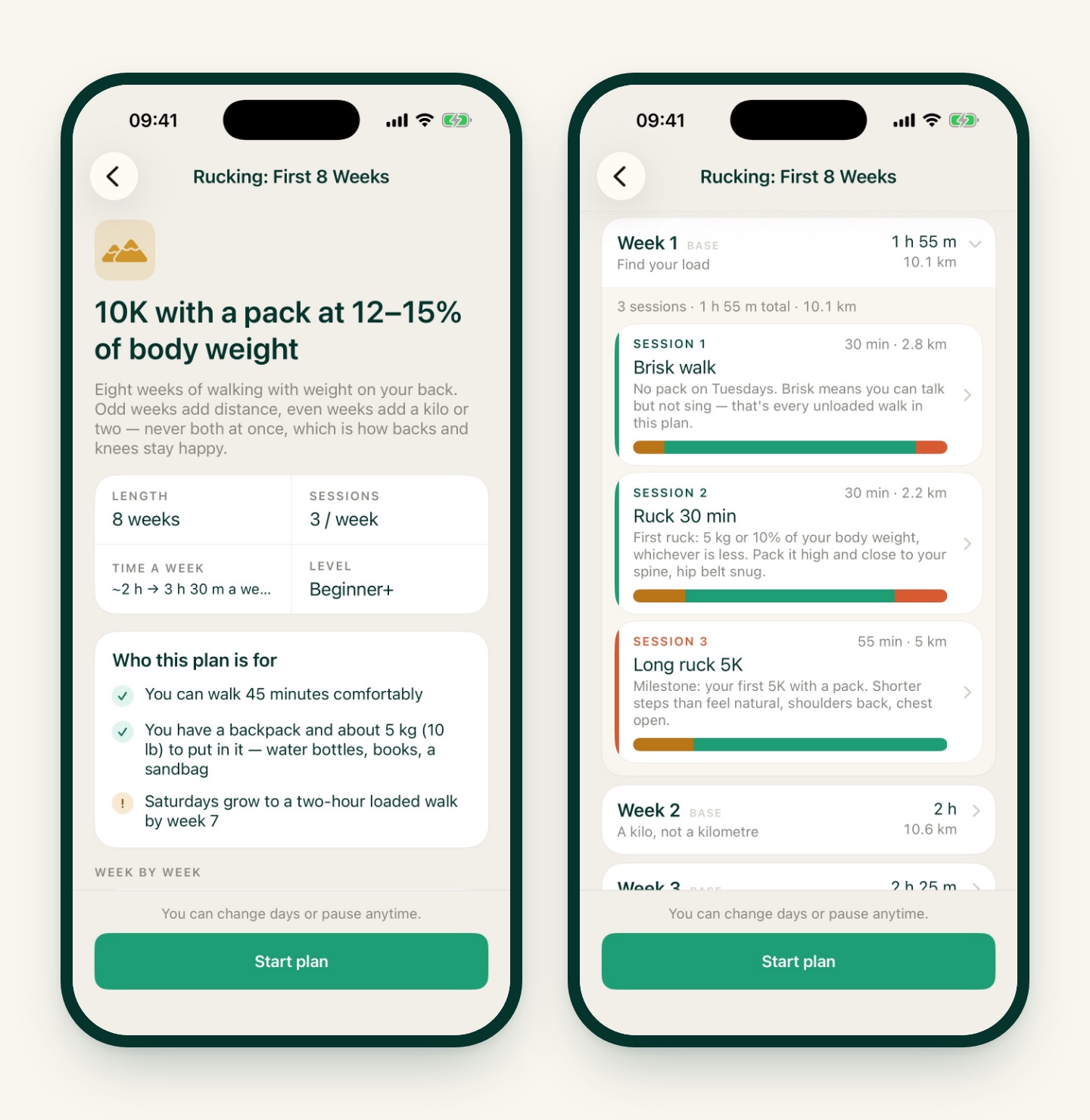
- Every walk is a walk. The app records these sessions as walks, so they go to Apple Health as walking workouts, with the route, pace and heart rate of a run.
- The pack is the only thing you track yourself. The plan tells you which weeks to add weight; the app can’t weigh your rucksack. Keep a note of what’s in it.
- Loaded walks carry a zone 2 heart-rate target. With an Apple Watch or a chest strap, you’ll hear “Heart rate too high” when the pack and a hill together push you out of a talking effort. Slow down; that’s the plan working.
- Interval Tuesdays are read to you. From week 5, voice cues tell you when the fast three minutes start and end, so you can leave the phone in a pocket.
- Setup checks where you are. It asks whether you have a pack and 4–6 kg to put in it, and whether you’ve rucked before. If you walk with a pack regularly already, it starts you at week 3.
- Missed a Saturday? You can move a session, pause the plan or restart a week instead of quitting.
After week 8
Ten kilometres with a pack at 12–15% of body weight is a real base. From here, most people go one of three ways: keep a weekly ruck as a long-term habit at that weight, build toward a multi-day hike (the app’s Trek Ready plan picks up where this one leaves off), or take the pack on the Camino, where the Camino: The Last 100K plan assumes exactly this starting point.
Get the plan
Rucking: First 8 Weeks is part of iRunning Premium, alongside 40 other training plans. In the app, tap Choose a plan on Home, then Browse all plans, and look under Hiking & rucking. You’ll need to be able to walk 45 minutes comfortably. If you can’t yet, start with Start Walking, a free four-week plan that builds to a brisk half hour.
Not ready to subscribe? The free version still records walks with route and heart rate, gives you heart-rate zones and alerts and voice cues, and lets you build two custom workouts, so you can set up the loaded walk and the interval walk from the table above yourself.
Training advice, not medical advice. Check with a doctor before starting if you have a health condition, back or knee problems, or have been inactive for a while.