If Berlin is the fastest marathon course in the world, Valencia is the fastest one for everybody else. The course record is 2:01:48, national records fall every December, and the middle of the field runs fast too: in 2025, more than 5,500 people broke three hours in Valencia, about 18% of the finishers. In a typical big-city marathon it’s 6–8%.
The 46th Maratón Valencia Trinidad Alfonso is on Sunday, 6 December 2026, with 36,000 places, all sold out. Here’s what the course looks like, where you’ll get water and gels, the one thing that can spoil a fast day here, and how to race it.
Race weekend at a glance
| What | When and where |
|---|---|
| Expo and bib pick-up | Feria Valencia, Av. de les Fires. Thu 3 Dec 17:00–21:00, Fri 4 Dec 09:00–21:00, Sat 5 Dec 09:00–19:00. No pick-up on race day |
| Start | Av. del Professor López Piñero, by the Palau de les Arts in the City of Arts and Sciences. First wave 08:15, last wave 09:35 |
| Finish | The blue walkway over the water, between the Hemisfèric and the Science Museum |
| Time limit | 5 h 30 min; the course closes at 15:15. Cut-off at km 25: you must pass by 12:57 |
| Course | 42.195 km, World Athletics Platinum Label, flat: the lowest point is 2 m above sea level, the highest 18 m |
Start waves
Your box (cajón) and start time are on your bib, based on the time you entered with. Boxes go off every ten minutes:
| Entered time | Start |
|---|---|
| Under 2:50 | 08:15 |
| 2:50–2:59 | 08:25 |
| 3:00–3:11 | 08:35 |
| 3:12–3:19 | 08:45 |
| 3:20–3:31 | 08:55 |
| 3:32–3:42 | 09:05 |
| 3:43–3:55 | 09:15 |
| 3:56–4:09 | 09:25 |
| 4:10 and over | 09:35 |
Anyone in a box under 3:32 had to prove it with a recent result. You can still move box until 26 November in your runner’s area (€25, with proof of time); after that, the box on your bib is the one you run from.
Note the gap: if you’re in the last wave, you start 80 minutes after the first one, and the 12:57 cut-off at km 25 is measured on the clock, not from your own start. At 9:35 you have 3 h 22 min to reach km 25, which is 8:05 per km. That’s comfortable for almost everyone, but if you’re planning to walk a lot, know it’s there.
The course in one line

Valencia’s course is compact. It never leaves the city, it has several out-and-back sections, and it passes some streets twice. That’s good for spectators and for your head: you’re rarely more than a few kilometres from somewhere you recognise.
Km 0–2: the start and the Montolivet bridge. You start among the white curves of the City of Arts and Sciences, run south along López Piñero, cross the Pont de Montolivet over the old riverbed and turn round the Plaça d’Europa. The first kilometre is crowded, and there are bike-lane separators on parts of the road. Look down, not at your watch.
Km 3–5: the port and the beach strip. Past La Marina and the old clock building at the port, then north along Calle Eugènia Viñes, parallel to the Cabanyal and Malvarrosa beaches. You won’t see the sea, but you’ll feel it: this is the most exposed part of the course, and if there’s wind on race day, this is where it finds you. Sit in a group.
Km 5–8: Tarongers and the universities. West along the wide Avenida dels Tarongers past the university campuses, an out-and-back with a turn at the Mirador roundabout. You’ll see the faster runners coming back the other way, which is either motivating or demoralising depending on your mood.
Km 8–17: Blasco Ibáñez, Benimaclet, the Turia. The longest stretch of wide, straight city avenues. Avenida Blasco Ibáñez (you’ll pass it twice, around km 8 and km 16), a double right-angle turn onto Avenida de Catalunya with tram rails at km 9, the edge of Benimaclet, then south past the Viveros gardens and the Fine Arts museum (more tram rails around km 12–13), along the Alameda beside the Turia gardens and past the Mestalla stadium. Big crowds, easy running. The first gel point is at km 16.2.
Km 18–21: back to the sea. East again on Tarongers and then south on Calle de la Reina through El Cabanyal, the old fishermen’s quarter. The halfway mark is on Calle de la Reina, just past km 21, near the port.
Km 22–27: Avenida del Port and the riverbed. West along the straight Avenida del Port, past the Plaça de Saragossa at km 25 (the cut-off point) and along the Turia gardens to a turnaround at about km 27.5. From km 24 to km 32 the road climbs very slightly, under 1%. You won’t see it; you might feel it. The second gel point is at km 25.8.
Km 28–31: the old town. Past the medieval Torres de Serranos gate, through Ciutat Vella on narrower streets (General Tovar, Calle de la Pau, Poeta Querol past the baroque Palacio del Marqués de Dos Aguas) and out along Guillem de Castro. The streets are tighter and twistier here, the crowds closer and louder, and GPS gets less reliable between the buildings.
Km 32–36: Bioparc and Tres Creus. Out west along Gran Vía Fernando el Católico and Avenida Pío XII to the Bioparc at km 34, the course’s highest point at a towering 18 metres, and the last gel point. Then comes the part people remember: Avenida Tres Creus, a long, straight, quiet avenue of about two kilometres with few spectators, right at the point where the marathon starts to hurt. Have a plan for it: a mantra, a gel, a song in your head. Many runners say this is where Valencia is won or lost.
Km 37–42: back into the city and the walkway. East along Avenida del Cid, past the North Station and the bullring on Calle Xàtiva at km 39, down Calle Colón, round the Porta de la Mar and along the Alameda with the crowds getting thicker every hundred metres. Then the Palau de les Arts appears, the course drops down a ramp, and the last few hundred metres are on the blue walkway over the water. It’s one of the most beautiful finishes in running, and you’ll have earned every metre of it.
Aid stations
| What’s handed out | Where |
|---|---|
| Water (Aquabona, small bottles) and Aquarius sports drink (cups) | km 5.5, 10, 14.5, 18.7, 23, 28.3, 33.1, 37.1, 40.4, and the finish |
| Gels (Enervit, with and without caffeine) | km 16.2, 25.8, 34 |
| Fruit | km 23, 28.3, 33.1, 37.1, 40.4 |
| Quick assistance (Vaseline, cooling spray) | around km 24.5, 29.5, 34.2 |
Every drink station also has medical staff and toilets. The stations are long, so there’s no need to fight for the first table; drink from the bottles on the move and keep them to cross a road or two before dropping them in the bins.
Three gel points are spread too far apart for most runners to fuel from alone. If you take a gel every 30–40 minutes, carry most of your own and use the course gels as top-ups. If you haven’t trained with Enervit, don’t try it for the first time at km 16.
How flat is “flat”?
Very. The whole course sits between 2 and 18 metres above sea level, and the only “climb” is a gentle drag from about km 24 to the Bioparc at km 34, over ten kilometres, too gradual to show up on anything but an altimeter. There are no bridges to speak of after the first two kilometres.
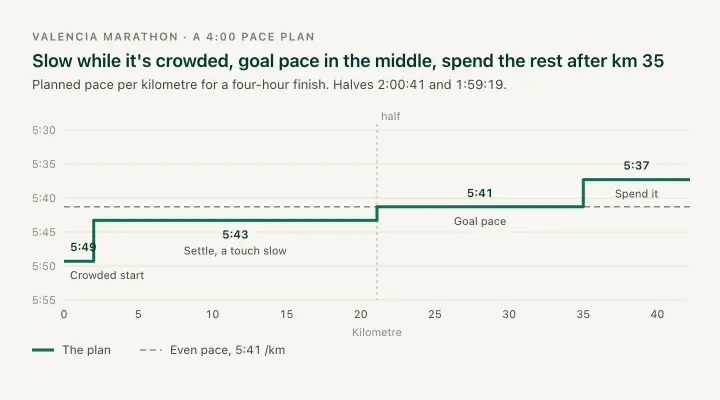
That’s the good news, and it changes how you should pace: on a course this flat, even pace and even effort are the same thing. Unlike New York or Boston, there’s no hill to give time back on and no downhill to bank it. Pick your pace and hold it. We’ll go through the numbers in a separate guide to pacing Valencia.
Wind and weather
Early December mornings in Valencia are usually 8–14 °C, which is close to ideal. Recent race mornings ranged from a cold, clear 6 °C in 2023 to 14 °C in 2025, when it reached 19 °C by noon and 21 °C by 13:00. That warmth hit the later waves hardest.
Two things to plan for:
- Wind. In each of the last five editions, the morning wind came from the west, from inland, at anything from a light breeze to 25 km/h. It’s a headwind on the westbound avenues (Tarongers, Blasco Ibáñez, Avenida del Port) and a tailwind coming back. On a windy day, tuck into a group on the westbound stretches and don’t chase your pace; you’ll get the seconds back on the way east.
- The later you start, the warmer you finish. If you start at 09:35 and run 4:30, you’ll finish after 14:00, when it can be 6–8 °C warmer than at the start. Above about 18 °C, slow down by 5–10 seconds per kilometre and drink at every station.
Bag drop, the tram, and getting to the start
- Bag drop had to be booked in advance (it closed on 1 November and is now full). It’s on López Piñero next to l’Umbracle, close to both the start and finish. If you didn’t book one, bring only what you can wear or throw away, and arrange for someone to meet you with dry clothes.
- Take the tram. In recent years tram line 10 started at 06:00 and ran every five minutes from 06:30 to 09:00, to the Amado Granell–Montolivet stop next to the start area. Roads around the course are closed and taxis are hard to find. Check Metrovalencia’s race-day timetable in the week of the race.
- Get there an hour before your wave. The start area is big, and the toilet queues at 08:45 are not.
Racing Valencia with iRunning
- Hear your pace every kilometre. In Settings › Customise › Run screen › What to announce, set By distance to every 1 km and choose Avg pace, Distance and Total time. On a flat course, a calm voice every kilometre is all the pacing information you need.
- Build the race as a workout with a pace band. Valencia is the course where pace bands work best: there are no hills to make them lie. Make one step of 42.2 km with a pace range a few seconds either side of goal, and you’ll hear “Pick up the pace” or “Slow down” if you drift. If you’re on the Sub-4 Marathon plan, race day already has a 5:36–5:46 band.
- Run phone-free. Send the workout to Apple’s Workout app with Add to Apple Watch, or start it in the iRunning Watch app. Both give you haptic alerts.
- Trust the kilometre markers in the old town. GPS will wander between the buildings around km 28–31 and your watch will likely read a few hundred metres long by the finish. Pace off the markers and the clocks.
If you’re not running
Valencia is easy to watch. The course loops through a compact city, and one person on foot can see a runner five or six times without public transport. The official Maratón Valencia app tracks runners every 5 km, and the race has been broadcast live on À Punt, the Valencian public channel, from 08:00. Good spots: Avenida de Balears just after the start, Blasco Ibáñez (km 8 and 16 from the same corner), Avenida del Port (km 23–24), the old town around km 29, and the Alameda for the last kilometre. We’ll publish a full spectator guide the week of the race.
After Sunday
The week after a marathon is for walking and eating; our first two weeks after a marathon covers it. And if you want to come back, entries for 2027 will open soon after the race: for 2026 there was a loyalty window for finishers in mid-December, then a ballot in the second half of the month.
Good luck in Valencia. See you on the blue walkway.
Race details are from the Valencia Marathon’s 2026 regulations and course map and from previous editions’ runner guides, as of 24 October 2026. The 2026 runner’s guide is published in the week before the race; check it for final times and transport.