For New York we wrote a pacing guide built around hills: run even effort, accept slower miles on the bridges, and don’t chase a negative split on a course that won’t give you one. Valencia is the opposite. The whole course sits between 2 and 18 metres above sea level. There’s no hill to hide behind and no downhill to bank time on.
That makes pacing simpler and less forgiving. On a flat course, even pace and even effort are the same thing, so the plan is the classic one: start a few seconds slow, settle at goal pace, and spend what’s left in the last 7 km. Here’s how to do that in Valencia specifically, where it usually goes wrong, and the split tables to print on your arm.

The plan in four steps
- Km 0–2: let the crowd decide. Valencia’s start is busy, with 36,000 runners going off in boxes ten minutes apart, plus bike-lane separators and the Montolivet bridge in the first kilometre. Expect to run 5–10 seconds per km slower than goal, and accept it. Weaving round people to make up 20 seconds costs far more than 20 seconds.
- Km 2 to halfway: a touch under goal. About 2 seconds per kilometre slower than goal pace. It should feel too easy. That’s correct: a marathon at goal pace should feel easy at km 10, and if it feels like work, you’re going too fast or it’s going to be a hard day.
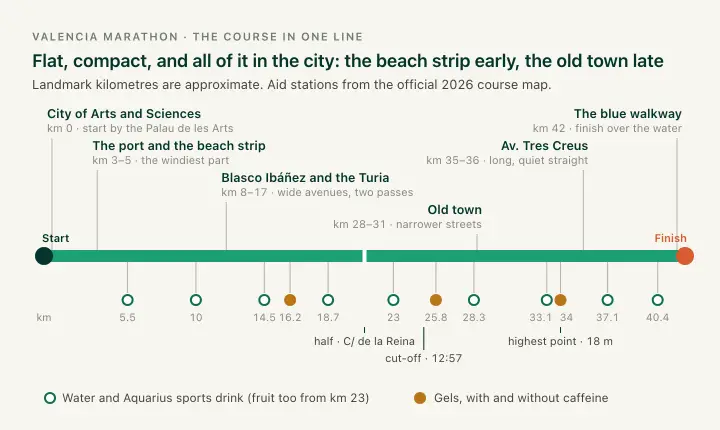
- Halfway to km 35: goal pace. Now hold the number. There’s a very slight drag from about km 24 to the Bioparc at km 34, under 1%; you may need a little more effort for the same pace. That’s fine. This is the stretch where the race is actually decided.
- Km 35 to the finish: spend it. The long, quiet Avenida Tres Creus comes first, then the city again and the crowds of the last 4 km. If you’ve paced the first 35 km well, you’ll have a few seconds per kilometre left. If you haven’t, you’ll find out on Tres Creus.
The result is a negative split of about a minute or so: 2:00:41 and 1:59:19 for a four-hour runner. Our negative-split guide explains why the second half should be the faster one, and how much faster.
The four ways Valencia goes wrong
1. The fast first 10 km. The classic. The road is flat, you’re tapered, it’s cool, and 15 seconds per kilometre faster than goal feels like nothing. Every runner who blows up at km 32 felt great at km 10. If your 10K split is more than a minute ahead of your plan, you haven’t “banked” anything. You’ve borrowed it at a high rate of interest.
2. Chasing pace into the wind. In recent years the race-morning wind has come from the west, from inland. That’s a headwind on the westbound avenues (Tarongers around km 5–7, Blasco Ibáñez, Avenida del Port around km 22–24) and a tailwind on the way back. On a windy day, don’t hold pace into it: hold effort, tuck in behind a group, and let the tailwind give the seconds back. A pace band set two seconds either side of goal will complain; let it.
3. Fighting for the pacers. Valencia’s pace groups are huge, especially at 3:00, 3:30 and 4:00. In the first 10 km they can be a scrum, with elbows and clipped heels at every drink station. Run 20–30 metres behind your group, not inside it, until it thins out after halfway. You’ll still get the shelter on the windy bits.
4. Ignoring the temperature. Valencia in December is usually cool, but not always: in 2025 it was 14 °C at the start and 19 °C by noon, and the later waves felt it. If the forecast high is above 18 °C and you start after 09:00, slow every number in the table below by 5–10 seconds per kilometre from the start, and drink at every station. Going for a PB in the heat and missing it by 3 minutes is a far better day than blowing up and missing it by 20.
Split tables: 3:00 to 5:00
Each row follows the plan above: 8 seconds slow for the first 2 km, 2 seconds slow to halfway, goal pace to km 35, 4 seconds quick to the finish.
Pace per kilometre
| Goal | Km 0–2 | Km 2–21 | Km 21–35 | Km 35–42 | Even pace |
|---|---|---|---|---|---|
| 3:00 | 4:23 | 4:17 | 4:15 | 4:11 | 4:16 |
| 3:30 | 5:06 | 5:00 | 4:58 | 4:54 | 4:59 |
| 4:00 | 5:49 | 5:43 | 5:41 | 5:37 | 5:41 |
| 4:30 | 6:31 | 6:25 | 6:23 | 6:19 | 6:24 |
| 5:00 | 7:14 | 7:08 | 7:06 | 7:02 | 7:07 |
Clock time at each split
| Goal | 5 km | 10 km | 15 km | 20 km | Half |
|---|---|---|---|---|---|
| 3:00 | 21:39 | 43:06 | 1:04:32 | 1:25:59 | 1:30:41 |
| 3:30 | 25:12 | 50:12 | 1:15:12 | 1:40:12 | 1:45:41 |
| 4:00 | 28:45 | 57:19 | 1:25:52 | 1:54:25 | 2:00:41 |
| 4:30 | 32:19 | 1:04:25 | 1:36:32 | 2:08:39 | 2:15:41 |
| 5:00 | 35:52 | 1:11:32 | 1:47:12 | 2:22:52 | 2:30:41 |
| Goal | 25 km | 30 km | 35 km | 40 km | Finish |
|---|---|---|---|---|---|
| 3:00 | 1:47:18 | 2:08:35 | 2:29:52 | 2:50:48 | 3:00:00 |
| 3:30 | 2:05:04 | 2:29:55 | 2:54:45 | 3:19:15 | 3:30:00 |
| 4:00 | 2:22:51 | 2:51:14 | 3:19:38 | 3:47:41 | 4:00:00 |
| 4:30 | 2:40:37 | 3:12:34 | 3:44:31 | 4:16:07 | 4:30:00 |
| 5:00 | 2:58:24 | 3:33:54 | 4:09:24 | 4:44:34 | 5:00:00 |
The times are measured from when you cross the start line, not from the gun. Your chip time is what counts. Course clocks usually run from the first start at 08:15, so if you’re in a later box, subtract the difference, or simply go by the elapsed time on your watch.
A rule of thumb for the day: if you’re within 30 seconds of the table at 10 km, you’re on plan. If you’re more than a minute ahead at 10 km, slow down now, not at km 30.
Fuel on a timetable, not on the gel points
Valencia’s three gel points (km 16.2, 25.8 and 34) are useful top-ups, but they’re 9–10 km apart, which is 45 minutes to an hour for most runners. Most people need a gel every 30–40 minutes. Carry your own and take them on the clock: at 0:40, 1:15, 1:50, 2:25 and so on, with water at the next station. The taper guide has the carb-loading plan for the days before.
Pacing Valencia with iRunning
- Put the plan on your wrist as a workout. In the workout builder, make four distance steps (2 km, 19.1 km, 13.9 km and 7.2 km) with a pace range on each from the table above, a few seconds either side. You’ll hear “Pick up the pace” or “Slow down” only when you drift out of the band, so on a flat course you’ll hardly hear anything at all. That’s how it should be.
- Or keep it simple. A single 42.2 km step with your goal pace range works too. If you’re on the Sub-4 Marathon plan, race day already has a 5:36–5:46 band.
- Hear your average pace every kilometre. In Settings › Customise › Run screen › What to announce, set By distance to every 1 km and add Avg pace. Average pace is the number that tells you whether you’re on plan; the current pace jumps around.
- Run phone-free. Send the workout to Apple’s Workout app with Add to Apple Watch, or start it in the iRunning Watch app. Haptic taps on the wrist work even when you can’t hear anything over the crowd on the Alameda.
- Expect your watch to read long. GPS wanders in the narrow old-town streets around km 28–31, and every watch measures a few hundred metres more than the certified 42.195 km. Use the kilometre markers to check, and don’t panic if your watch says 42.0 with the walkway still ahead of you.
After the race: read your splits
Back home, the run summary shows every kilometre’s pace. Compare it with your plan: if your first half was within a minute of the table and your second half was the same or faster, you paced it well, whatever the clock says. If kilometres 30–38 are a minute slower than the rest, the problem started at km 5, not km 30. Next time, start slower.
For the first week after, the recovery guide has the plan. And for the route itself, our Valencia course guide goes through it kilometre by kilometre.
Good luck on the walkway.
Weather and course details from the Valencia Marathon’s 2026 regulations and course map and from previous editions, as of October 2026. Split tables are calculated, not official pacer splits.