
Autumn marathon season does something to people. You watch the finish line in Berlin, Chicago or New York, and a quiet thought arrives: could I do that?
If you’ve already run a half marathon, the answer is very likely yes. What you need is time and patience. Sixteen weeks is the classic length for a first marathon plan: long enough to build the long run in small, safe steps, and short enough that you can still see the finish from week 1. Start now and race day lands in mid-January. Start in December and you’re ready for the spring races.

This article walks through a 16-week plan in kilometres, using the Marathon plan in iRunning as the example. You can follow the structure on paper and with any watch. The app just saves you from doing the maths and remembering what today’s session is.
Is this plan for you?
“First marathon” and “beginner runner” are two different things. This plan is for finishing your first marathon, not for your first months of running. It fits you if:
- You’ve finished a half marathon. Any time counts.
- You run around 30 km a week and have 16 weeks until race day.
- You can protect a weekend slot for the long run, every week. It grows to 2 h 45 min.
| Where you are now | Where to start |
|---|---|
| New to running, or under 10 km at a time | A 5K or 10K plan first. The marathon will wait |
| Running regularly, no half marathon yet | A 12-week half marathon plan, then come back |
| A half marathon done, around 30 km a week | Week 1 of this plan |
| A marathon done, chasing a time | A goal-pace plan, such as one built around breaking four hours |
There’s no shame in the second row. A half marathon first is the faster way to a good first marathon, not a detour.
The shape of the plan
Sixteen weeks, counted back from race day, in four phases:
| Weeks | Phase | What happens |
|---|---|---|
| 1–4 | Base | Four runs a week become routine. Tempo running from week 1, and the long run goes from 12 to 15 km. Week 4 is a lighter cutback |
| 5–9 | Build | Marathon pace appears in week 6. The long run passes 20 km, and week 9 brings your first 21 km in training |
| 10–13 | Peak | The biggest marathon-pace blocks and the longest run of the plan: about 26 km in week 13 |
| 14–16 | Taper | Volume drops by about 25%, 40% and 75%. A little pace stays in, then race day |
A typical week takes four to six hours: two easy runs of 35–45 minutes, one quality session of 40–60 minutes, and the long run. The suggested days are Tuesday, Thursday, Saturday and Sunday, with the long run on Sunday, but you can pick your own.
About 70% of the running is easy, 20% is at marathon pace and 10% is tempo and hills. That easy share is higher than in a half marathon plan, on purpose. The marathon is an endurance problem, and endurance is built with a lot of calm minutes, not a few heroic ones.
The long run: from 12 to 26 km
The long run is where a marathon plan succeeds or fails. Here it grows for two or three weeks, then drops back for a lighter week so your legs can catch up:

| Week | Long run | Approx. distance |
|---|---|---|
| 1 | 75 min, all easy | 12 km (7.2 mi) |
| 2 | 85 min, start practising gels | 13 km (8.2 mi) |
| 3 | 95 min | 15 km (9.1 mi) |
| 4 · cutback | 65 min | 10 km (6.3 mi) |
| 5 | 1 h 45, fuel every 25 minutes | 16.5 km (10.1 mi) |
| 6 | 1 h 55 | 18 km (11.1 mi) |
| 7 | 2 h 05 | 19.5 km (12 mi) |
| 8 · cutback | 85 min | 13 km (8.2 mi) |
| 9 | 2 h 15 | 21 km (13 mi), a half marathon in training |
| 10 | 2 h 25, last 20 min at marathon pace | 22.5 km (14 mi) |
| 11 · lighter | 1 h 40 | 15.5 km (9.6 mi) |
| 12 | 2 h 35, a full rehearsal: kit, fuel, pacing | 24 km (14.9 mi) |
| 13 | 2 h 45, last 15 min at marathon pace | about 26 km (15.9 mi) |
| 14 · taper | 1 h 50 | 17 km (10.6 mi) |
| 15 · taper | 75 min | 12 km (7.2 mi) |
| 16 | Race day | 42.2 km (26.2 mi) |
Distances are estimates at an easy pace. The long run is set by time, not distance, so a slower runner covers less ground in the same minutes. That’s fine. Time on your feet is what builds endurance.
Three things people often ask:
- “I never run more than 26 km before race day?” Right. The long run is capped at 2 h 45 min. Beyond that, the extra fitness is small and the extra recovery is large: a 3 h 30 training run can cost you the next week of training. The last 16 km come from sixteen weeks of total volume, the taper and a rested body. It’s how most first-marathon plans work, and it’s why they work.
- “Why not 32 km, like my friend’s plan?” Plans that go to 30–32 km are usually written for people who run more per week, and faster. For a four-runs-a-week runner, a 32 km long run would be more than half of the week’s running in one day.
- “Why does the long run drop in weeks 4, 8 and 11?” Fitness is built while you recover from training, not during it. The lighter weeks are when the previous block sinks in. Skip them and the plan tends to end in week 10 with a sore shin.
The midweek session
One run a week has a job beyond easy mileage. Tempo, hill and marathon-pace sessions start with a 12-minute easy jog and end with a 10-minute one.
| Week | Quality session |
|---|---|
| 1 | Tempo: 15 min |
| 2 | Tempo: 20 min |
| 3 | Tempo: 2 × 12 min, 3 min jog between |
| 4 · cutback | Light hills: 6 × 45 s uphill, walk back down |
| 5 | Tempo: 25 min continuous |
| 6 | Marathon pace: 2 × 15 min |
| 7 | Marathon pace: 25 min |
| 8 · cutback | Easy 30 min + 8 strides |
| 9 | Marathon pace: 30 min |
| 10 | Marathon pace: 2 × 20 min |
| 11 · lighter | Fartlek: 8 × 1 min quick, 1 min easy jog |
| 12 | Marathon pace: 35 min, the biggest block of the plan |
| 13 | Marathon pace: 25 min |
| 14 · taper | Marathon pace: 20 min |
| 15 · taper | Marathon pace: 2 × 8 min |
| 16 · race week | Easy 20 min + 4 strides |
Tempo is “comfortably hard”: you could say a few words, but you wouldn’t want a conversation. Strides are 20-second relaxed accelerations with a minute of easy jogging between them.
The pattern: tempo first, then marathon pace, and the blocks grow with the long run. The first five weeks of tempo lift your ceiling. From week 6 the midweek session is about one thing only, which is learning what race pace feels like, until 35 minutes of it in week 12 feels calm rather than exciting.
How hard is “marathon pace”?
This is a finishing plan, so it doesn’t hand you a pace in minutes per kilometre. Marathon pace here is an effort:
- It should feel almost easy at first. In week 6, fifteen minutes at marathon pace should leave you thinking “is that all?” That’s the right answer. You have to hold it for four hours or more, not fifteen minutes.
- Steady, not hard. Clearly quicker than your easy runs, clearly gentler than tempo. You can speak in short sentences.
- By heart rate, the race is a zone 3 effort, and so are the marathon-pace finishes of the long runs. Easy and long runs stay in zone 2.
If you’re unsure, err on the slow side. Nearly every first marathon that goes wrong goes wrong in the same way: a first half that felt great.
Fuel is part of the training
In a half marathon you can get away with a bad fuelling plan. In a marathon you can’t, because the race lasts longer than your stored carbohydrate does. So the plan treats eating as a skill to practise:
- From week 2, take a gel or whatever you plan to race with on the long run. The point is to find out early what your stomach accepts.
- From week 5, fuel every 25 minutes or so on the long run, with water.
- By week 7 it should be a habit you don’t think about.
- Week 12 is the dress rehearsal: race kit, race breakfast, race fuel, race-morning timing.
Check what your race hands out on the course, and train with that or carry your own. Race day is a bad time for a first date with a new gel.
The three-week taper
After week 13 the hard work is done, and the job changes from building fitness to uncovering it. Volume falls by about a quarter in week 14, by about 40% in week 15 and by about three quarters in race week, while short marathon-pace blocks stay in so your legs remember the rhythm.
Feeling flat, heavy or oddly nervous in the middle of a taper is normal. It isn’t lost fitness. We wrote a separate guide to the last two weeks before a marathon, with the day-by-day detail.
How the plan works in iRunning
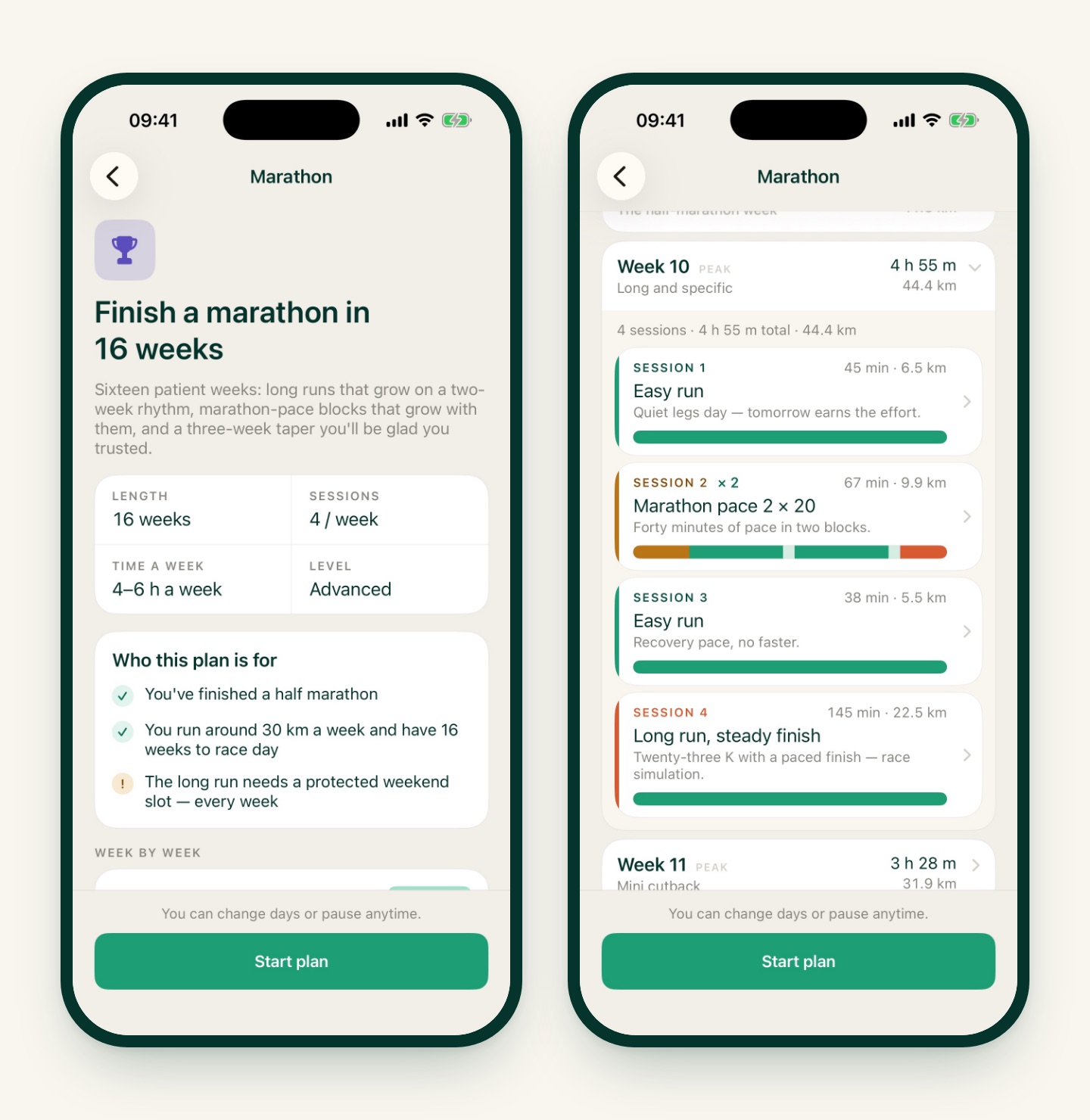
- Every run has a target. Easy and long runs carry a zone 2 heart-rate target, and the zone turns into a bpm range from your own zone settings. With an Apple Watch or a Bluetooth chest strap, you hear “Heart rate too high” when an easy run quietly turns into a tempo. On a 2 h 30 long run, that voice is worth a lot.
- The session is read to you. Voice cues tell you when each block starts and ends, including the switch to marathon pace at the end of the week 10 and week 13 long runs.
- Setup checks where you are. It asks whether you’ve finished a half marathon. If not yet, it points you to the Half Marathon plan first.
- Missed a run? That’s normal. Sixteen weeks will contain a cold, a work trip or a bad week. You can move a session, pause the plan or restart a week instead of quitting it.
- After the race, the app suggests Post-Race Recovery: two quiet weeks of walks and easy runs.
Race day
- Change nothing. The shoes, kit, breakfast and fuel from your week 12 rehearsal. All of it.
- Start slower than feels right. The first 10 km should feel like you’re holding back. You are, and that’s the plan.
- Spend it evenly. Aim for even halves or a slightly faster second one. Time “banked” early is paid back with interest after 30 km.
- The race starts at 30 km. Everything before it is getting there in good shape. If you feel good at 32 km, that’s the moment to push, not at 12.
Sixteen weeks from now, you’ll be a marathoner.
Get the plan
Marathon is part of iRunning Premium, alongside 40 other training plans. You’ll find it in the Race distances group, next to Half Marathon and Half: Improve Your Time. If you already have a marathon behind you and four hours in mind, Sub-4 Marathon is in the Chase a time group. In the app, tap Choose a plan on Home (or Show other plans if you’re already on one).
Not ready to subscribe? The free version still gives you heart-rate zones and alerts, voice cues, the Apple Watch app and two custom workouts, so you can build a marathon-pace session or a long run from the tables above yourself.
Training advice, not medical advice. Check with a doctor before starting if you have a health condition or have been inactive for a while.