The clocks have gone back, the marathons are done, and for the next four months every run starts with the same question: is it worth going out? The answer is usually yes, and the runners who keep going through the winter are the ones who show up to the spring races fit. But winter running is a different skill from summer running, with its own kit, its own hazards and its own excuses.
Here’s a practical guide to the season: what to wear, how to be seen, when the treadmill is the right call, how to keep a plan alive through December, and the parts of the app that were built for exactly this.
Dress for ten degrees warmer
The most common winter mistake is dressing for how it feels at the front door. Ten minutes in, you’re ten degrees warmer, and overdressed runners end up sweating in the cold, which is worse than being cool at the start.
The rule: dress as if it’s 10 °C warmer than the thermometer says. You should feel slightly cold for the first five minutes.
| Temperature | What to wear |
|---|---|
| 10 to 5 °C | Long-sleeve top, shorts or light tights. Gloves if it’s windy |
| 5 to 0 °C | Light tights, long-sleeve base layer, a light wind-resistant jacket or vest. Gloves and a thin hat or headband |
| 0 to −5 °C | Thermal tights, base layer plus a long-sleeve mid-layer, wind jacket, warm gloves, hat. A buff over the mouth helps the first kilometre |
| Below −5 °C | Everything above plus a second layer on the legs if it’s windy, and consider shortening the run. Cover skin: cheeks and ears are where frostnip starts |
| Rain near freezing | The hardest condition. A proper waterproof shell, a cap with a brim, and run a loop near home so you can bail out |
Three details that matter more than the exact layers: gloves (cold hands ruin more runs than cold anything else), a hat or headband over the ears, and wind. A calm −3 °C is comfortable in two layers; a windy 3 °C can be worse.
Shoes: your summer shoes are fine on dry roads. If you’ll run on packed snow regularly, a trail shoe with a deeper lug grips better, and for ice there are strap-on spikes. Wool socks keep their warmth when wet, cotton doesn’t.
Running in the dark
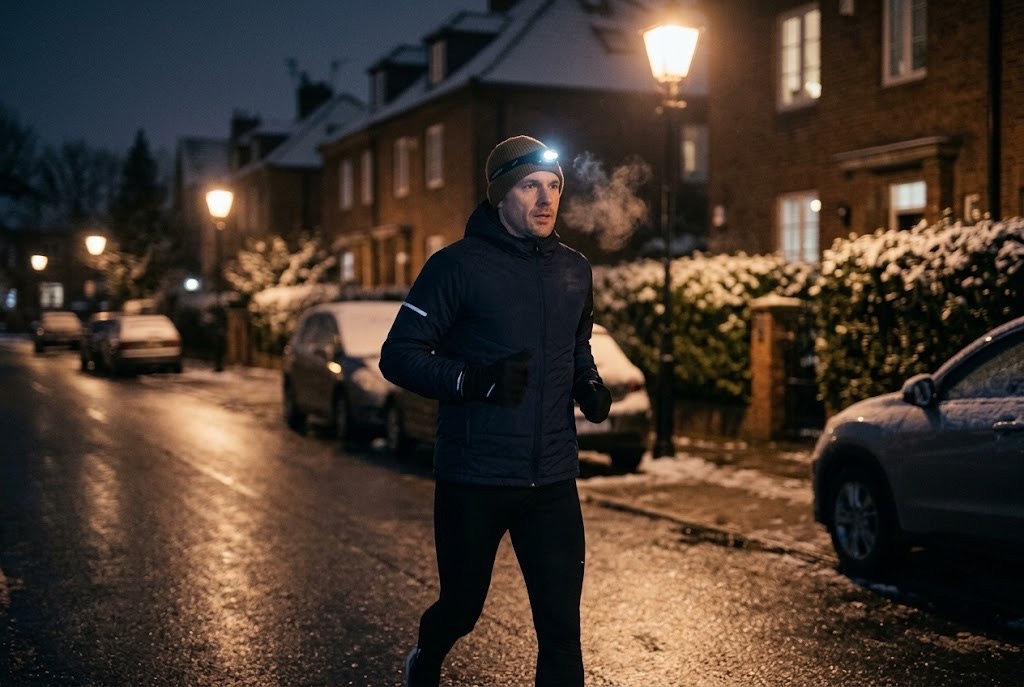
From November on, most weekday runs happen in the dark, and the risk isn’t the dark itself. It’s drivers who can’t see you. Two rules:
- Be lit, not just reflective. Reflective strips only work when headlights hit them. A small clip-on light front and back, or a headlamp, works from every angle. The best winter kit purchase under 20 euros.
- Run facing traffic where there’s no pavement, so you can see what’s coming. Lose the music, or keep one earbud out.
A headlamp also fixes the second problem with dark runs, which is not seeing the ground. Kerbs, roots and ice patches all arrive faster at night. Pick routes you know, and run the first winter weeks on them until the darkness feels normal.
For pace, let it go. Dark, cold runs are 10–20 seconds per kilometre slower at the same effort, and that’s the point: winter is for easy miles and strength, not for personal bests.
When ice means the treadmill
There’s a difference between cold and dangerous. Snow is fine, cold is fine, and a frosty morning with grip is one of the nicest runs of the year. Ice is not fine. A fall on black ice at 5 km/h is a bruised hip; at 12 km/h it’s a broken wrist and six weeks off.
The treadmill rule: if the pavement is glazed, or it rained yesterday and froze overnight, go inside. The same goes for the days when it’s −10 °C with wind, and for the evenings when you’d be running on an unlit road in snow. Nobody gets fitter from a run that ends in a car park with a sprained ankle.
Used properly, the treadmill is the best interval tool you own: exact pace, exact incline, no corners, no weather. Our treadmill intervals guide has eight belt sessions that make 40 minutes go by, and two habits that make it feel like running outside: set 1% incline to make up for the missing wind resistance, and give the first five minutes to warming up, because a cold body on a cold belt gets injured.
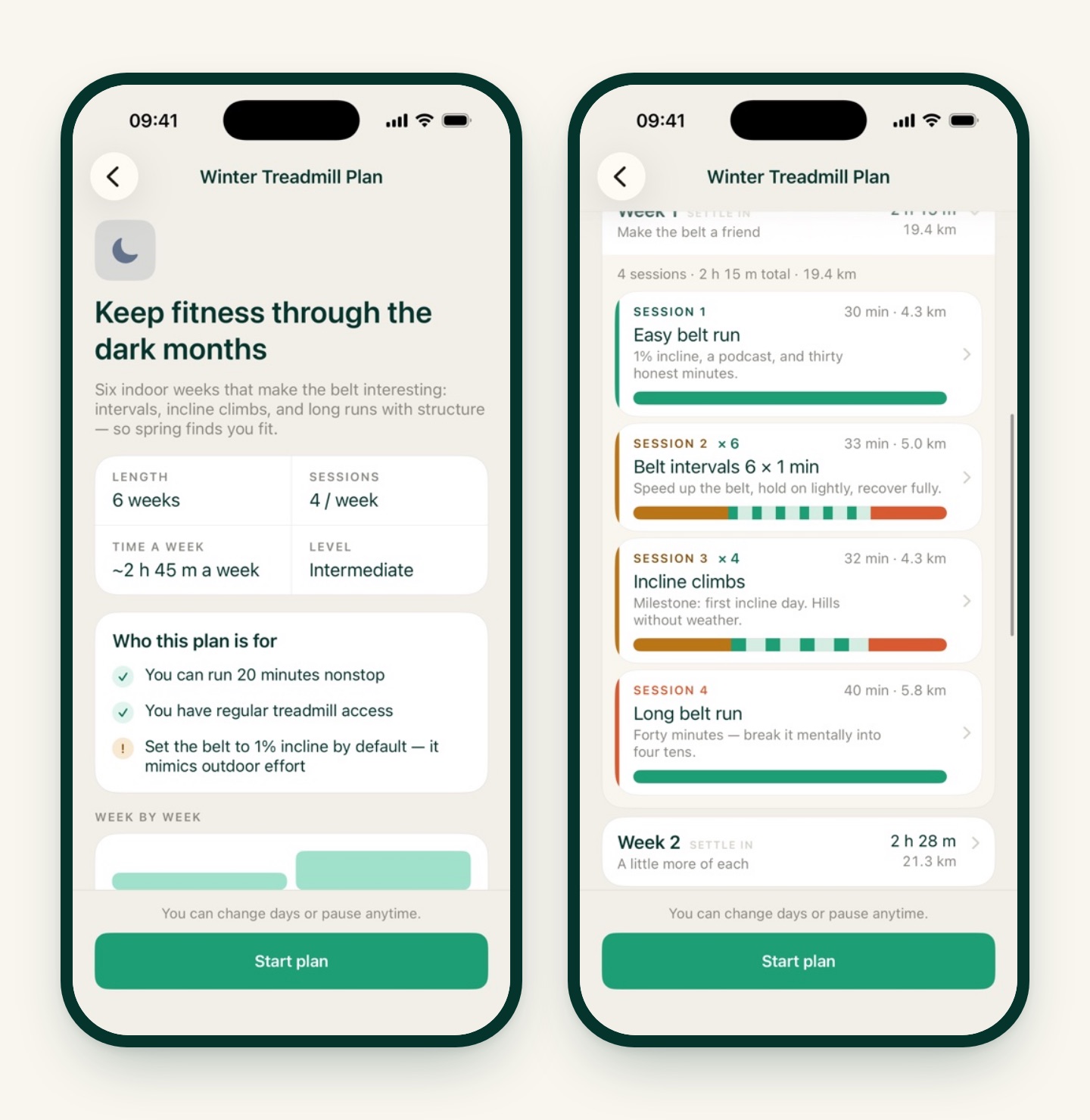
If the treadmill is going to be home until spring, the Winter Treadmill Plan makes it a block rather than a string of random sessions: six weeks, four runs a week, about 2 h 45 min in total, with an easy belt run, belt intervals, incline climbs and a long run with structure. It assumes you can run 20 minutes nonstop. If you’d rather walk, the 12-3-30 plan is the same idea on an incline.
Keeping a plan alive through December
Winter kills training plans in a specific way. Not with one dramatic failure but with a missed Tuesday, a work dinner on Thursday, a cold on Saturday, and a plan that’s suddenly two weeks behind and feels pointless.
The fix is built into how the app handles plans, and it’s worth knowing before December arrives:
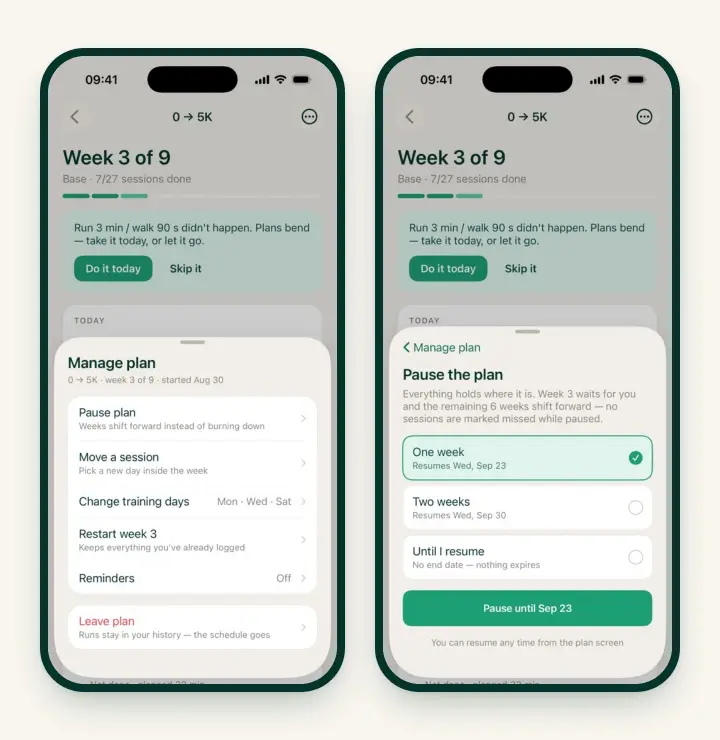
- Move a session, don’t skip it. A run moved from Tuesday to Wednesday is a run done. The plan doesn’t care which day.
- A missed week is a week to repeat, not to catch up. Trying to fit six runs into the next seven days is how winter injuries happen. Restart the week and carry on.
- Pause for the holidays, on purpose. A plan paused for a week over Christmas, then resumed, is a plan that survives. A plan abandoned on 22 December is a January restart from zero.
- Lower the bar, keep the habit. Twenty minutes easy on a dark Tuesday keeps the routine alive. The fitness cost of a short run instead of a long one is tiny; the cost of a missed month is not.
How to do all that in the app is in Life Happens: pause, move or skip a training day.
If you have no race and no plan, winter is the right time for a base block: easy running by heart rate, with one session of strides or hills a week. The Zone 2 guide explains why slow winter miles turn into fast spring ones.
The app in winter
A few things in iRunning were built, or work best, for this season:
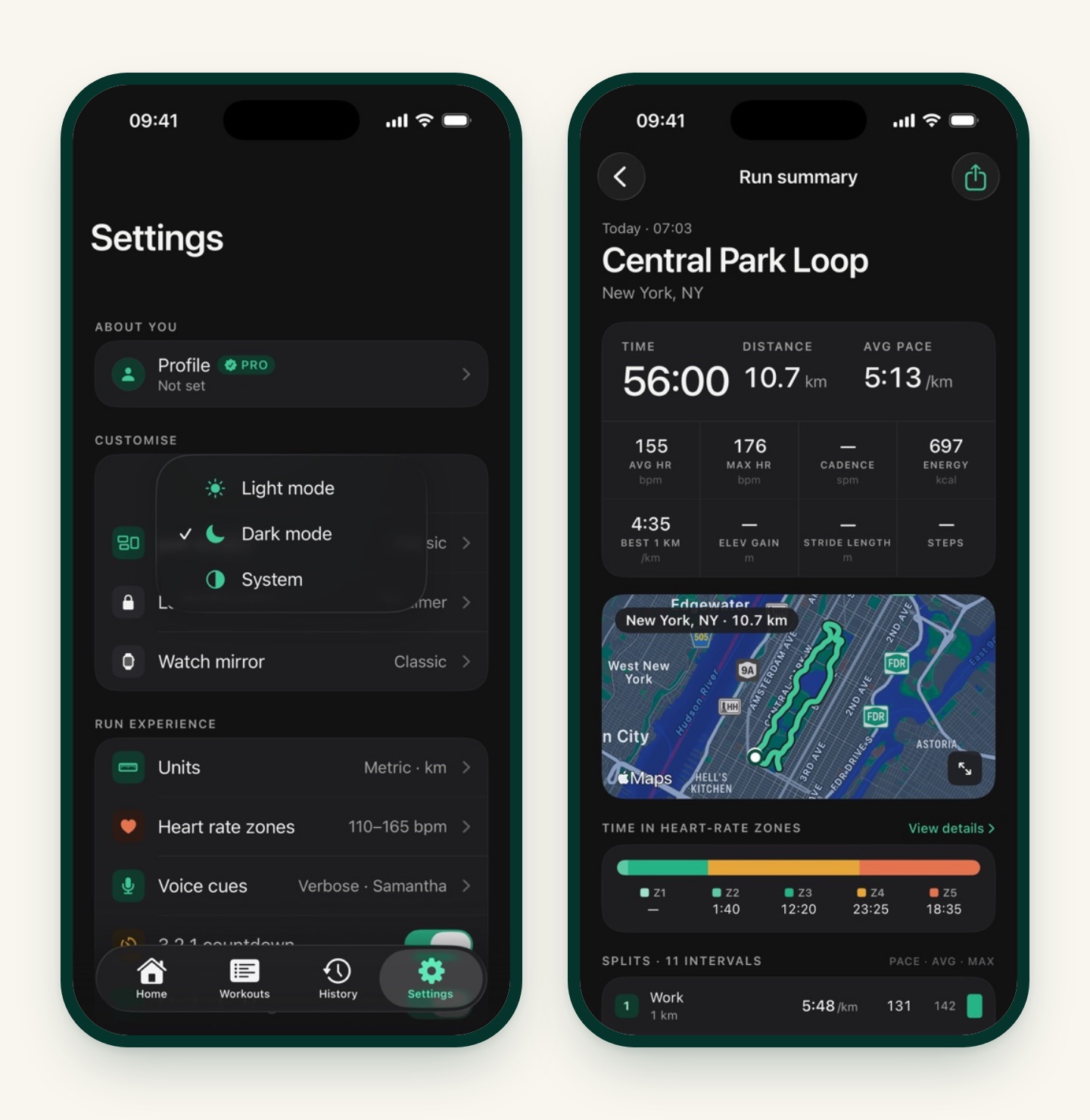
- Dark mode. In Settings › Appearance, pick Dark or System. The run screen in the dark theme is readable on a black morning without lighting up the street, and the lock screen Live Activity shows your pace and distance without unlocking the phone with cold fingers.
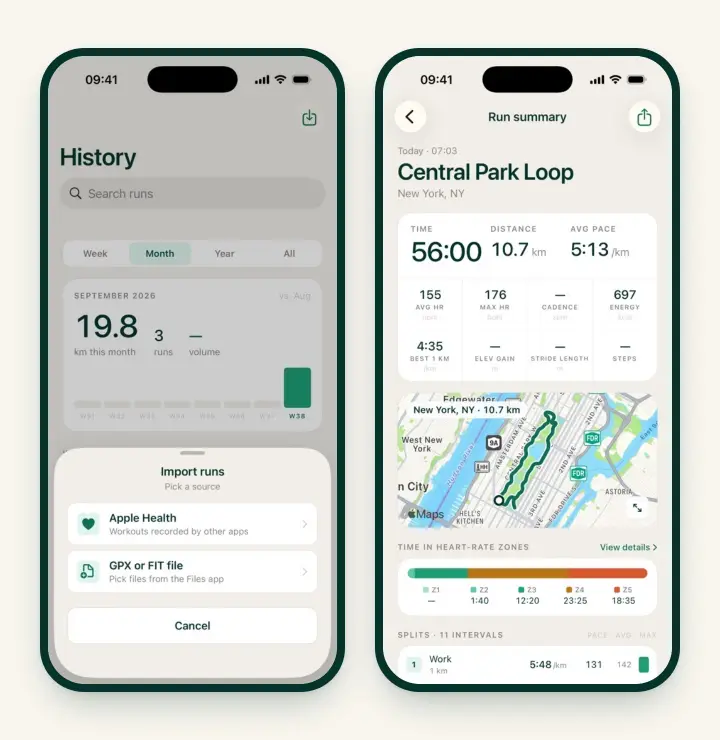
- Indoor runs. Pick Indoor above the start button and the app skips GPS for the session. Distance on a treadmill is an estimate, so the belt’s own numbers win, but intervals, heart rate and the voice cues work exactly as they do outside, and the run goes to Apple Health as a treadmill run.
- Voice cues, gloves on. In winter the phone stays in a pocket and the watch is under two sleeves. With cues for every interval and an announcement every kilometre, you don’t need to look at either. “Announce my run” on the Action Button gives you the full status with one press through a glove.
- Heart-rate pacing instead of pace. Cold air, wind and snow all slow your pace at the same effort. Set your easy runs to a zone 2 heart-rate target rather than a pace band, and the app will stop telling you to speed up on a day when speeding up is the wrong call.
- Apple Watch on its own. For a short dark loop, leave the phone at home: the Watch app records the run with heart rate and route, and syncs it when you’re back.
- Schedule a reminder. Winter runs happen when they’re planned, not when the mood arrives. A scheduled workout with a reminder ten minutes before is a small nudge that works surprisingly often at 6 pm in November.
A winter that pays off
Nobody remembers the individual runs of a winter. What they remember is turning up to the first spring race and finding that the 10K pace that was hard in October is now easy. That’s what November to March is for. Dress a bit colder than feels right, buy a light, respect the ice, and keep the habit smaller than your ambition.
See you in the dark.
Training advice, not medical advice. If you have asthma or a heart condition, talk to a doctor about running in very cold air.